
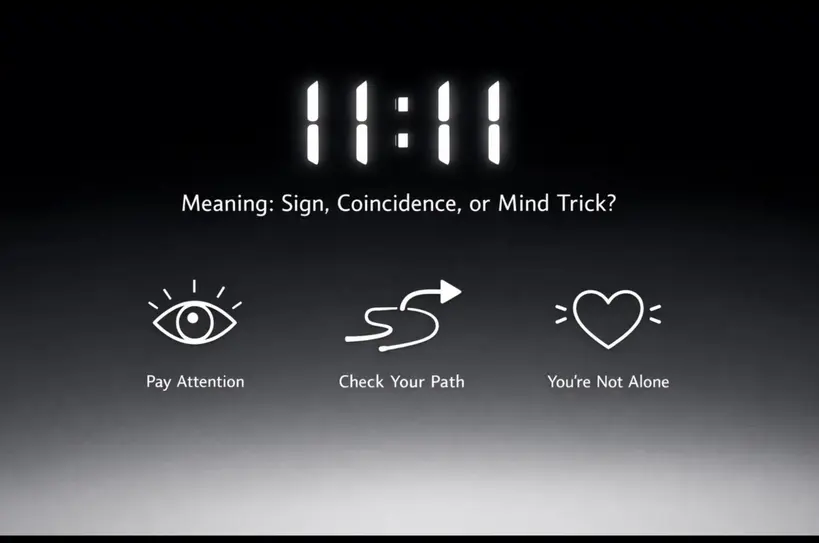
You notice 11:11 on the microwave, your phone, the car clock, and suddenly it feels personal. The question isn’t whether you’re “crazy” for noticing it. The real question is what you do with that moment. Do you treat it as a helpful pause button—or do you let it steer decisions you’ll regret later?
This article gives you a practical way to interpret 11:11 without losing the spiritual angle—or your common sense.
What People Mean When They Say “11:11”
When numbers repeat, like 11:11, folks often nod without thinking. One person might say it’s a nudge; another names it serendipity; yet another shrugs and admits it’s odd. Still, they’re pointing at the same thing – a rhythm standing out just when thoughts are tangled, bright, restless, quiet, or charged.
What keeps people noticing 11:11 might come down to simplicity. It just sits there – two numbers exactly like each other, side by side. Order catches attention because life often brings uneven rhythms. A creak in the walls during darkness could mean something shifted. A shift in how a friend speaks might point beyond words. Numbers piling up in your statement may trace paths you didn’t draw yourself. Spotting patterns helps you stay alive.
Still, spotting a sequence isn’t the same as showing proof. Saying 11:11 is a “sign” might come down to any of three ideas:
- something nipping at the edge of thought, best to stay aware
- A nudge to check your direction (work, relationships, habits)
- A comfort cue: “You’re not alone; keep going”
Think of it as a signal, nothing more. Its purpose? To draw attention. Action follows choice, never force. That difference might keep things less painful.
Spiritual and Manifestation Interpretations
Some people say seeing 11:11 means the world is humming along with you. Others talk about it like a door cracking open, where what you think gains strength. If that kind of idea fits your mind, that’s okay. Here’s what matters – how do you actually live by that idea without losing control over your days?
Here’s a way to go – think of 11:11 like a quick quiet moment. Stop what you’re doing, name that sensation without explaining it. Then point at something specific you want to shift toward. Just one thing that might actually change. Not making a list of hopes. One aim, something within reach. For instance: “My mind keeps returning to cash.” One thing on my mind now – checking those subscriptions to see what sticks.
So the essence stays rooted. What might go wrong in manifestation settings? It could turn into a way bypass real effort, swapping intent with wishful thinking. Maybe 11:11 refines your direction when needed. That works too. When something makes you believe there is no need to do anything, that might actually be standing in the way.
Mini-case: Novice vs experienced use
A fresh start – someone spots 11:11, thinks fate will take care of things, so skips the tough talk or heading to the gym.
Seeing 11:11 leads her straight to what comes next – like sending the message, setting up a meeting, or heading outdoors for half an hour.
What sets them apart isn’t belief. It’s what happens after.
Astrology and Numerology Angles
Numerology is the system people use to assign symbolic meaning to numbers. The number 11 is often called a “master number,” linked with intuition, insight, and heightened awareness. 1111 is basically a louder version of that—like turning the volume up.
Here’s the practical way to handle numerology without getting lost in it: use it as a prompt to ask a better question. When you see 11:11, ask:
- What am I avoiding?
- What am I overthinking?
- What would “aligned” behavior look like in the next hour?
Also, remember that different traditions interpret numbers differently. Some astrology and spiritual communities attach relationship meanings to 11:11, others focus on purpose, and others treat it as a general “wake up” signal. If interpretations clash, that’s your clue to stay grounded. When a system can mean everything, it can also mean nothing—unless you tie it to actions you control.
Two useful terms to know:
- Confirmation bias: you notice evidence that supports what you already believe and ignore the rest. If you think 11:11 means “love is coming,” you’ll notice every romantic hint and miss every red flag.
- Apophenia: seeing meaningful patterns in random data. It’s not stupid—it’s a normal brain feature. It just needs a steering wheel.
When “Signs” Start Steering Money Decisions
Here is the part that might cause trouble. A so-called sign can shift from helping you pause to letting you leap without checking yourself. Not loud. Not sudden. Just quiet: noticing repeating numbers while ignoring your gut about what to do next.
A man, lately under pressure at his job, tired for weeks, maybe feeling isolated. Something about seeing 11:11 sets something light inside him. That instant, raw emotion makes it simple to see risk fade away.
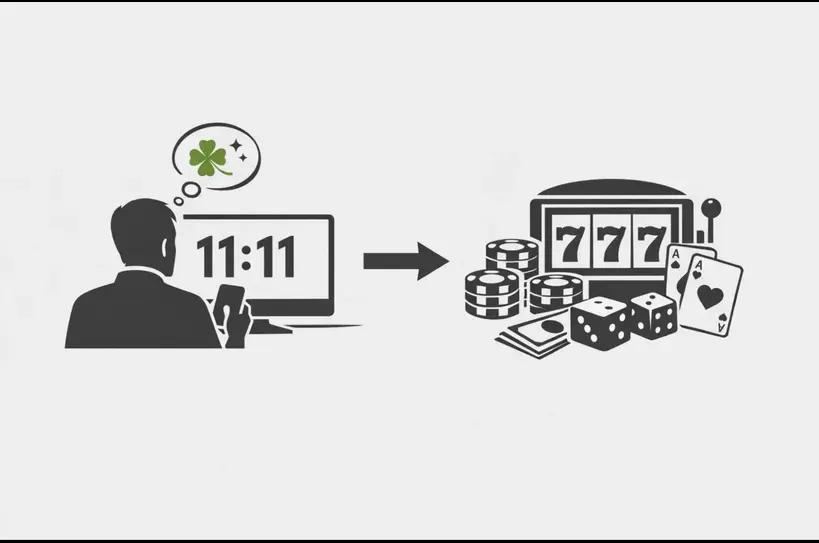
In real life, this shows up as impulse spending: “I’ll buy the thing,” “I’ll double down,” “I’ll chase the loss.” That’s not spirituality. That’s emotion wearing a spiritual costume.
Here’s a clean example: a player jumps into an online casino in Australia right after seeing 11:11, telling himself the timing is “lucky.” That’s the brain grabbing a story to justify a choice it already wants to make.
Another pattern is confusing coincidence with skill. Someone hits a small win and starts believing 11:11 is their personal signal. They then play longer, take bigger swings, and stop tracking results. The experienced move is the opposite: you track, you limit, you step away.
Mini-case: Novice vs experienced behavior
- Novice: Sees 11:11, takes it as a “go” signal, increases stakes, and chases losses.
- Experienced: Sees 11:11, treats it as a pause cue, checks budget, and sticks to preset limits.
If you play at all, you need language for the mechanics so you don’t get hypnotized by vibes. RTP (return to player) is the long-run average a game pays back; it doesn’t guarantee short-term results. Volatility describes how swingy outcomes are—small frequent wins vs rare big hits. Bankroll is the money you set aside only for that activity, separate from rent, food, and obligations. Those three terms keep you anchored.
You’ll also hear people debate the best australian online casino as if the “best” choice eliminates risk. It doesn’t. A “better” platform may have clearer rules and tools, but your decisions still matter more than the label.
One more common trap: the “just this once” story. You tell yourself it’s a one-off because the sign felt special. That story is how discipline gets quietly replaced by impulse.
A Simple Reality-Check Framework for High-Emotion Choices
When 11:11 hits and you feel that internal spark—hope, urgency, fate—use a simple framework. Here’s one I’ve seen work for practical guys because it’s short and concrete:
The CLEAR Framework (60–180 seconds)
- Breathe quiet inside – one breath slips in, then lingers a moment longer.
- Call that moment “I’m excited,” “I’m anxious,” “I’m lonely.” Saying it out loud makes it weigh less on the mind.
- Look at the tale – what do I say the sign indicates, then where does that lead in terms of justification?
- Assess the cost: what’s the downside if I’m wrong—money, time, trust, health?
- Here’s something clear: when in doubt, pull out a ready-made rule instead of deciding by feeling.
This is not anti-spiritual. It’s pro-responsibility. You can still view 11:11 as meaningful while refusing to let it hijack your wallet or your week.
Here’s where the rule part matters. If you sometimes play an Australian online casino, the rule could be: “I only play with a fixed bankroll, I stop at a set time, and I never chase losses.” That’s how you keep a sign from turning into a spiral.
Mini-case: Same trigger, different result
- Novice: Sees 11:11, thinks “today’s my day,” and keeps playing past the planned stop time because it “feels aligned.”
- Experienced: Sees 11:11, runs CLEAR, and sticks to the plan—even if it’s boring. Especially if it’s boring.
Use a compact checklist you can screenshot mentally:
Plain-text table:
| Trigger moment | Best response |
| You see 11:11 and feel urgency | Do 1 slow breath + name the feeling |
| You want to act immediately | Wait 10 minutes before any money decision |
| You’re about to “chase” a result | Stop, review your preset rule, and stick to it |
| You’re seeking a sign to avoid thinking | Write one practical next step and do it |
| You feel “lucky” or “chosen” | Ask: what’s the downside if I’m wrong? |
If you’re comparing online casinos australia options, don’t let 11:11 do the choosing. Use criteria you can defend tomorrow: clear terms, transparent limits, and your own boundaries. The point isn’t perfection; it’s reducing impulsive damage.
And here’s the gentle responsible-risk note, because it matters: if you ever notice that signs like 11:11 are becoming excuses to spend beyond your means, skip meals, borrow money, or hide behavior, that’s a red flag. Use limits, take breaks, and keep it within a strict budget. Self-control beats superstition every time.
One last practical angle: people chase the best australian online casino like it’s a magic shield. It’s not. The best tool is still a personal rule you follow when you’re emotional.
To make CLEAR even stronger, pre-write two rules:
- Money rule: “No unplanned spending after 9pm.”
- Mood rule: “If I’m stressed or lonely, I don’t make high-risk choices.”
That turns 11:11 into a cue for discipline, not drama.
FAQ: The Most Common 11:11 Questions (and When to Worry)
Why do I keep seeing 11:11?
Because your brain is good at pattern recognition and you’ve trained your attention. Once something feels meaningful, you notice it more.
Is 11:11 a spiritual sign?
It can be, if you treat it as a prompt for reflection and better choices. The healthiest “spiritual” use is one that improves your behavior, not one that replaces responsibility.
What should I do when I see 11:11?
Do a 10-second reset: breathe, label the feeling, choose one practical next step. If you want a ritual, keep it simple: gratitude + intention + action.
Does 11:11 mean my manifestation is working?
It might mean you’re focused. That’s valuable. Just don’t confuse focus with guaranteed outcomes—use the moment to act, not to wait.
Is 11:11 about love?
Sometimes it’s interpreted that way, but interpretations vary. A better move is to ask what kind of partner you’re being and what actions you’re taking.
When should I worry about this stuff?
If noticing 11:11 makes you anxious, obsessive, or dependent on “signs” to make decisions, it’s time to ground yourself. Sleep, stress, and mental load can intensify pattern-fixation. If it’s affecting daily life, talking to a professional can help.
Key takeaways: 11:11 can be meaningful without being magical. Use it as a pause, not a push. The CLEAR framework keeps your decisions sane when emotions run hot, and preset rules protect you better than any “sign.”
Practical actions you can start today:
- Decide your two preset rules (one money rule, one mood rule) and write them down.
- Practice CLEAR once today on a small choice, so it’s available for big ones later.
- When you see 11:11, set one intention you can complete in 15 minutes.
- Audit one area where you’ve been using “signs” to avoid a decision—then take the next concrete step.
- Build a simple stop-point for high-emotion moments: a 10-minute wait before any risky action.
If you’re collecting good reads, add this interesting pick to your list.
(DISCLAIMER: The information in this article does not necessarily reflect the views of The Global Hues. We make no representation or warranty of any kind, express or implied, regarding the accuracy, adequacy, validity, reliability, availability or completeness of any information in this article.)
Must Read:
- Why is Motilal Oswal Mid Cap Fund an Investor Favourite?
- A Complete Guide On How To Pitch Investors For Funding?
- Top 10 Crowdfunding Sites to Raise Funds
- Grow Your Funds Safely with Money Market Solutions in Singapore
- Importance of Term Insurance for First-Time Investors