
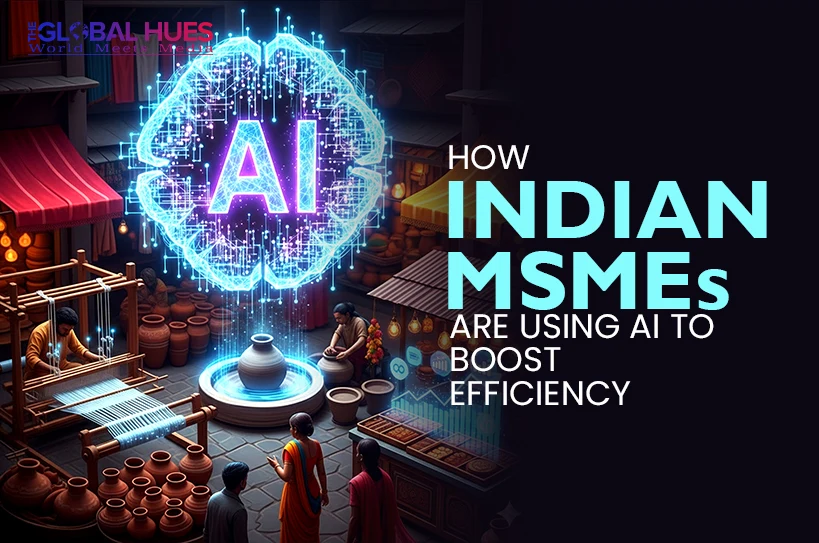
If you’ve run or worked inside a small business in India, you know the daily juggle, whether it be unpredictable supply chains, handling customers who expect “Amazon-level” experiences at kirana-level prices or struggling with razor-thin margins in a competitive landscape. That’s exactly why India’s MSMEs (Micro, Small & Medium Enterprises) are turning to artificial intelligence.
Why AI, and why now?
With UPI payments, Aadhaar-based identity, and platforms like ONDC, even the smallest shops now run on digital rails. According to a SIDBI survey, 90% of MSMEs already accept online payments and nearly one in five use digital lending apps. Digital adoption is no longer limited to metro cities but is touching every possible corner.
A NASSCOM study this year showed that India’s AI maturity score has climbed to 2.47 out of 4, with more companies moving from pilots to real adoption. This positive rise in the ecosystem makes it quite easier for MSMEs to reap the benefits.
Moreover, in March 2024, the Union Cabinet approved the IndiaAI Mission, a ₹10,372 crore program to boost AI research and skill-building. The idea behind this is to limit access to AI not just to big giants but also to make it accessible for small players.
How MSMEs are actually using AI
- Sales & customer service via WhatsApp
If there’s one app small businesses swear by, it’s WhatsApp. MSMEs have started plugging AI chatbots into WhatsApp Business. These chatbots handle FAQs, send catalogues, confirm orders, and even process payments. Since customers are always active on their phones and use the app daily, response rates are much higher compared to email.
And the best part is, AI tools can run 24/7. Imagine a five-member team now handling customer queries like a full-fledged call centre without extra manpower. That’s what you call efficiency in action.
- Quality improvement on the shopfloor
Manufacturers now use AI-powered cameras that inspect products in real time. Whether it’s biscuits on a conveyor belt or small gears in an auto-parts shop, these systems catch defects (if any) in no time and reduce manual checks that last for hours. For many MSMEs, this means fewer returns and happier customers.
The cost isn’t sky-high either. Whatever costs are incurred in the setup, businesses often recover that money within months through reduced waste.
- Quicker access to credit
Artificial Intelligence is coming into the picture to make finance easier. Banks and NBFCs now use machine learning to analyse GST data, UPI transactions, and invoices to decide loans. For MSMEs, this means faster approvals, sometimes in just minutes and of course, less paperwork, which also saves on time.
- Smarter logistics and deliveries
For businesses that deliver goods, AI is helping cut costs by optimising routes. Instead of manually planning deliveries, AI looks at real-time traffic, demand, and fuel usage to suggest the best path. Moreover, the rise of Open Network for Digital Commerce (ONDC) is also on the rise. It connects MSMEs with multiple logistics providers, which gives them flexibility and better rates.
Challenges for MSMEs in Adopting AI
While AI integration can bring exciting possibilities, small businesses face genuine challenges in bringing these solutions to life. One of the primary barriers is cost. Many MSMEs operate on thin margins and worry about whether the upfront investment in AI will really pay off.
Another major hurdle is the lack of awareness and skills. Most MSMEs don’t have dedicated IT teams that can operate AI tools. Without proper training, even the simplest AI tool can go unused.
Lastly, trust is another important factor. MSMEs’ owners may be sceptical about letting algorithms make decisions on credit, customer service, or logistics. Concerns about data privacy, cybersecurity, and dependence on third-party vendors also slow the adoption of AI.
The Road Ahead
Although Artificial Intelligence has made many processes smoother and hassle-free for MSMEs, it can’t solve all existing problems. But the success stories so far show that when the enterprise owners are adapting to AI for their everyday tasks like chats, inspection and more, it is adding value to their business and yielding positive outcomes.
With government support, platforms like ONDC, and a maturing vendor ecosystem, even small and emerging firms can now rent advanced tech instead of building it from scratch. They don’t need to invest heavily in terms of money. In years to come, the future of AI for MSMEs in India won’t be about big-bang transformations, but rather about small and steady wins that add up.
Must Read:
- Using AI in Healthcare Revenue Cycle Management: Scope for Next Three Years
- What Is Causing The Bankruptcy Of Airlines In India?
- Top 10 AI Writing Tools To Boost Your Productivity
- Top 10 Language Learning Apps With Advanced AI Features
- Where Do You Fit in The Generation Timeline