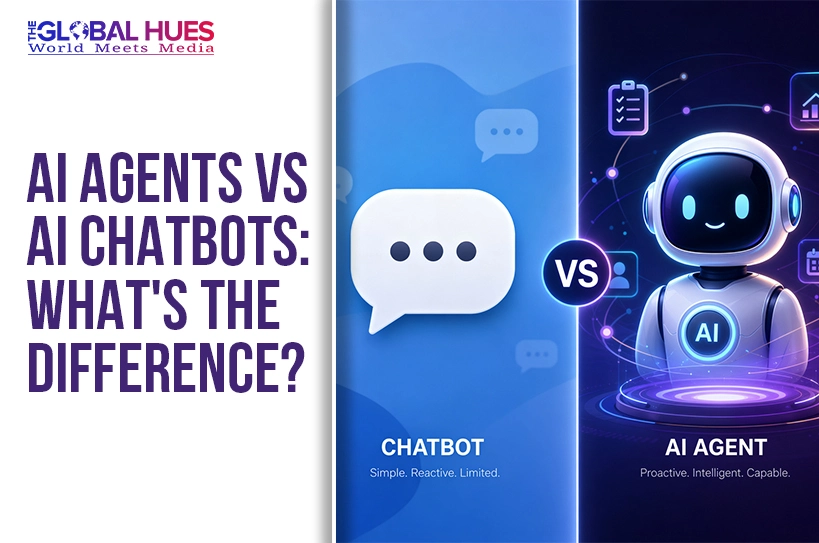
AI agents and AI chatbots are both able to communicate in natural language, but they are meant for varying degrees of tasks.
The main difference between the primary AI Agent vs AI Chatbot is action. A chatbot will usually provide an answer to the user’s message.
This does not make one automatically better. A chatbot may be the right choice for simple conversations. An agent becomes useful when a task requires decisions and actions across several steps.
What Is an AI Agent?
If you are asking what an AI Agent, it is an AI-powered system that can complete tasks with some independence.
OpenAI describes agents as systems that independently accomplish tasks on a user’s behalf. They commonly combine a model with tools and instructions.
An AI agent could be asked to prepare a sales report. It may retrieve business data, calculate results, compare performance, prepare a report, and flag missing information.
Read OpenAI’s practical guide to building AI agents for a deeper technical explanation.
What Is an AI Chatbot?
A Chatbot is a software that is created with a main focus on conversation.
The majority of the traditional chatbots are rule-based or menu-based. With a large language model, modern AI chatbots are capable of comprehending inquiries & producing adaptable answers.
A chatbot can explain a refund policy, answer a product question and help a user find information.
It’s primarily a means of communication. It can be used for tools and a basic chatbot doesn’t run a complicated workflow all by itself.
AI Agent vs AI Chatbot: Key Differences
| Feature | AI Chatbot | AI Agent |
| Main purpose | Conversation | Task completion |
| User interaction | Usually prompt and responsive | Goal followed by several actions |
| Planning | Limited or unnecessary | Often plans next steps |
| Tool use | Optional | Common |
| Autonomy | Usually low | Can be higher |
| Feedback loop | Often stops after answering | Can review results and continue |
| Best suited for | FAQs and basic assistance | Multi-step workflows |
The boundary is becoming less rigid because modern chat interfaces can include agent features. The difference depends on what the system can actually do, not what the product is called.
How Do AI Chatbots Work?
People searching how AI chatbots work usually need a simple explanation.
A user sends a message. The system processes the text, identifies the context, and generates or selects a suitable reply.
A modern LLM-based chatbot may also use conversation history or retrieve information through a knowledge base.
The process is primarily conversational:
- Question
- Understanding
- Response
A chatbot can be highly capable without becoming an agent. It becomes more agent-like when it starts choosing tools and controlling the steps needed to complete a task.
How Do AI Agents Work?
People asking how AI agents work are usually describing a longer loop.
The agent receives a goal, determines the next action, uses an available tool, examines the result, and decides what to do next.
Anthropic describes agents as systems where LLMs dynamically direct their own processes and tool usage.
You can read Anthropic’s Building Effective AI Agents for more details.
| Task | Chatbot Approach | Agent Approach |
| Hotel planning | Suggests hotels | Searches and compares options |
| Customer support | Explains policy | Checks the account and processes allowed actions |
| Research | Summarises supplied text | Searches several sources and organizes findings |
| Coding | Suggests code | Edits files and tests changes |
| Scheduling | Suggests a time | Checks availability and creates an event |
Difference Between AI Agents vs AI Chatbots in Real Use
The difference between AI agents vs AI chatbot becomes clearer when you look at responsibility.
Suppose a customer says, “My order has not arrived.”
A chatbot may explain the delivery policy and ask for an order number.
An agent could use the order number to check the delivery system, identify the shipment status, determine an approved next action, and prepare or process a resolution within its permissions.
This additional capability has the potential to save time, but also introduces more risk, as the system can impact actual data or business processes.
When Should a Business Use an AI Chatbot?
A chatbot is ideal for a business that needs to respond to queries or lead individuals via predictable information.
Uses include product FAQs and product onboarding help. Also, there are policy explanations and simple troubleshooting, while in-house knowledge support is also available.
Simple systems may be less expensive and easier to test as well.
Businesses should not build an agent when a chatbot already solves the problem effectively.
When Should a Business Use an AI Agent?
An agent becomes more useful when a task needs several connected actions and the exact path may change depending on intermediate results.
Examples include researching a prospect, preparing reports, handling selected support workflows, monitoring systems, or performing approved software tasks.
Anthropic recommends increasing agentic complexity only when a simpler solution cannot handle the task well.
The Media Beacon’s article on technology and financial consulting provides another example of automation supporting professional work instead of removing the need for judgment.
Its analysis of AI-first devices beyond smartphones also shows how AI assistants are moving into new interfaces.
Are AI Agents Replacing Chatbots?
Not necessarily.
Many businesses still need simple conversational systems. Adding autonomy to every chatbot can increase complexity, cost, and risk without improving the customer experience.
The likely direction is a mix. Some chatbots will stay focused on information, while others will gain selected agent capabilities for tasks that benefit from action.
Final Thoughts
The AI Agent vs AI Chatbot comparison comes down to the job each system performs.
A chatbot is mainly designed to communicate. An AI agent is designed to pursue a goal and may use tools to act on the user’s behalf.
Businesses should choose the simplest system that handles the task reliably. More autonomy is useful only when it creates a clear practical benefit.
FAQs
1. What is the main difference between an AI agent and AI chatbot?
The main function of a chatbot is to reply or converse. AI agents can plan, act with tools, take actions and keep on going toward a goal.
2. Can an AI chatbot become an AI agent?
Yes. Agent capabilities can be added to a conversational system by providing it with tools, decision-making logic, and authorizing it to take multi-step actions.
3. Are AI agents smarter than chatbots?
Not automatically. They can both employ the same AI models. The primary distinction relates to autonomy, access to tools and the ability to complete workflows.
4. Which is better for customer service?
Chatbots are perfect for basic questions. Agents can assist in situations where they need to check an account, use tools, or take approved actions. There should be the option to escalate to a human if necessary.
5. Are AI agents more risky than chatbots?
They can be because they may take real actions. Permissions, testing, guardrails, logging and human oversight are more crucial.
Related Article:
- The Generative AI Revolution Transforming UI/UX Workflows Forever
- What Boundaries is Generative AI Breaking in Reshaping Marketing?
- The New Chapter: Generative AI and Beyond