
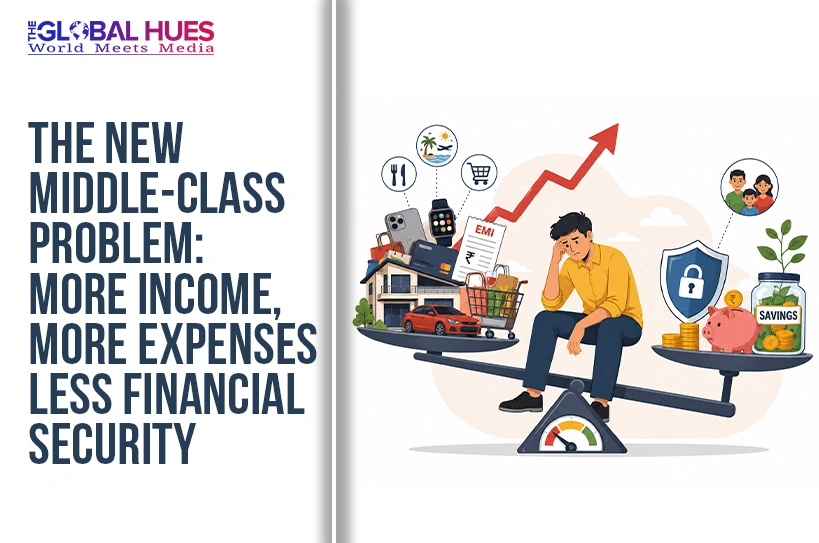
Your salary got a raise. Your lifestyle got a raise. Your rent got a raise. Your subscriptions got a raise. Even the coffee you buy while complaining about inflation has quietly become a financial decision.
Welcome to the strange new economics of being middle class.
On paper, you see things getting better than they were five or ten years ago. Salaries have grown. You have access to formal employment, digital banking, investments, credit and a wider range of products and services. There are more choices than ever before.
And yet, somewhere between the first salary hike and the third streaming subscription, many middle-class households have discovered an uncomfortable truth that earning more does not necessarily mean feeling more financially secure. In fact, for many people, it’s the opposite.
Why Does a Salary Increase Still Leave You Financially Stressed?
A traditional middle-class person dreams of earning a decent salary, buying a house, owning a car, educating the children, saving regularly and eventually retiring without worrying about money. Today, the equation is considerably messier.
A salary increase of 8–10% can disappear surprisingly quickly when rent rises, school fees increase, health insurance becomes more expensive, grocery bills creep upward, and transportation costs refuse to behave.
Then come the expenses that don’t look serious individually.
A food-delivery order here. A streaming subscription there. A premium gym membership. Weekend brunches. Cab rides because traffic is unbearable. Faster internet. Cloud storage. Shopping apps that know exactly when you are most vulnerable. None of these expenses is necessarily irresponsible. That is precisely the problem. The modern middle-class budget is rarely destroyed by one spectacular purchase. It is usually squeezed by dozens of perfectly reasonable ones.
The lifestyle inflation trap
In simple words, Lifestyle inflation is a term used to define the tendency of individuals to spend more as they earn more. For instance, as soon as you get a better job, i.e. a higher-paying job, suddenly the neighbourhood you were happy living in feels too basic. You get a bigger salary, and the old car begins to feel inconvenient. You receive a promotion, and the occasional restaurant visit becomes a weekly ritual.
It’s not about showing off. Sometimes, it is all about comfort. And sometimes, it is about exhaustion. After working long hours, people are willing to pay for convenience. Food delivery saves time. Cabs save energy. Domestic help buys back a few hours. Premium products promise better quality. Short holidays become a way of recovering from work.
The middle class is not simply spending more because it wants more. It is often spending more because time has become expensive too. This is where the problem gets interesting for businesses.
Consumers today are willing to pay for convenience, experience and speed, but they are also becoming very conscious of whether those purchases actually improve their lives.
The EMIs that quietly became permanent
A decade ago, buying a phone, television or car meant saving for it. Today, the question is often not Can I afford this? but Can I afford the monthly EMI? This has serious consequences. A ₹50,000 purchase can feel intimidating. A ₹4,500 monthly payment feels manageable.
Add a car loan, a home loan, a credit-card balance, a phone EMI and perhaps a few “buy now, pay later” purchases, and suddenly a big portion of tomorrow’s income has already been spent today. This is where higher income can create a dangerous illusion of affordability.
The person earning ₹1.5 lakh a month may look financially comfortable from the outside. But if ₹80,000 is already committed to rent, EMIs, household expenses, school fees and other fixed costs, the actual financial flexibility may be surprisingly small.
Remember, income tells us how much money comes in. It does not tell us how much freedom remains.
The home ownership puzzle
For an average middle-class person, owning a house, whether big or small, is the biggest milestone to achieve. But the distance between income growth and property prices has made that milestone very complicated, especially in major cities.
Young professionals may earn salaries their parents could not have imagined at the same age, but they are also looking at housing prices that belong to an entirely different economic universe. The result is a generation caught between two competing aspirations: wanting the security of owning a home and wanting to maintain enough liquidity to enjoy life today.
Some move away from the city and choose to live far off, some delay buying and some end up taking long-term loans. The house may still be an asset, but the EMI can become a lifestyle constraint.
The middle class is becoming more selective
There is, however, another side to this story. The new middle-class consumer is not necessarily becoming poorer. They are becoming more discerning. People are asking questions that previous generations did not always ask.
Is this worth the price?
Do I really need this or is it going to be an impulsive purchase?
Will I use it regularly?
Can I rent instead of buy?
Do I really need the premium version?
Would I rather spend on a holiday than another gadget?
Consumers may be cutting back on some categories while spending aggressively in others. A person might bargain over groceries but happily spend on a concert. Someone may postpone buying a new car but spend on international travel. Another may avoid luxury brands but pay a premium for better healthcare, education or wellness. The middle-class wallet is not closing. It is reallocating.
The new definition of financial success
For earlier generations, financial success meant a bigger house, a better car, expensive clothes and a comfortable lifestyle. Today, that definition has changed. For today’s generation, financial security increasingly means something less visible. It is having an emergency fund, being able to handle an unexpected medical bill, not panicking when a job changes, or it can be about saying no to an unnecessary purchase without feeling deprived. In other words, financial freedom is beginning to look less like luxury and more like breathing room.
And that may be the real middle-class problem today. It is not that people are earning too little. It is that modern life has become so efficient at finding new ways to spend whatever they earn. The solution, therefore, may not always be another salary hike. Sometimes, it is knowing what the extra money is actually supposed to do.
The real upgrade, perhaps, is not earning more. It is reaching a point where more of what you earn actually stays yours.
Frequently Asked Questions
- What is lifestyle inflation?
Lifestyle inflation is the tendency to increase spending as income increases. As salary rises, people may upgrade their homes, cars, subscriptions, dining, travel and other expenses, leaving less money available for saving and investing.
- Why do people earn more but still feel financially insecure?
Because higher income can be offset by rising living costs, lifestyle inflation, EMIs, housing expenses and other recurring financial commitments.
- Does earning more always improve financial security?
No. Financial security depends not only on income but also on savings, debt, expenses, emergency funds and how much disposable income remains after essential commitments.
- How can middle-class families avoid lifestyle inflation?
They can control recurring expenses, increase savings when income rises, avoid unnecessary debt, maintain an emergency fund and distinguish between genuine needs and lifestyle upgrades.
Related Article:
- Top 10 Ways to Save Money on Taxes
- Balancing Returns and Taxes: A Beginner’s Guide to Smart Investing
- Laid Off or Left Behind: The Harsh Truth About Today’s Job Market