
There is something almost magical about quick commerce.
You realise you are out of milk. You open an app. You tap a few things. And before you have decided whether you actually needed them, someone is already ringing your doorbell.
Milk. Bread. Eggs. Chips. Toothpaste. Ice cream. A phone charger. Sometimes even a bottle of shampoo you remembered only because the app reminded you it existed.
The delivery is free. Or at least, it looks that way. That is where the story gets interesting.
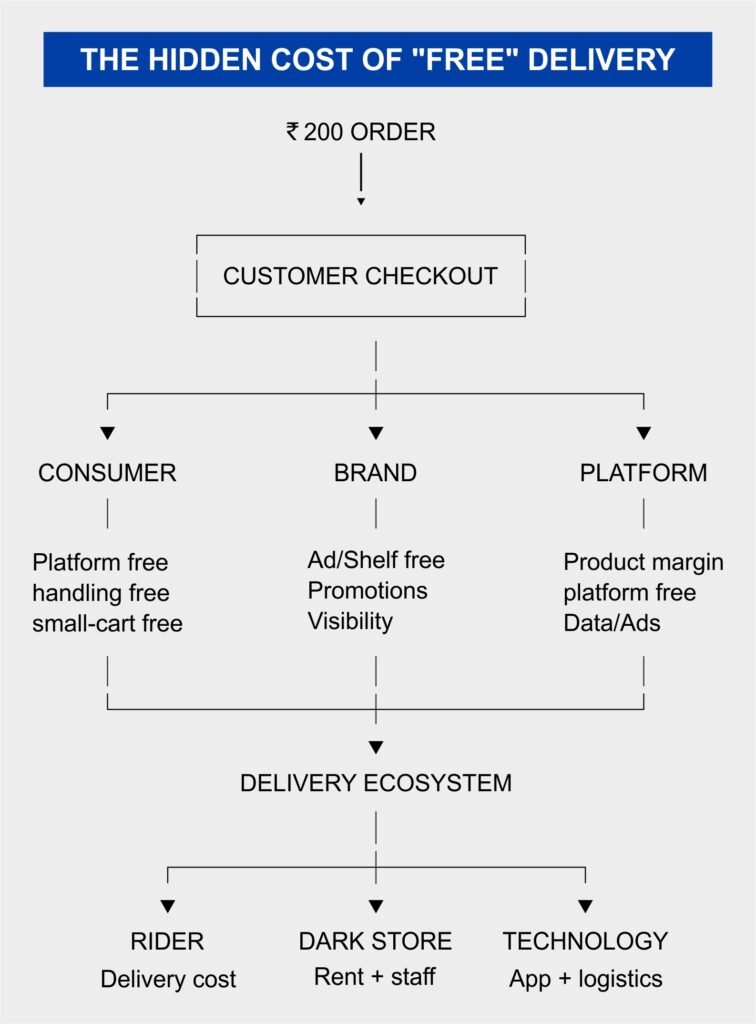
Because delivering a ₹200 grocery basket to your doorstep in 10–20 minutes is not a free service. Somewhere behind that tiny green, yellow or pink “Free Delivery” label are a delivery rider, a picker inside a dark store, warehouse rent, electricity, technology costs, inventory losses, packaging, discounts, advertising, merchant commissions and, increasingly, a collection of small fees that can add up.
The battle is no longer about who delivers fastest but about who makes delivery financially sustainable. And that raises an uncomfortable question for consumers – If delivery is free, who is actually paying for it?
The Rs 200 order that isn’t really a Rs 200 business
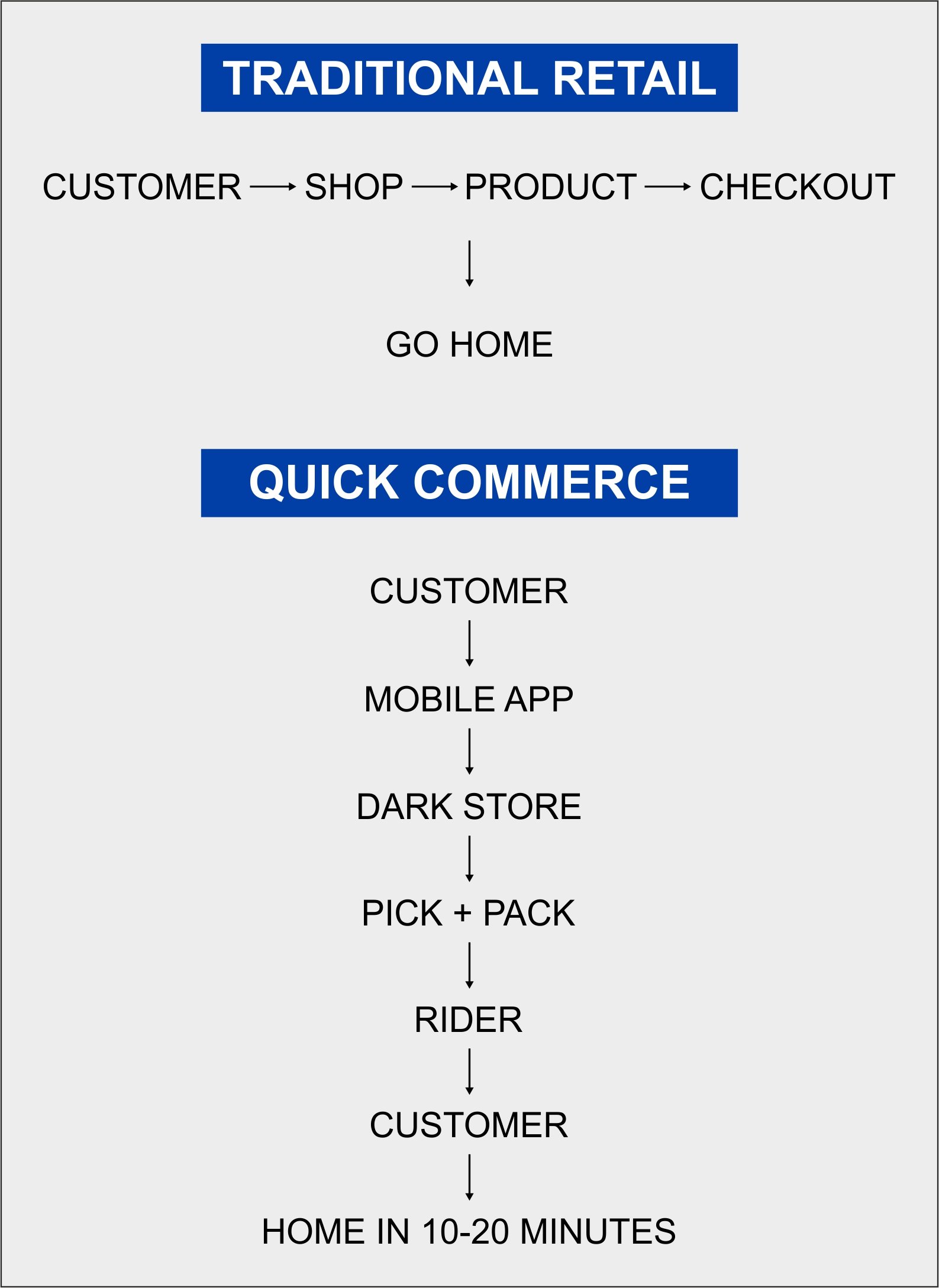
Now, let’s understand the basic economics. What’s a standard process? A consumer places a small order. The company picks the products, packs them, moves them from a dark store and gets them to the customer within minutes.
Now, there’s an important thing to notice. Dark stores sit close to residential clusters so that riders do not have to travel several kilometres for every order. This makes speed possible, but it also creates a very expensive physical network.
A 2026 ‘Indian Quick Commerce Industry’ report by the Global Association of Economics Education (GAEE) also suggests that roughly 85–90% of operating costs in quick commerce are linked to fulfilment activities, including rider payouts, packing, warehousing and last-mile delivery. The same report puts the average order value at around Rs 600. The maths becomes highly uncomfortable when customers place small basket orders.
A ₹150 order and a ₹700 order may require many of the same operational steps. Someone still has to pick it. Someone still has to pack it. A rider still has to travel to the customer’s house. That is why the industry’s biggest obsession is not just order volume. It is basket size. If the value of the cart is on the higher side, it becomes easier to spread the cost of fulfilment across a larger transaction. And this is where the apparently innocent phrase “free delivery” starts looking very different.
Let’s take a look at different case studies of some popular quick commerce platforms to understand it better.
Blinkit – From delivery fee to an ecosystem of revenue
Blinkit is perhaps the clearest example of how quick commerce has evolved from a delivery proposition into a full retail ecosystem. The business is no longer dependent on one revenue stream.
There is product margin. There are commissions and commercial arrangements with brands and sellers. There is advertising. There are customer-facing fees. And there is the enormous value of owning the digital storefront through which consumers increasingly discover products.
That last piece is particularly important.
When a consumer searches for chips, shampoo or coffee, brands are competing not only for shelf space in a supermarket but also for visibility inside the app.
The digital shelf has become advertising real estate.
This creates a potentially powerful flywheel for the platform: more customers attract more brands; more brands create more advertising opportunities; advertising can improve economics without necessarily making the consumer pay more for every product.
Blinkit’s parent, Eternal, reported consolidated adjusted EBITDA of ₹555 crore in Q1 FY27, up 223% year-on-year, while B2C net order value grew 54% to ₹31,120 crore.
The significance is bigger than the headline numbers. Quick commerce is gradually trying to prove that scale can change the economics of a business that once looked structurally loss-making. But scale does not mean every order is profitable. The objective is to make the overall system work.
Zepto – Growth comes with a bill
Zepto is also quite popular when it comes to quick commerce. This platform has grown at extraordinary speed, but rapid growth requires enormous investment.
Its updated IPO filings show that Zepto’s revenue more than doubled in FY26, while losses remained substantial. In Q4 FY26 alone, revenue reached ₹7,498 crore, while the company reported a loss of ₹1,538 crore.
Its full-year numbers tell an even bigger story: revenue rose to ₹22,624 crore in FY26, while the loss increased to ₹5,905 crore, according to its updated IPO filings reported by Reuters.
This is the paradox of quick commerce. More orders do not automatically mean more profits. A company can grow at a rapid pace while spending heavily on dark stores, technology, delivery infrastructure, employees, customer acquisition and expansion. Zepto’s challenge, therefore, is not whether Indians want 10-minute commerce. They clearly do. The challenge is whether the customer will eventually pay enough, directly or indirectly, for the infrastructure required to provide it.
Instamart – When scale becomes the strategy
Swiggy’s Instamart provides another interesting case study because the company has been trying to turn quick commerce from a cash-burning growth story into a scalable business.
If we take facts and figures into consideration here, in Q1 FY27, Instamart’s GOV reached ₹7,907 crore, up 40% year-on-year. The business served more than 14 million monthly transacting users across 130-plus cities through more than 1,200 dark stores. Its contribution-margin loss narrowed to just 0.2% of GOV. One thing to note here is that contribution margin is not the same thing as company-wide profitability. It essentially asks whether the business is generating enough revenue from its transactions to cover the variable costs associated with those transactions.
Instamart’s improvement suggests that the economics of individual orders are getting healthier. Swiggy is now expecting Instamart’s GOV to grow from ₹28,000 crore in FY26 to around ₹1.5 lakh crore by FY31.
It is not simply a grocery-delivery plan. It is a bet that quick commerce will become a major part of everyday retail. And that makes customer behaviour critical. If consumers continue using these platforms primarily for ₹150–₹250 emergency purchases, the economics remain difficult. If they start moving their weekly grocery baskets onto them, the equation changes.
Flipkart Minutes: The new battleground is Bharat
Flipkart Minutes brings another dimension to the story. This quick commerce platform has changed the game by pushing aggressively into smaller cities. Launched in August 2024, Minutes crossed 1,000 micro-fulfilment centres by June 2026 and reached more than 130 cities and 8,000-plus PIN codes. Flipkart said orders had grown fivefold year-on-year, while Tier 2 and Tier 3 markets had expanded 42 times compared with the previous year.
That changes the competitive map. Quick commerce is no longer only about delivering avocados to a Bengaluru apartment or forgotten toothpaste to a Mumbai high-rise. It is moving into smaller cities where consumers may have different shopping habits, different income levels and, importantly, strong relationships with local kirana stores.
Flipkart says smaller markets are becoming an important growth engine. Reuters reported that about 70% of Flipkart Minutes’ city coverage comes from smaller urban markets and that its average order value is around ₹700.
The higher basket size is important. For a quick-commerce company, a ₹700 order is a much more attractive economic proposition than a ₹150 order. This may ultimately be the industry’s next frontier – not just faster delivery, but larger baskets delivered fast enough that customers stop thinking of the service as an emergency option and start treating it as a primary shopping channel.
Free for the customer. Expensive for everyone else.
If you have used quick-commerce apps long enough, you may have noticed that “delivery fee” is no longer the only charge. Handling fees, platform fees, convenience charges, small-cart fees and even rain charges can appear at checkout. An Economic Times analysis in 2025 found that these additional charges could range from around ₹6 to ₹30 per order, depending on the platform and situation.
Individually, these amounts may seem small. But when multiplied across millions of orders, they become an important revenue stream. The customer may see “free delivery”, while the platform earns through several smaller charges.
But the consumer is not the only one paying for quick commerce.
Brands are also part of the equation. Quick-commerce platforms have become important marketing channels, with brands paying for visibility and sponsored listings. In many ways, the app has become the new digital shelf, where brands compete for consumer attention just as they compete for physical shelf space in stores.
Delivery partners are another part of the cost. The promise of delivering an order within minutes depends on a large delivery workforce operating within a highly time-sensitive system. As concerns around rider safety and delivery-time pressure have grown, the industry has also faced pressure to move away from fixed “10-minute delivery” promises.
Then comes infrastructure, the highest cost of all. Dark stores allow platforms to keep products close to customers and deliver quickly, but operating thousands of these small fulfilment centres is expensive. Rent, staff, electricity, inventory, technology and delivery costs all have to be recovered. The more stores a company operates, the greater the need to generate enough orders from each location.
Then comes another visible cost, which is customer behaviour. Quick commerce has changed what people consider “fast”. Delivery that once meant a day or two can now mean 10–20 minutes. Once customers get used to this convenience, it becomes difficult for platforms to slow down without affecting demand. This is why the next phase of quick commerce will be less about simply delivering faster and more about making convenience profitable.
The real question is not whether free delivery is actually free. It isn’t.
The question is who ultimately pays for it – the consumer, the brand, the investor, the delivery ecosystem or the platform itself? The answer is – to some extent, everyone does. Because in quick commerce, the delivery may be free, but the infrastructure behind those few minutes certainly isn’t.
Key Takeaways:
- Free delivery does not mean delivery has no cost.
- Quick-commerce companies recover costs through multiple revenue streams.
- Larger basket sizes can improve fulfilment economics.
- Brand advertising has become an important part of quick-commerce economics.
- Customer-facing fees are increasingly being used to improve unit economics.
- Scale can improve economics, but rapid growth does not automatically mean profitability.
Frequently Asked Questions
- Is free delivery really free?
No. The cost of delivery may be recovered through product margins, advertising, commissions, customer fees, subscriptions or other parts of the platform’s business model.
- How do quick-commerce companies make money?
They can generate revenue from product margins, brand advertising, commissions, customer fees and other commercial arrangements.
- Why do quick-commerce apps charge handling or platform fees?
These fees can help platforms recover fulfilment and operating costs and improve unit economics.
- Why are quick-commerce companies focused on increasing basket size?
A larger basket allows fulfilment costs to be spread across a higher-value transaction.
- Are quick-commerce companies profitable?
Profitability varies by company and metric. Contribution-margin improvement does not necessarily mean the entire company is profitable.
About the Author:
Shubham Garg is a digital marketing expert with 10+ years of experience in SEO, AEO, GEO, Google Ads and digital marketing. He writes about technology, digital business, marketing trends and emerging online ecosystems.
Related Article:
- How Nykaa is Beating Amazon & Flipkart In The e-Commerce War?
- Why E-commerce is Booming: Key Benefits of E-commerce for Businesses?
- BoAt Case Study: This Fifth Largest Wearable Brand is Earning Beyond Guesses