
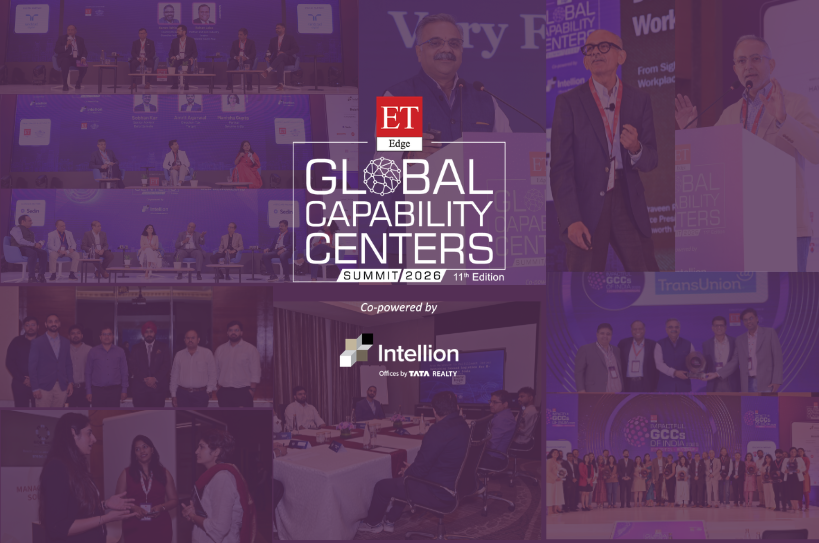
The 11th Edition of the ET Edge GCC Summit 2026, co-powered by Intellion Offices by Tata Realty in Bengaluru, marked a defining inflection point in India’s Global Capability Center (GCC) journey. As enterprises transition into AI-first, data-driven organisations, the summit brought together GCC CEOs, policymakers, technologists, and ecosystem partners to examine how these centers are evolving into strategic hubs of innovation, resilience, and enterprise intelligence.
At a time when India hosts over 1,700 GCCs employing nearly two million professionals, the conversations reflected a clear shift. GCCs are no longer operational extensions. They are core drivers of global business transformation.
The Rise of the GCC CEO: From Operators to Enterprise Strategists
Setting the tone for the summit, the inaugural panel explored how GCC leadership is being redefined in an AI-led enterprise landscape.
Rohan Lobo outlined the evolution of GCCs across three distinct waves. The journey has moved from efficiency and capability building to their current role as strategic nerve centers. As AI reshapes enterprise decision-making, leadership must now move beyond execution to actively steer products, platforms, and enterprise intelligence.
Building on this, Pawan Sachdeva emphasised that owning a clear problem statement is fundamental to delivering meaningful impact. The ability to combine the right capabilities with the right technology enables GCCs to create sustained enterprise value.
From an industry perspective, Balu Chaturvedula reinforced that talent remains the defining differentiator. GCCs have evolved from centers of excellence into engines that deliver business outcomes through deep domain understanding and continuous innovation.
Infrastructure as Strategy: Real Estate Powering GCC Expansion
In a solution showcase, Ritesh Sachdev highlighted how real estate has emerged as a critical enabler of GCC growth.
With India’s GCCs occupying nearly 200 million square feet of office space, workplace strategy is now directly linked to enterprise expansion. As GCCs scale, the demand is shifting toward high-quality, future-ready environments that support collaboration, innovation, and operational resilience. Real estate is increasingly being viewed as a strategic lever that enables long-term growth.
GCC × Startup: Building India’s Innovation Flywheel
A key theme across the summit was the growing collaboration between GCCs and India’s startup ecosystem.
Prashant Choudhary noted that India’s combination of over 1,700 GCCs and more than 100,000 startups is creating a powerful innovation ecosystem. This convergence is enabling enterprises to move faster from ideation to execution while strengthening India’s position as a global technology leader.
Speakers highlighted how startups are contributing across AI, data analytics, and cybersecurity. These collaborations are helping GCCs accelerate product development and unlock new efficiencies while giving startups access to enterprise scale and global markets.
Designing the Next-Gen GCC Workplace
As GCCs evolve into AI-driven enterprise hubs, workplace design is undergoing a fundamental shift.
In a showcase, Praveen Rawal emphasised the transition toward flexible and adaptive environments that support hybrid work and technology-led collaboration. Static office models are being replaced by dynamic workspaces that prioritise employee experience, agility, and productivity.
With expectations from workplaces evolving rapidly, organisations are rethinking infrastructure to align with the needs of future-ready enterprises.
Cyber Resilience: From Compliance to Enterprise Governance
Cybersecurity discussions reflected a clear shift from reactive defence to proactive governance.
Sowmya Vedarth highlighted that GCCs are increasingly responsible for managing global platforms, sensitive data, and cloud ecosystems. This makes cyber resilience a strategic priority.
As organisations expand their digital footprint, GCCs are playing a central role in shaping enterprise-wide risk frameworks. The focus is moving toward anticipating threats, strengthening governance, and ensuring continuity across global operations.
Agentic AI at Scale: From Experimentation to Enterprise Deployment
AI emerged as the most transformative force shaping the future of GCCs.
Across discussions, leaders pointed to a clear shift from proof-of-concept initiatives to full-scale deployment. Organisations are embedding AI into core business processes, product development, and decision-making frameworks.
In a solution showcase, Atul Gupta demonstrated how enterprises are leveraging advanced data platforms to convert large volumes of information into actionable insights. As data becomes central to enterprise strategy, the ability to connect analytics with real business outcomes is becoming a critical differentiator.
The broader discussion reinforced that successful AI adoption depends not only on technology but also on data readiness, business alignment, and scalable implementation models.
Sustainability and the Future of GCC Campuses
Sustainability is becoming a core business priority across the GCC ecosystem.
Discussions highlighted how organisations are embedding ESG principles into everyday operations, from infrastructure and energy use to workforce behaviour and decision-making. The growing awareness among younger professionals is accelerating this shift and turning sustainability into a cultural as well as strategic priority.
As GCCs expand, the focus is on building campuses that are scalable, efficient, and environmentally responsible.
Talent at the Core: The 4Cs of GCC Strategy
Talent continues to define the trajectory of India’s GCC ecosystem.
The panel on talent economics focused on the framework of the 4Cs. Cost, capability, culture, and continuity are emerging as the foundation for building resilient and future-ready organisations.
Jaikumar Subramanian noted that with nearly two million professionals and around 20 new GCCs being established every month, India’s talent ecosystem is entering a new phase of maturity.
Speakers emphasised that the next wave of GCC growth will depend on how organisations build leadership pipelines, enable continuous learning, and integrate human talent with emerging technologies such as AI.
Policy and Regulatory Clarity: Strengthening India’s GCC Advantage
Policy frameworks are playing a critical role in sustaining India’s GCC momentum.
Manisha Gupta highlighted how improved tax clarity, evolving transfer pricing norms, and state-level incentives are creating a more stable and attractive environment for global enterprises.
As states compete to attract investments, regulatory frameworks are increasingly being used as strategic tools to strengthen India’s position as the world’s leading GCC destination.
India’s GCC Future: Bengaluru at the Centre of Global Capability
Delivering the Chief Guest Address, Sanjeev Kumar Gupta reaffirmed Bengaluru’s central role in India’s GCC story.
From hosting the country’s first GCC set up by Texas Instruments in 1987 to becoming home to over 880 centers today, Karnataka continues to anchor India’s global capability ecosystem. With nearly 42 percent of GCC office leasing concentrated in the state, Bengaluru remains the nerve center of enterprise innovation and transformation.
A Defining Moment for GCC Evolution
The 11th Edition of ET Edge GCC Summit 2026 – Bengaluru concluded with a clear message. GCCs are no longer defined by efficiency or scale alone. They are strategic centers shaping enterprise intelligence, innovation, and global competitiveness.
As AI accelerates transformation and ecosystems become more interconnected, the GCCs that lead will be those that integrate technology with talent, align strategy with execution, and build resilience into every layer of their operations.
Looking Ahead: Mumbai 2026
Building on the momentum of the Bengaluru edition, the journey continues with the 12th Edition of the ET Edge GCC Summit, scheduled to take place in Pune in June 2026.
As GCCs evolve into AI-native, innovation-led enterprise hubs, the Mumbai edition will bring together global leaders, policymakers, and ecosystem partners to explore the next phase of this transformation. With India’s financial capital as the backdrop, the summit will deepen conversations around enterprise value creation, global collaboration, and the expanding role of GCCs in shaping the future of business.
(DISCLAIMER: The information in this article does not necessarily reflect the views of The Global Hues. We make no representation or warranty of any kind, express or implied, regarding the accuracy, adequacy, validity, reliability, availability or completeness of any information in this article.)
Must Read:
-
- Developers Building India’s Future Are Illuminated By The Country’s Most Reliable Real Estate Platform
- ET NOW Global Business Summit 2026 to reflect on ‘A Decade of Disruption, A Century of Change’
- NexTech Summit 2026 – INDIA’S LARGEST CIO CONFERENCE
- A Platform That Amplifies Influence, Drives Conversations, and Unlocks High-Value Storytelling Opportunities