

The Internet of Things (IoT) has the potential to transform industries. Its business value can be significant, from digitalizing a company’s internal operations to creating digital products and business models. According to McKinsey’s calculations, the IoT could generate up to $11.1 trillion per year by 2025.
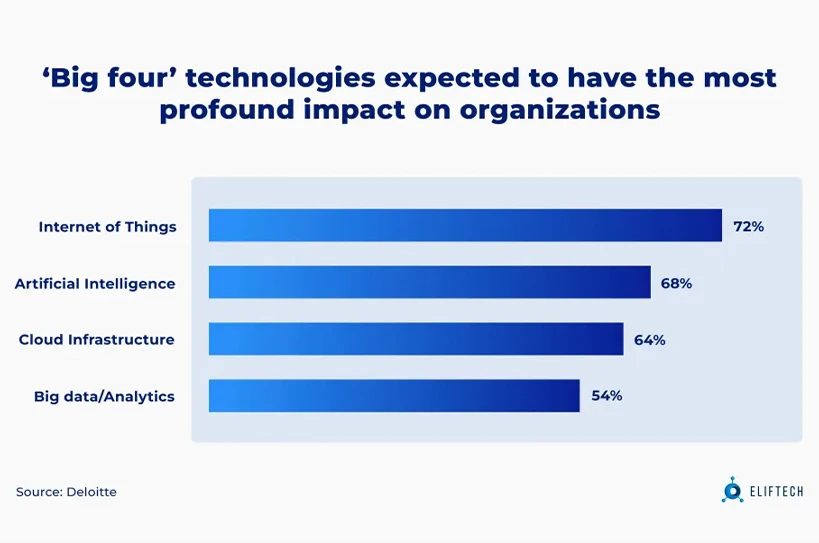
However, with its significant popularity comes complex development challenges. Each IoT application requires a different set of tools, platforms, and tech stack. They differ from the systems used to create standard applications. Below, we will take a closer look at the features and applications of IoT in Asia, as well as the main stages of their development.
What are IoT applications?
The Internet of Things (IoT) is a system of physical objects equipped with sensors, software, and other technologies that connect and exchange information with other devices via the Internet. The list of smart devices is huge, from thermostats and fitness bracelets for health monitoring to connected cars and industrial machines. The widespread use of devices means that the need for IoT software will grow. These applications allow devices to synchronize and exchange data with other gadgets.
Such software allows users to remotely control connected gadgets through an interface. It enables them to access smart systems from anywhere in the world. Thus, smart home applications allow you to turn on the light or adjust the temperature with a smartphone from any place.
Key benefits of IoT applications
IoT creates an intelligent environment using smart devices; on the website you can get more information. When combined with mobile apps that allow the user to remotely control such devices, this technology demonstrates significant potential. Let’s consider the key benefits of IoT-based applications.
- Cost-effectiveness. IoT allows businesses to perform standard functions and operations, but at a lower cost than using classic tools. IoT devices can be used to track equipment to reduce human intervention and costs.
- Understanding consumer preferences. Using IoT allows a company to collect relevant data and statistics through social networks, mobile Internet, CCTV cameras, etc. This helps businesses learn what customers need.
- Optimal customer service. Applications built on IoT allow users to perform operations with mobile card readers, smart trackers, etc. Such software enables users to track their activity and other relevant information, ensuring comfortable interaction with customers.
- Safe workplaces. Such applications make monitoring high-risk environments safer to ensure optimal working conditions for personnel. Such devices can monitor in real-time and provide information to detect potential threats faster.
With IoT, users can work with colossal datasets that would take years to collect manually. This information can be collected for research.
Analysis of the main components of IoT
When developing software for IoT, the challenge is to allow devices to interact and exchange information. Designing an IoT system requires an understanding of its key elements and their relationships. Each element brings its set of challenges to the development process.
- Sensors. These are the eyes and ears of the system. They receive information from the environment. They are essential for collecting raw datasets that need to be processed for further use. You must properly select and configure sensors to accurately collect information. You may consider such factors as sensitivity level, range, and environmental conditions. Their miniature size, cost, and power consumption can also create some challenges.
- Devices on which sensors are installed. These are the points where the collected information is processed and actions are performed based on it. These are physical elements that perform actions determined by the information being processed. It is crucial to choose reliable sensors. They must work effectively with information and perform actions based on data in any conditions without errors. Each specialist must find a solution that will provide a balance between computing potential and power consumption.
- Connectivity. This is a key part of the system that enables the exchange of information between devices. It is also a key hub or cloud for further analysis. This part of the system causes many difficulties, since it is necessary to form stable and reliable communication channels at any distance. The need for network synchronization and limited bandwidth characteristics worsens the situation, especially in dense urban areas.
- Information Processing. It is the engine of the system, that transforms raw information into a meaningful set of facts. Processing massive data sets in real-time, and extracting key insights require advanced software and significant computing power.
- User Interface. This is the gateway that users use to interact with the system, collect information, and control devices as needed. Developers must create an intuitive interface that provides users with control and analytics. The challenges in interface design arise from the need to synchronize across multiple platforms and devices.
When designing a complex IoT system, pay close attention to each element to ensure it works efficiently.
How are mobile apps impacting different IoT sectors?
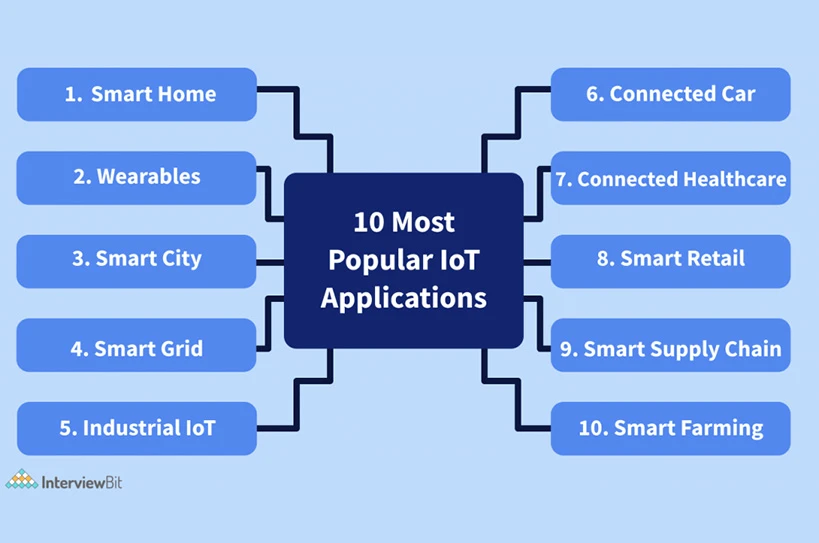
Mobile digital solutions influence IoT in different fields to expand the scope of application of technologies. Below, in the table, we will consider the most striking examples in Asia.
| Applications | Description | |
| Smart Homes | This software allows you to manage multiple devices in the home with a single control center locally and remotely. | One software combines specific applications for different devices on a single control panel for maximum convenience. |
| Wearables | The most striking example of application-based use of IoT are fitness bracelets and smart watches. | Such devices send information to the corresponding software on the connected gadget. Users can access the application at any time to review the data. |
| Medicine and Healthcare | IoT devices have found wide applications in the medical sector. | Software based on such technology offers several critical functions, including monitoring, quick reporting, remote medical care, etc. The Center for Unified Health Policy conducted a study that showed a 50% reduction in the frequency of rehospitalizations within a month for patients with heart failure through remote monitoring. |
| Retail | Important areas of IoT application for sellers include applications for interaction with consumers, supply chains, and smart stores. | Such software allows stores to monitor sales opportunities in real-time and missed orders. This improves supply and demand planning. |
| Agriculture | Farmers can monitor climate changes, track animals, control inventory, and analyze information from a central application synchronized with multiple sensors. | |
| Smart Cities | These are the largest IoT projects. | Features such as traffic alerts warn the population and authorities and help develop an emergency plan. Lighting is another popular example of IoT use in smart cities. Advanced cities are switching to wireless technologies to save money and resources. |
| Hospitality and Tourism | IoT creates many opportunities for improved operations in the tourism and hospitality industry. | Hiring staff is a significant investment for hotels, but IoT can automate some activities and reduce the workload. For example, using mobile electronic keys allows guests to enter and check out their rooms without interacting with staff. |
| Smart Manufacturing | IoT increases the transparency of production processes. | The technology provides real-time inventory, personnel safety and asset control. A point-of-sale (POS) system with IoT securely transfers information from cards. |
These are just the main examples of IoT use in cities, but as the technology develops, its scope of application will also expand.
Basic steps to create software for IoT
Creating an application for IoT may seem like a complicated procedure, but with the right approach, it is a feasible task. You should create a minimum viable product to quickly test the concept. Then, you can improve the software based on user feedback. You can also use our instructions, which provide the following steps for creating software.
- Formation of UI/UX design. The first step in releasing mobile software is to create an attractive interface. This involves developing a wireframe, prototyping, and creating a layout of the application.
- Frontend development. After creating the design, you can move on to the software interface. You need to create the user interface code, which will include basic elements, including button placement, information display, and navigation.
- Backend development. At this stage, you need to configure datasets, servers, and APIs. Such elements are responsible for communication between the software and smart gadgets or IoT sensors.
- Testing and quality assurance. Before presenting the application, you need to test its effectiveness and functionality. At this stage, it is necessary to eliminate any errors and problems that arise during the testing phase.
- Feedback and iteration. After you introduce users to your software, collect feedback and change the application based on their suggestions. This will improve the customer experience and make your software relevant.
- Maintenance and support. Maintaining and providing stable support for the application is important for its success in the long term. This includes immediate bug fixes, updates, and solving any difficulties that the user encounters.
These steps allow you to create user-friendly IoT applications. Now you just have to constantly collect feedback and make changes to keep up with competitors.
Challenges of IoT development in Asia
The development of IoT applications has created significant potential for innovation, but has also brought with it a number of challenges. Let’s analyze what challenges users in Asia most often face.
- Synchronization. Today, many companies create IoT devices and software. The lack of standardization leads to compatibility issues. Devices and applications may not interact effectively, which complicates the exchange of information. Creating universal standards or using software that supports different protocols is key to solving this problem.
- Scalability. As the IoT evolves, it becomes increasingly difficult to effectively scale. Systems must deal with the returning volume of traffic without compromising efficiency. Scalability includes information storage, processing capacity, and network infrastructure.
- Power control. IoT devices often operate in hard-to-reach locations, which requires rational power consumption. For continuous operation of such systems, it is necessary to ensure long-term autonomous operation of devices or implement alternative power sources.
Creating software for IoT is present in the development strategy of all large companies. This allows firms to bypass competitors using advanced technologies. Optimal IoT is an effective option for companies to build deeper relationships with customers. IoT software will be a good choice for remote control of home, business, and medical records.
(DISCLAIMER: The information in this article does not necessarily reflect the views of The Global Hues. We make no representation or warranty of any kind, express or implied, regarding the accuracy, adequacy, validity, reliability, availability or completeness of any information in this article.)
Must Read:
- The New Chapter: Generative AI and Beyond
- Your Guide to Personal Injury Legal Assistance Services
- Transforming Data into Marketing Gold with FLUODIGITAL
- THE POWER OF NEXT-GENERATION IN SOLVING CHALLENGES
- Child Injured in a Car Accident? Legal Options for Ontario Parents