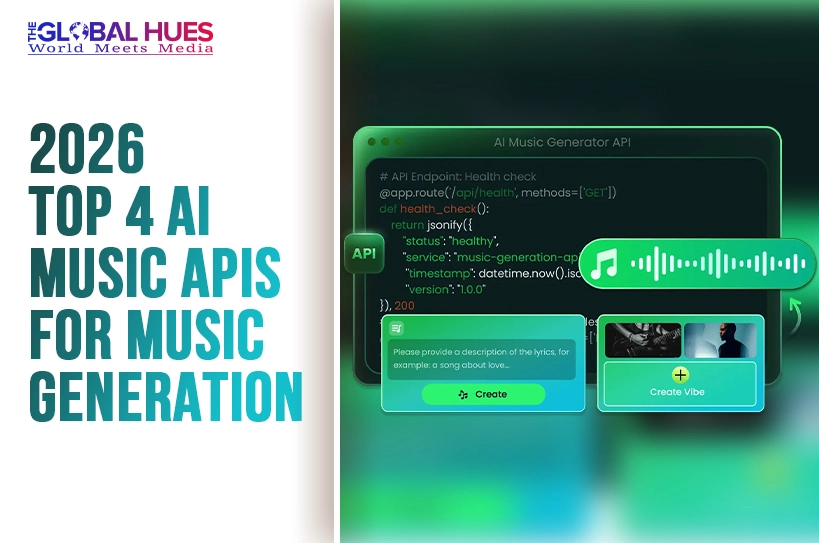
In recent years, with the rapid development of AI music generators, AI music developers and businesses must not only consider output quality when selecting the right API, but also strike a balance between cost control, compliance, and system stability.
This article will conduct an in-depth comparative evaluation of the four most popular AI music APIs currently on the market: Suno, Udio, Musicful.ai, and Stable Audio.
Part 1. Comparison of Suno, Udio, Musicful, and Stable Audio API
We will evaluate the AI music generator API based on the key points that developers care about most.
| Metric | Suno (v5.5) | Udio | Musicful.ai | Stable Audio |
| Areas of Expertise | Emotional Vocals, Pop/Rock/Rap | Instrument Separation, Jazz/Classical | All-rounder, Multi-lingual, MV Integration | Pro Sound Design, Stems, Atmospheric BGM |
| API Maturity | Third-party Proxies (No official public API) | B2B Partnership Model | Native Developer API (Mature) | Official API (Stability AI) |
| Price / Track (Est.) | ~$0.10 (via Proxy) | ~$0.12 (Contract-based) | ~$0.04 (Enterprise Tier) | ~$0.05 (Credit-based) |
| Throughput | 10 Concurrent (Pro) | Tier-dependent | 5-15+ (Elastic Scaling) | High (Platform-based) |
| Licensing | Rights for Paid Users | Rights for Paid Users (Legal volatility) | Full Commercial (Music + Video) | Creator License |

Part 2. Generation Quality: Emotion vs Precision
The quality of the output is the key factor in determining whether an API is good or bad. Most APIs produce songs that sound stiff and unnatural. A good API, on the other hand, will make your AI-generated music sound more emotional, just like a real human singer. Here is a summary of quality evaluations for four music-generation APIs:
Suno: Remains the undisputed “King of Vocals.” Its ability to generate “human” imperfections—like breathiness and vibrato—makes it the go-to for social media content. However, the mix can get “muddy” when layers of instruments increase.
Udio: Offers superior instrument separation and 48kHz audio fidelity. It excels at complex arrangements (e.g., polyphonic jazz), though the vocals can occasionally feel slightly synthesized compared to Suno.
Musicful.ai: Offers good overall balance. Its standout features include the generation of multilingual vocals and complete song structures (intro, chorus, bridge, and outro). It’s ideal for users who need complete, radio-ready tracks.
Stable Audio: The professional’s top choice. It performs most consistently in the creation of extended ambient music and provides producers with the highest-quality “track separation.” It operates more like a studio tool than a “black box” generator.
Part 3. Subscription Model and Developer-First Billing Model
For developers, the cost per API call is the make-or-break factor:
Musicful.ai: Offers the most transparent developer tiers. Its Pro Plan (~$599/mo) allows for roughly 15,000 tracks, bringing the unit cost down to $0.04. This is currently the most cost-effective option for high-volume apps.
Stable Audio: Uses a credit system. While the Pro plan is ~$11.99 for 250 tracks, scaling via the Stability AI platform allows for on-demand billing, which suits burst-heavy workloads.
Suno & Udio: Since they prioritize web-based subscriptions, accessing them via API usually requires third-party proxies, which inflates costs to $0.10+ per track and introduces reliability risks.
Part 4. Concurrency and Engineering Implementation
If your app requires real-time feedback (e.g., an AI-driven gaming soundtrack):
Musicful.ai provides native API accounts with 5 to 15 concurrent task channels, with custom enterprise scaling.
Stable Audio boasts the most robust API architecture, backed by Stability AI’s global infrastructure, resulting in the lowest latency.
Suno/Udio: Without an official standard API, developers often face “rate-limiting” or “bot-detection” hurdles, making them less suitable for large-scale, mission-critical deployments.
Part 5. Commercial Use Rights for Songs Generated by the API
Musicful.ai and Stable Audio lead the pack in data transparency. Musicful, in particular, often provides comprehensive commercial licensing that covers both audio and its generated visual assets, significantly lowering legal risks for platform owners.
Suno and Udio are currently navigating major lawsuits from record labels. Although you technically own the copyright to songs generated using an API, uploading these tracks to mainstream music platforms like Spotify may still result in copyright disputes.
Conclusion
By comparing the key features of these APIs, you should now have a general idea of which one best meets your needs. Additionally, we’ve summarized the target audience for each API below:
If you’re looking for maximum emotional impact: Choose Suno (requires a reliable proxy).
For professional-grade sound quality and track control: Choose Stable Audio. If you prioritize bulk production and the best return on investment, Musicful.ai offers the most scalable and cost-effective API. For high artistic expression: Udio provides the best tools for complex, non-mainstream music genres.
(DISCLAIMER: The information in this article does not necessarily reflect the views of The Global Hues. We make no representation or warranty of any kind, express or implied, regarding the accuracy, adequacy, validity, reliability, availability or completeness of any information in this article.)
Must Read:
- S Jaishankar: Meet Veteran Diplomat Shaping India’s Foreign Policy
- Top 10 Forex Traders in India – Updated Ranking & Insights
- The Techno Sparks
- SHIV NADAR: A PHENOMENAL BUSINESS TYCOON