
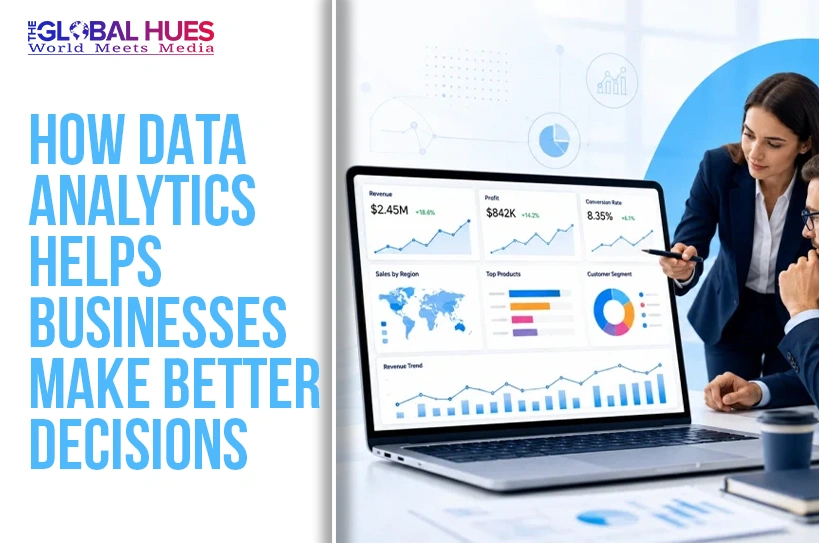
Businesses make decisions every day about customers, involving matters such as prices, marketing, stock, labor and investments. Data analytics is used to help make these decisions more based on evidence and less on assumptions.
Data analytics is the process of gathering information and sorting it. Also, it helps in finding patterns and applying these patterns to inform business decisions.
You don’t have to have a large technology team to utilise analytics. Whether it’s a small company or a large one, they can analyse their sales data, website traffic, customer behaviour or any kind of marketing campaign to see what’s working.
What Is Data Analytics in Business?
Business data analytics is the study of data to resolve real-life questions.
For example:
- What are the best-selling products?
- Who are the most profitable customers?
- What marketing channel is more effective in terms of leads?
- What are the reasons for customer cancellation?
- Which store location has the better performance?
- What areas are costs growing?
If you have a problem in your team, analytics will provide a structured method of obtaining the answers.
What Types of Data Analytics Do Businesses Use?
| Type | Main Question | Example |
| Descriptive analytics | What happened? | Monthly sales declined |
| Diagnostic analytics | Why did it happen? | One product category lost demand |
| Predictive analytics | What may happen next? | Demand may increase during a holiday period |
| Prescriptive analytics | What action may help? | Increase stock before expected demand |
How Does Data Analytics Improve Decision-Making?
Data helps teams compare options using measurable evidence.
Assume an eCommerce enterprise needs to enhance the marketing spend. It can research which channels are worthwhile and cost an acceptable level, rather than equal distribution.
The business can then put more money into stronger channels and reduce spending where results are weak.
It Reduces Guesswork
Experience helps, but human judgements are subject to assumptions.
Data provides an alternative option for managers to test those assumptions.
For example, a restaurant owner might think that the weekends represent the most profitable time for his business. Statistics may indicate that the weekday lunchtime crowd is more profitable.
This will impact the staffing or promotions process.
How Does Data Analytics Improve Customer Understanding?
Businesses collect useful customer information through:
- Purchases
- Website visits
- Surveys
- App activity
- Customer support
- Loyalty programs
- Sales conversations
Analytics can identify common patterns inside this information.
Customer Segmentation
Businesses can divide customers into useful groups based on behaviour or needs.
Segments may include:
- New customers
- Repeat buyers
- High-value customers
- Inactive users
- Frequent support users
- Customers interested in one product category
Different groups may need different communication.
How Does Analytics Improve Marketing?
Marketing teams can compare campaign results instead of relying only on clicks or impressions.
| Marketing Metric | What It Can Tell a Business |
| Conversion rate | How many visitors complete a desired action |
| Cost per lead | How much it costs to generate an enquiry |
| Customer acquisition cost | Approximate cost of gaining a customer |
| Repeat purchase rate | How often customers return |
| Email click rate | How readers interact with emails |
| Revenue by channel | Which channels contribute sales |
The goal is not to track every available metric. Businesses should focus on numbers connected to actual goals.
How Can Analytics Improve Operations?
Operational data can help businesses work more efficiently.
A retailer can review stock movement to identify products that sell quickly and products that remain unsold.
A delivery company can analyse routes and delivery times.
A factory can track equipment performance to identify recurring delays.
Useful operational analytics may support:
- Inventory planning
- Staffing decisions
- Delivery scheduling
- Quality control
- Supplier management
- Capacity planning
Small improvements in these areas can reduce costs over time.
How Does Data Help Financial Planning?
Financial analytics assists business owners understand revenue, costs, cash flow, etc.
Do not just look at the total sales. Instead, businesses can study profitability by:
- Product
- Customer group
- Location
- Service
- Sales channel
- Time period
A product generating high revenue may have poor margins due to delivery or production costs.
Analytics helps reveal these differences.
What Makes Business Data Useful?
More data does not automatically mean better decisions.
Useful data should be:
- Accurate
- Relevant
- Consistent
- Timely
- Easy to understand
- Connected to a business question
What Are Common Data Analytics Mistakes?
One common mistake is tracking too many numbers. A dashboard containing 100 metrics may create more confusion than clarity.
Other mistakes include:
- Using outdated data
- Ignoring data quality problems
- Comparing unrelated periods
- Confusing correlation with cause
- Focusing on vanity metrics
- Ignoring customer context
How Can Small Businesses Start Using Data Analytics?
Start with one business problem.
For example:
Problem: Too many customers leave after their first purchase.
Then follow a simple process:
- Identify the required data.
- Review customer purchase history.
- Compare repeat and one-time buyers.
- Look for common patterns.
- Test one improvement.
- Measure the result.
Simple spreadsheets and existing business software may be enough at the beginning.
How AI Is Changing Data Analytics
AI can assist businesses in processing and analysing larger volumes of data more efficiently.
AI-embedded analytics can provide teams with the ability to create basic forecasts and group customer feedback. Also, it can help highlight unusual changes, and summarise reports.
There is a need for human review. A good analysis will take into account the business situation surrounding the figures.
Final Thoughts
Data analysed is used to inform businesses and guide decision-making.
Sometimes the best value is in the simplest of questions – what is going on, why is it going on, and what should the business try next?
Businesses don’t have to do a complete analysis of everything. They need consistent data in relation to relevant business choices.
FAQs
1. What is data analytics in simple terms?
Data analytics is the process of analyzing data of a company to determine patterns, measure performance and guide decision-making.
2. Can small businesses use data analytics?
Yes. Simple tools can be used to examine sales data, customer behavior, website traffic, marketing outcomes and costs of small companies.
3. What business areas benefit most through analytics?
This can benefit marketing, sales, customer service, operations, inventory management, finance, product development, etc.
4. What is the best way to start using analytics?
Select a key business question, determine the data needed, analyze the data, and measure an improvement.
Related Article:
- How to Improve Your Credit Score: Proven Strategies for Financial Success
- Ethical Investing in India – Exploring Faith-Based Investment Options
- How to Make Money Online: Legit Ways to Earn Income