
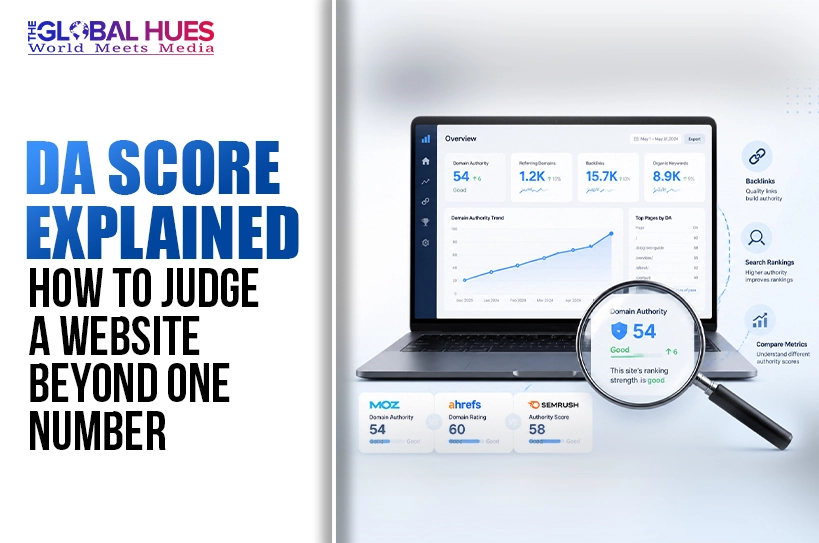
A website can have an impressive-looking authority score and still be a poor place to publish an article. It may attract little relevant traffic, cover an unrelated subject, or link out to pages without much editorial care. The DA score guide helps explain what this metric represents, but using it well means looking beyond the number.
For marketers, publishers and small businesses, understanding website authority can make guest-posting and link-building decisions more considered. The score can be a useful starting point. It is not a guarantee of rankings, traffic or value.
What does a DA score measure?
Domain Authority (often abbreviated to DA) is a metric created by Moz to predict how likely a website is to rank well in relation to other domains. It is based on the backlink profile of the site as well as other factors in Moz’s index. It uses a scale from 1 to 100, with higher scores reflecting a stronger position overall.
The critical point is that it is an estimate. DA is not a Google metric and Google is not using Moz’s score to determine a page’s position in its results. It is a third-party tool designed to compare the relative strength of domains and it must be treated as such. In reality, not every page with a high score is deserving of its position.
Why does the score change?
A domain’s authority score can fluctuate over time in response to updates to Moz’s index and changes to the link profile of the page or those of comparable sites. A domain’s score might drop even if its content remains the same.
Whilst backlinks are an important consideration in a page’s SEO, the sheer volume of links is not necessarily an indicator of quality. A small number of relevant, reliable links might have more impact than thousands of irrelevant ones. The value and trustworthiness of individual links must be considered.
DA, DR and Authority Score are not the same thing
Each SEO software provider will typically have its own method of assessing the strength and value of a domain. Ahrefs’ Domain Rating reflects the strength of a domain’s link profile, whilst Semrush’s Authority Score is a combination of factors that estimate the overall value of the domain to SEO. Moz’s Domain Authority has its own unique methodology.
Since each provider will be using a different underlying dataset, a direct comparison between the three is not possible. A domain might have a higher rating in one system and a lower one in another but neither is necessarily wrong. It is important to assess sites using the same tools and to remember that no single metric reflects the value of an entire website.
How to assess a website for guest posting
If you are looking at buying a guest post or a link, the critical question should be whether the domain is appealing to the right audience. A smaller, niche site in your industry might be more valuable than a much bigger domain that has little relevance to your market.
Consider topical relevance: does the site focus on the same themes as your content, or would a post there seem out of place? Research traffic figures: look at the average number of visitors and ensure that numbers are not dropping. Note that most traffic estimators only provide rough figures. Study recent articles: are they well-written and informative or full of errors? Are they clearly aimed at real people or are they keyword stuffing exercises? Examine the backlink profile: are there relevant references or are many of the links random or untrustworthy? Look at other links on the page: a post with excessive unrelated adverts might have less value and could be seen as a risk. Consider audience appeal: would people actually want to read your post in addition to the benefits for SEO?
These steps will give a more rounded assessment of a website’s value. Search engine optimisation is only one element of a page’s ability to perform and attract visitors.
Related Article:
- How Data Analytics Helps Businesses Make Better Decisions
- Unlock Website Performance with Professional Technical SEO Services
- How Search Engine Optimisation Can Drive Traffic To Your Corporate Website