
For two years, Norway was the cautionary tale of European higher education. It had been one of the last countries in the world where anyone, from anywhere, could earn a master’s degree at a public university for free. Then in autumn 2023 it started charging non-EU students cost-covering fees, and a country that had been a budget destination became an expensive one almost overnight.
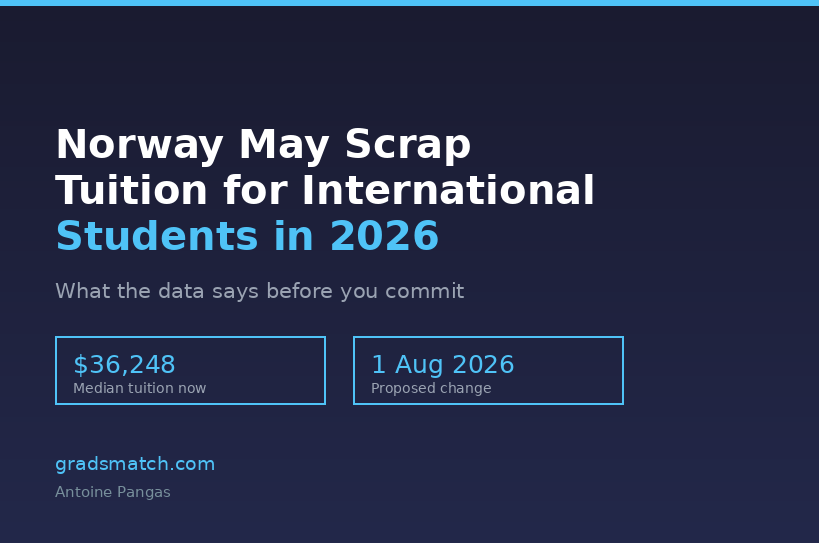
That may be about to reverse. In June 2025 Norway’s Ministry of Higher Education and Research proposed dropping the national requirement that public institutions charge full-cost tuition, handing each university the freedom to set its own rate for non-EU and non-EEA students, including setting it at zero. The Local Norway reported the plan when it was announced. The change is scheduled for 1 August 2026, subject to parliamentary approval.
The reason for the reversal is blunt. After fees came in, new enrolments from non-EU and non-EEA students fell by roughly 80 percent. That is not a policy adjusting at the margins, it is a policy that emptied the pipeline, and Norway noticed.
That is a meaningful swing, and it is worth understanding precisely what it would change and what it would not. It is also worth understanding before you make a decision on it, because as of right now the fees are still in place.
What Norway costs today
I maintain a database of master’s programs and their published tuition, currently covering 41,583 programs at 551 institutions across 58 countries. Pulling the Norwegian programs and converting to USD, the median annual tuition for a non-EU student sits at about $36,200 across 305 programs.
That is not a rounding error. It puts Norway in roughly the same bracket as the United Kingdom, where the median across 6,502 programs comes to about $37,000. A student choosing Norway today on the assumption that Scandinavian education is cheap is making a decision based on information that expired in 2023.
If the proposal passes, that $36,200 could fall to something close to the semester registration fee. Very few policy changes move a number by that margin.
One caution on the timing. Nord University and NTNU have already announced reductions for 2026/27, but because the proposal devolves the decision to each institution rather than mandating free tuition nationally, the outcome will vary by university. “Norway is free again” will be too blunt a summary either way.
The catch nobody mentions
Tuition is only one line in the budget, and in Norway it has never been the line that stops people.
The Norwegian Directorate of Immigration requires students at universities and university colleges to document NOK 170,368 for the 2026/2027 academic year, or NOK 15,488 per month, to prove they can support themselves. At current rates that is roughly $16,000 that has to be visible in an account before a study permit is granted.
This money is not a fee. You spend it on rent, food, and transport over the course of your studies, and Norway is expensive enough that you will need most of it. But it is a hard gate, and it is assessed before you arrive. A student who cannot show that balance does not get the permit, no matter how cheap tuition becomes.
So the honest summary of the proposed change is this: Norway would go from expensive-and-gated to affordable-and-gated. It opens the door for students who have savings or family backing but were priced out by fees stacked on top of living costs. It does not open the door for students whose constraint is having no capital at all.
How this compares to the rest of Europe
Here is where the Norwegian change lands in context. These are median annual tuition figures in USD, converted from published fees across my dataset:
| Country | Median annual tuition | Programs in sample |
|---|---|---|
| Germany | $0 | 2,599 |
| France | $549 | 739 |
| Italy | $5,916 | 1,213 |
| Canada | $24,700 | 1,885 |
| United Kingdom | $37,020 | 6,502 |
| Norway (current) | $36,248 | 305 |
| Australia | $55,559 | 2,039 |
| United States | $61,394 | 11,144 |
Germany is the number that surprises people most. Of 2,599 German master’s programs with published tuition in the dataset, 1,758 charge exactly zero. Public universities there charge no tuition to international students at all, only a semester contribution that generally runs EUR 100 to 400 and usually bundles in a regional transit pass. The DAAD maintains the official programme database if you want to confirm this at the source. There are 1,044 German programs taught entirely in English in my dataset, so none of this is conditional on speaking German.
France is close behind at a median of $549 per year, in line with the rates Campus France publishes for public universities. Italy comes in under $6,000.
What this means practically: even in the best case, a tuition-free Norway would be joining a group that Germany and France have been in the whole time. If your single priority is minimizing tuition, Germany already solved that problem and did not stop solving it in 2023.
Norway’s real appeal is different. It is a small, high-wage, high-trust labour market with strong research funding in energy, marine science, and climate, and it teaches a lot of master’s programs in English. Those are the reasons to go. Free tuition would remove a barrier that was standing in front of those reasons.
What to do if you are applying for autumn 2026
The proposal has not passed. Until parliament approves it, the fee regime from 2023 is what governs your admission.
Anyone applying for autumn 2026 should get the fee position confirmed by the institution in writing before accepting an offer. Do not rely on a news article, and do not rely on this one. The University of Oslo, for instance, states plainly that applicants receive the precise tuition figure alongside their offer and that rates are adjusted annually. Ask the admissions office directly what you will be charged, and keep the answer in writing. If the change passes after you have accepted, you want a record of what you were told.
There is also a plainer point about the application year itself. The median application fee for a US master’s program in the dataset is $80, drawn from 9,724 programs that charge one. Apply to ten and you are $800 down before a single decision arrives. Of German programs in the dataset, 1,577 charge nothing to apply. If you are hedging across countries anyway, the European applications cost you almost nothing to add.
The wider pattern worth noticing
Norway charging fees in 2023 and possibly reversing in 2026 is a reminder that tuition is policy, not physics. It changes when governments change their minds, and it changes faster than the advice circulating in student forums and YouTube videos.
Most of the guidance students rely on is a few years stale. The “Norway is free” advice was correct until 2023 and wrong for three years after. Anyone repeating it in 2024 or 2025 was sending people toward a $36,000 bill. If the reversal passes, everyone who updated to “Norway is expensive now” will be wrong in the other direction.
The practical defence is a two-step habit. Shortlist broadly across countries, then confirm each figure at the source for the specific intake year you are applying to.
The first step is the one students skip, usually because comparing twenty programs across eight countries and six currencies by hand takes an evening. That is the problem I built GradsMatch to solve, and it is where the figures in this article came from. The second step is the one no tool can do for you. Published data goes stale the moment a ministry changes its mind, which is the entire lesson of Norway between 2023 and 2026.
Rankings change slowly. Tuition policy does not.
Antoine P. is the founder of GradsMatch, a free tool for comparing master’s programs across 58 countries on tuition, entry requirements, and deadlines. Tuition figures in this article are medians of published fees converted to USD, drawn from a dataset of 41,583 programs, and reflect a snapshot at the time of writing.
(DISCLAIMER: The information in this article does not necessarily reflect the views of The Global Hues. We make no representation or warranty of any kind, express or implied, regarding the accuracy, adequacy, validity, reliability, availability or completeness of any information in this article.)
Related Article:
- Top 10 Scholarships for International Students You Must Know
- Top 10 Courses for Data Science to Boost Your Career
- MBBS in Europe: The Path to a Global Medical Career