

The-Global-Hues-Speed-Without-Recklessness-How-Fast-Teams-Stay-Accurate-Under-Pressure

Speed Without Recklessness: How Fast Teams Stay Accurate Under Pressure

Guest Post

The organizations that move fastest are not always the ones that make the fewest mistakes. Sometimes they are, and their speed and accuracy are both products of the same well-designed operational system. But sometimes fast teams move fast precisely because they have cut the checks that would have caught the errors, and the speed they celebrate today is the rework, the revision, and the reputational cost they pay next quarter. The genuinely high-performing fast teams are the ones that have found a way to operate quickly without sacrificing accuracy, not by slowing down the work but by speeding up the verification. They make approval cycles faster rather than skipping them. They keep data current rather than working from stale numbers. They document decisions clearly rather than relying on memory to preserve nuance under pressure. That combination of speed and accuracy is not a personality trait. It is an infrastructure outcome, and it is built on project management tools designed to make the verification steps as fast as the work itself.
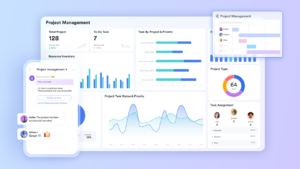
Overview of a modern project management dashboard with charts, stats, and team avatars on a pastel UI canvas.

Operational data that is always current without a refresh cycle with Lark Base

Fast teams make decisions quickly. The quality of those decisions depends on the quality of the information they are based on. When a fast team is making decisions from data that is one day old, or three days old, or last-week-old because the spreadsheet has not been updated since the last status meeting, the speed of the decision-making is not matched by the accuracy of its informational foundation. The team moves fast toward a conclusion that the current data would not have supported, and the cost of the correction is higher than the time saved by moving quickly.

UI concept of an AI-assisted workflow with panels for conditions, actions, and AI-generated text linked by glowing lines over a light blue background.

Lark Base keeps every piece of operational data current in real time without requiring a refresh cycle or a manual update step from any team member. When a project moves to a new stage, the record updates immediately and the relevant stakeholders receive an automated notification. When a sales record changes, the dashboard that leadership uses for decision-making reflects the change at the same moment. “Real-time cross-Base sync” allows data from separate departmental databases to be referenced in a consolidated management view, so the fast decision being made at the executive level is based on the same live operational data that the team on the ground is working from rather than a summary that was compiled before the last three changes were made.

Approvals that accelerate decisions without bypassing governance with Lark Approval

The instinct of a fast team under pressure is to skip the approval step. The decision needs to be made now, the approver is unavailable, and waiting for the formal sign-off will cost more time than the risk is worth. That instinct is understandable and frequently correct in its assessment of the immediate trade-off while being wrong about the cumulative cost. The approval step that gets skipped once becomes the approval step that gets questioned in the next audit, and the pattern of skipping it under pressure becomes a governance gap that compounds over time into a real compliance risk.

Illustration of a dual-panel dashboard: left panel shows a 'New Purchase Approval Request' with an orange banner 'No more chaos—Zero app switching', arrow to right panel 'New Vendor Request' with status steps and Approved/Rejected buttons.

Lark Approval allows fast teams to keep approvals in place without accepting the delay they traditionally carry. “Parallel Routing” sends approval requests to all required reviewers simultaneously, so the sequential waiting that makes approval cycles feel incompatible with fast-moving work disappears. “Auto-delegation” routes requests to a backup approver automatically when the primary reviewer is unreachable, so a time-sensitive decision never stalls on a single person’s availability. “Approval Notifications” reach approvers wherever they are working, on mobile and on desktop, so requests are seen and acted on within hours rather than days. The fast team keeps moving and the governance record stays intact.

Numbers that tell the same story to every audience with Lark Sheets

One of the most consistent sources of costly errors in fast teams is the divergence between the numbers different stakeholders are working from. The product team’s forecast was built from the revenue model three weeks ago. The finance team updated that model last Tuesday. The board presentation uses the product team’s version. The discrepancy surfaces in a room where both the finance lead and the product lead are present, and the time spent reconciling them in front of leadership is neither fast nor accurate. Lark Sheets eliminates the divergence by making every stakeholder’s view of the numbers a filtered window into the same live dataset.
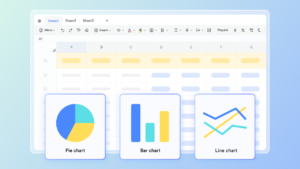
Spreadsheet workspace with three floating cards: Pie chart, Bar chart, and Line chart.

Cross-sheet formula references mean that any update to a source data sheet cascades through every dependent calculation automatically, so the forecast, the budget summary, and the operational variance report all reflect the same current numbers without any manual reconciliation step. Granular sharing controls allow each stakeholder to access the range of data relevant to their role without exposing the full financial picture, so the product team’s forecast view and the finance team’s full model are both live, both current, and both derived from the same source. Charts embedded in Lark Slides presentations update automatically when the source data changes, so the board deck that was prepared for this week’s meeting still shows accurate numbers even if the underlying data changed yesterday.

A traceable record under every fast decision with Lark Docs

Fast teams in high-pressure environments make decisions quickly and move on. The decision made at 9am on Monday is already three decisions behind by Wednesday afternoon, and the reasoning behind it is being displaced in memory by everything that came after. When that decision turns out to have been the right one, the traceability does not matter. When it turns out to have been the wrong one, or when it needs to be defended to a client, a regulator, or a board, the absence of a clear record of how and why it was made becomes a significant liability.
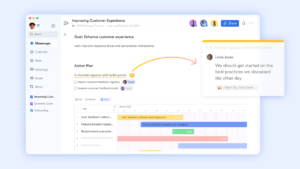
Dashboard-style project document: goal, action plan checklist, and a Gantt-like timeline on the screen with a floating note card on the right.

Lark Docs makes the decision record a natural byproduct of the decision-making process rather than a separate documentation task that nobody has time for when the team is moving fast. “Version History” captures every edit with the editor’s name and a timestamp, so the evolution of any decision document is permanently traceable without anyone having to maintain a separate change log. “Comment” threads attach the reasoning behind specific choices to the exact section of the document where those choices appear, so the record of why a decision was made travels with the decision itself rather than living in a separate conversation that nobody can find months later. The fast team’s pace is preserved because the documentation step is built into the tool rather than added on top of it.

Process knowledge that prevents the same mistake twice with Lark Wiki

Fast teams that do not document their mistakes are fast teams that repeat them. The error made in the third quarter’s campaign launch, the data validation step that was skipped because everyone was moving too quickly, the client communication that went out before legal had reviewed it: each of these is a lesson that the organization paid a real price to learn. Without a structured, accessible record of what went wrong and what should be done differently, the lesson stays with the individuals who experienced it and leaves the organization the moment those individuals do.
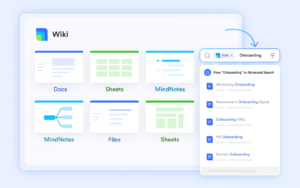
A dashboard-style window showing a Wiki app with six document cards labeled Docs, Sheets, MindNotes, MindNotes, Files, Sheets; a side panel titled Onboarding with search and list items.

Lark Wiki’s “Advanced Search” with powerful filters makes process documentation immediately retrievable when the team is in the middle of a fast-moving situation and needs to check the right way to handle something before committing to an action. “Permission Settings” allow different levels of process documentation to be accessible to the relevant teams without exposing proprietary operational details to the broader organization. “Rich Content” pages can carry the full reference layer for any process, including embedded checklists, linked decision records, and reference databases, so the team member who is moving quickly and needs to verify a step finds everything they need in a single organized location rather than searching across multiple tools while the clock is running.

Bonus: The accuracy cost that fast teams rarely calculate

Fast teams rarely calculate the cost of their errors because the speed is visible and the errors are attributed to other causes. The rework is logged as a new project. The client revision is absorbed into the account management budget. The compliance gap is treated as a one-time exception. The pattern that connects all of them to the same root cause, a team moving faster than its verification infrastructure can support, is never named.

Platforms like Jira and Asana improve task tracking for fast teams. Confluence and Notion improve documentation. Slack and Microsoft Teams improve communication speed. But none of these addresses the fundamental issue that accuracy under pressure requires all four of these functions to be connected, so that the live data, the traceable decision, the valid approval, and the accessible process knowledge are available in the same place at the same moment the fast decision needs to be made. Evaluating those tools alongside Google Workspace pricing as a foundation reveals a system where speed and accuracy are optimized separately rather than together. Lark optimizes them in the same environment.

Conclusion

Speed without recklessness is not a personality trait that some teams have and others do not. It is an infrastructure property that organizations can build deliberately by designing a workspace where the data is always current, the approvals are always moving, the numbers are always consistent, the decisions are always traceable, and the process knowledge is always accessible. A connected set of productivity tools that makes accuracy as fast as the work itself is how high-performing teams stay ahead without paying for their speed in errors they could have avoided.

(DISCLAIMER: The information in this article does not necessarily reflect the views of The Global Hues. We make no representation or warranty of any kind, express or implied, regarding the accuracy, adequacy, validity, reliability, availability or completeness of any information in this article.)

Must Read:

Previous
author avatar
TGH Editorial Team
Our team of authors at The Global Hues comprises a diverse group of talented individuals with a passion for writing and a wealth of knowledge in their respective fields. From seasoned industry experts to emerging thought leaders, our authors bring a wide range of perspectives and expertise to our platform.

Leave a Reply