
We don’t usually think about lungs. They quietly work in the background, every minute, every hour, without asking for attention. We notice them only when something goes wrong, such as a cough, breathlessness, or wheezing. In cities like Delhi, these moments are becoming far too common.
Every year, just after Diwali or Dussehra, hospitals see a sharp rise in patients. OPDs overflow, not because of accidents or infections alone, but because people can’t breathe the way they should. The air feels heavier. Chests feel tighter. Even young, non-smokers in their 20s and 30s walk into clinics complaining of breathlessness. But according to Pulmonologist Dr. Harish Bhatia, this is not just about pollution or festive smoke. “It’s about how we live every single day,” he says.
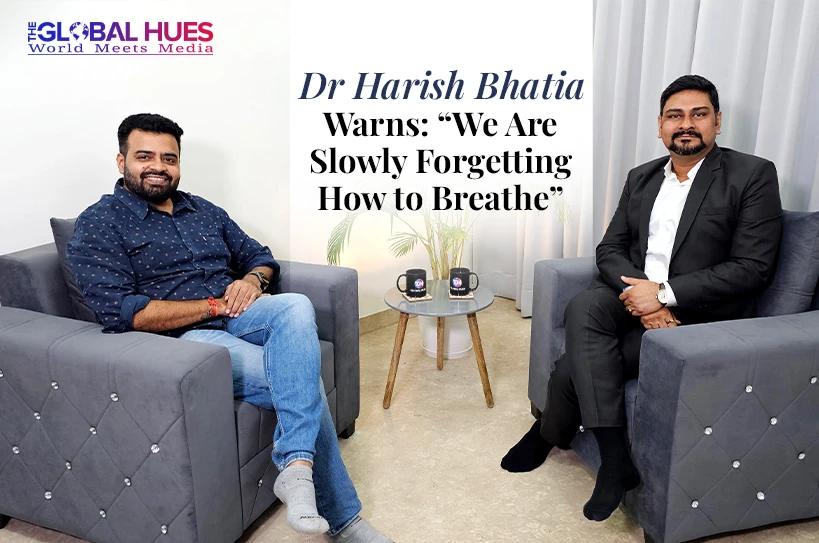
In a candid conversation with The Global Hues, Dr Harish speaks not just as a doctor, but as someone who has seen illness up close, from his own childhood battle with a life-threatening brain tumour, to treating thousands of patients during COVID when fear and desperation filled hospital corridors.
Lungs Are Like Balloons
Dr. Harish explains lung health in the simplest way possible. He says, “Our lungs work like a balloon. They inflate and deflate. They have a full capacity, but we are not using it.”
When we stop using any part of our body, it weakens. Just like a plastered hand becomes stiff, the muscles that help us breathe also weaken when we don’t move enough.
“We don’t walk. We don’t run. We don’t play. So slowly, the lungs forget how to work at their best.”
Why Rural Lungs Are Healthier
One study published in 2023 revealed that the lungs of people living in villages are 30–40% better than those living in cities. Dr. Bhatia explains, “In villages, children still play outside. They walk, run, climb, fall, and get up again. Their lungs are used every day.” He contrasts this with urban life and adds, “Go to a gaming zone, you’ll see many children. Go to a park, and you’ll see very few. Mostly children of labourers, they play all day. They don’t have lung problems. We do.”
Pollution Is Everywhere, Even Inside Our Homes
Outdoor pollution is only one part of the problem. PM2.5, one of the most dangerous pollutants, is so tiny that we cannot see it. It goes deep into the lungs and causes inflammation.
“But indoor pollution is equally harmful,” Dr Bhatia adds.
Mosquito coils, incense sticks, room fresheners, and chemical cleaners are all part of daily life and quietly damage the lungs.
“Delhi’s environment is not safe for even one full year,” he says. “Not just during festivals, every day.”
There Is No Such Thing as a Lung Detox
Social media is full of advice, be it steam inhalation, herbal teas, powders, or detox drinks. Dr Bhatia makes it clear. “Lungs cannot be detoxified. This is a myth.”
What actually helps is very basic:
- Clean air
- Masks when pollution is high
- Vaccinations
- Regular movement
- Following medical advice
“We can protect our lungs. We cannot clean them like a filter.”
Vaping: A Bigger Threat Than We Realise
Vaping has entered homes and school bags quietly. He explains, “It looks harmless because it smells good,” says Dr Bhatia. “But it is more addictive than cigarettes.”
Despite being banned, e-cigarettes are easily available. He adds, “From Class 9 onwards, nearly half the children have tried vaping. Many do it inside school bathrooms.”
WHO has clearly stated that vaping is not safer than smoking. “It is just better marketed,” he says.
Snoring Is Not Harmless
Snoring is often laughed off. It shouldn’t be. “Snoring happens when airways become narrow,” Dr Harish explains. In children, it may be due to tonsils or adenoids. In adults, weight gain is the most common reason. Untreated snoring can lead to sleep apnea, poor sleep, diabetes, high blood pressure, and even stroke. “It also affects relationships,” he adds with a smile. “Because no one can sleep peacefully next to a snorer.”
Change Begins With Acceptance
According to Dr Harish, lifestyle diseases don’t start suddenly. They build slowly. “The first step is to accept that something is wrong.” Trying to change everything at once never works.
“Pick one habit. Fix it. Then move to the next.” Mindfulness, he says, is the key, being aware of what we eat, how we move, and how we cope.
The Quiet Message Behind Everything
Dr Harish’s story, both personal and professional, comes back to one truth. “We don’t need extreme solutions,” he says. “We need simple discipline.” Move your body. Eat mindfully. Sleep on time. Breathe deeply. Because the ability to breathe freely is not guaranteed, and once it’s gone, everything else becomes secondary.
Must Read: