
Material rejection is one of the most persistent and expensive problems on any production floor. It does not always announce itself early. More often, it surfaces midway through a production run or at the final inspection stage, by which point the damage in time, labor, and raw material is already done. For manufacturers dealing with recurring rejecHow a Tensile Testing Machine Reduces Material Rejection in Manufacturingtion issues, the common thread is usually the same: materials entering the production line without adequate mechanical verification.
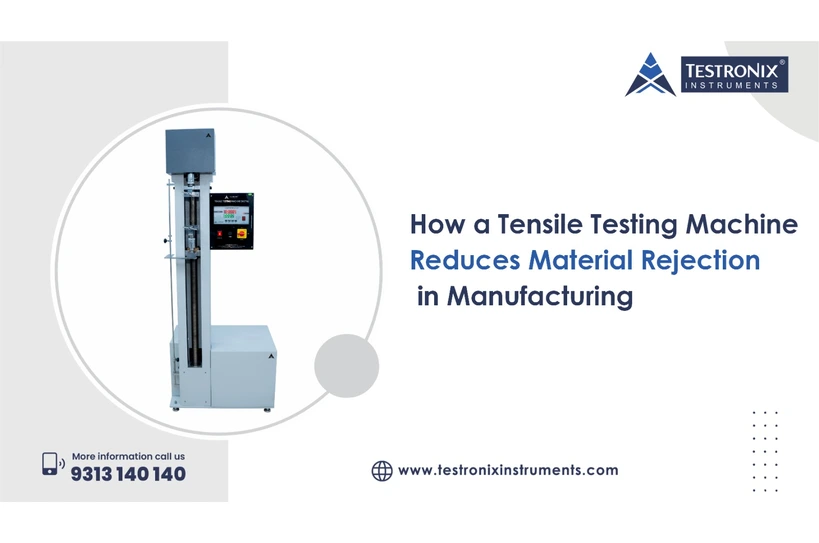
A tensile testing machine addresses how a material behaves under pulling force, with critical data such as tensile strength, yield point, elongation, and breaking load. These are not just numbers on a report. They determine whether a material will hold up under the conditions for which it was selected. When manufacturers have access to this data before and during production, the decisions they make are grounded in fact rather than assumption.
Where Material Rejection Actually Begins
Most manufacturers assume that if a supplier provides a material test certificate, the incoming material is safe to use. This assumption causes more production disruptions than most quality managers would like to admit. A certificate reflects the test results of a specific sample from the supplier’s end. It does no longer account for what passed off to the fabric at some point of storage, transit, or coping with. It additionally does no longer assure that each unit within the brought batch behaves identically to the examined sample.
When materials with undetected mechanical inconsistencies enter production, the consequences are not isolated. A single problematic batch can affect multiple production runs before anyone identifies the source. By then, the rejection volume is significant, and the effort required to trace the root cause adds further strain on the quality team. The only reliable way to prevent this is to test materials independently, in-house, before they move forward in the process.
How Tensile Testing Catch Problems?
Integrating tensile testing into the incoming material inspection process gives manufacturers something invaluable: a point of control before commitment. When a material sample is tested and its tensile properties are verified against the required specification, the quality team has a clear basis for accepting or rejecting that batch. There is no guesswork involved.
This is especially important in industries where material performance is non-negotiable. In metal fabrication, a sheet that does not meet yield strength requirements will deform incorrectly during forming. In wire and cable manufacturing, a conductor that lacks adequate tensile strength will fail under mechanical stress during installation or use. Catching these deviations at the material stage eliminates the downstream rejection that results when unsuitable materials are only identified after processing.
Testronix Instruments, a leading manufacturer and provider of tensile checking out machines, builds device that is well-suitable to lessen these downstream rejections. Their machines are designed to address a wide range of substances and sample kinds, making them a practical fit for manufacturers throughout various manufacturing environments.
Controlling Rejection During the Production Process
Material rejection does not stop at the incoming stage. Even materials that pass initial inspection can produce in-process failures if batch-to-batch variation is not monitored consistently. Different production lots of the same material from the same supplier can exhibit measurable differences in tensile properties. Without periodic testing at defined checkpoints within the production cycle, these variations go undetected until they cause visible failures.
Having a tensile testing machine available on the production floor fundamentally changes how quality teams respond to variation. Instead of waiting for a failure to surface in the finished product, operators can pull samples at regular intervals and verify that tensile properties remain within the acceptable range. When a deviation is detected, the affected batch can be isolated immediately. The problem is contained before it multiplies across further production output.
This level of control is only practical when testing is done in-house. Relying on outside laboratories introduces turnaround times that are incompatible with lively manufacturing choices. By the time an outside lab end result arrives, manufacturing has commonly persevered, and the size of the trouble has grown. An in-house tensile testing machine eliminates this lag entirely.
Strengthening Supplier Accountability with Test Data
One often omitted advantage of in-house tensile trying out is what it does to supplier relationships. When producers test incoming substances independently and keep facts of test consequences over the years, they increase a records-pushed photograph of ways continually every dealer plays. This shifts dealer conversations from anecdotal complaints to documented evidence.
The manufacturer can raise the concern with supporting evidence and work toward a corrective action before it becomes a production problem. Suppliers, aware that incoming material is being tested, are also more likely to exercise greater care in their own quality processes.
The quality of test data generated depends significantly on the accuracy and consistency of the testing equipment. Testronix Instruments has built a strong reputation in this space as a trusted supplier of tensile testing machines that deliver reliable, repeatable measurements. For manufacturers building a supplier evaluation framework around test data, the consistency of their testing equipment is as important as the testing protocol itself.
The Operational and Financial Case for In-House Tensile Testing
Every rejected batch carries a cost that goes beyond the material itself. There is the processing time already spent on it, the machine capacity consumed, the labor involved, and the disruption to the production schedule that follows. When rejection rates are high and recurring, these costs accumulate steadily and quietly erode margins that are difficult to recover.
Manufacturers who introduce structured tensile testing into their quality workflow consistently see a measurable reduction in rejection rates over time. Fewer batches fail mid-process. Fewer finished products are pulled at final inspection. The quality team shifts from constant problem resolution to systematic prevention. This change in dynamic has a direct and positive effect on output efficiency, delivery reliability, and overall production costs.
For manufacturers evaluating testing equipment options, Testronix Instruments stands out as a leading name in the tensile testing machine segment, offering solutions that align with the demands of serious production environments. Their machines are built to sustain regular use, deliver consistent accuracy, and support the kind of high-volume testing that industrial quality control requires.
Conclusion
Material rejection will always be a risk in manufacturing. But it does not should be an out of control one. A tensile checking out system gives manufacturers the approach to verify fabric best at each essential stage of the manufacturing process, turning what changed into previously an unpredictable hassle right into a possible and preventable one.
The manufacturers who see the most regular discount in fabric rejection are not always the ones with the most complicated exceptional systems. They are the ones who test at the right points, act on what the data tells them, and invest in equipment that gives them accurate results every time. In-house tensile testing is one of the most straightforward and effective steps a manufacturer can take toward that goal, and the return on that investment shows up in every production run that goes through without an avoidable rejection.
(DISCLAIMER: The information in this article does not necessarily reflect the views of The Global Hues. We make no representation or warranty of any kind, express or implied, regarding the accuracy, adequacy, validity, reliability, availability or completeness of any information in this article.)
Must Read:
- S Jaishankar: Meet Veteran Diplomat Shaping India’s Foreign Policy
- Top 10 Forex Traders in India – Updated Ranking & Insights
- Charting the IPO Journey in India: Past, Present, and Beyond
- SHIV NADAR: A PHENOMENAL BUSINESS TYCOON