
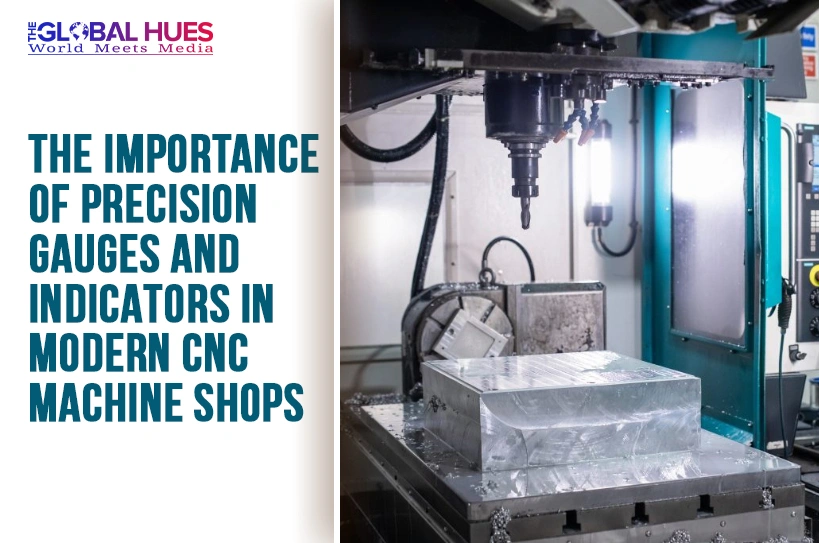
Today’s CNC machine shop is one where tolerances are tighter, production runs shorter and customer expectations higher than ever. Consistent dimensional accuracy is a factor that involves more than advanced machinery and skilled operators it requires precision gauges and indicators that reliably validate performance at each stage of the machining process.
From the initial setup to final inspection, measurement tools are essential for ensuring quality control. Precision gauges and indicators enable machinists discern small variances before they develop into scrap, rework or hitting a due date. Some hundredths of an inch is at most the difference between an acceptable and a rejected part in high-accuracy environments.
Knowing when and how to deploy the appropriate inspection tools is vital for accuracy, repeatability and overall shop efficiency.
Ensuring Accuracy with Precision Gauges
CNC quality control systems start with precision gauges. These provide tangible evidence that machined parts comply with blueprints and are also in tolerance throughout production runs.
Micrometers are perhaps the best known fine measuring tools. Micrometers are used to take extremely precise measurements of outside diameters, thicknesses and other important dimensions. They have fine spindle threads that help with measuring pressure to allow machinists to gather accurate data in tight tolerances.
Micrometers are still commonly used for in-process inspections and final quality checks in today’s CNC shops. For parts that need strict dimensional precision, they are pretty much required as they can measure with more resolution than most general-purpose tools.
In addition to exterior dimensions, internal features also need verification with the same kind of accuracy. The Dial bore gauge is a common tool used to check the internal diameters, roundness, and taper in machined bores. This kind of gauge allows machinists to detect slight variations that might not be immediately obvious but could have a huge impact on how the part works.
When choosing precision gauges, shops should consider:
Measurement Range and Resolution
Machining Tools: Use equipment beyond the tolerance requirements of what parts are being produced. High-resolution gauging increases confidence in inspection results.
Consistency and Calibration
Calibrating regularly helps to make sure the instrument’s readings remain reliable and traceable. A calibration schedule protects quality standards and customer confidence.
Durability in Shop Environments
CNC shops introduce tools to coolant, vibration, and temperature cycles. A good gauge will only be useful if you invest in a well designed, sturdy, durable so that it holds up over time and under wear.
In precision machining, the numerical evidence backing the high-accuracy work is provided by gauges. Without them, shops are forced to guess rather than use things the data can actually measure.
The Role of Indicators in CNC Setup
This is opposed to gauges that confirm dimensions while indicators are key for setup and alignment. Correct machine setup affects cutting accuracy, surface finish and tool life. Even minor misalignments can compound throughout production, causing dimensional drift that results in inconsistencies.
During CNC setup, a test indicator is often used to check if the alignments and runout and flatness are correct. These indicators allow machinists to verify workholding alignment, spindle runout and part positioning before cutting starts. This early tactical deviation detection can help operators adjust criteria to avoid costly mistakes.
Indicators are especially valuable when:
- Aligning on the machine vises or fixtures
- Checking concentricity in turning operations
- Verifying flatness of work surfaces
- Inspecting machine movement and backlash
By using indicators during setup, you help ensuring the machine, tooling and workpiece are on point right from the start of production. This minimizes the chances of chatter, loss taper and tolerance variation.
In high throughput environments setup efficiency is paramount. Indicators enable machinists to ascertain their alignment quickly, without making trial-and-error adjustments. Not only does this increase accuracy, it also reduces downtime and set up time between jobs.
When we build indicators into our standard operations, they become a corrective measure rather than remedial quality control.
Building a Measurement-Focused CNC Workflow
Precision measurement gives the modern CNC machine shop a leg up on their competition. Instead of waiting for failures during the inspection at the end of a run, utilizing gauges and indicators enables problems to be identified early.
Then begin incorporating indicators into all of your setup routines. Check alignment before machining begins and log baseline readings between shifts.
Then, create in-process measurement checkpoints using the micrometers and bore gauges. By tracking dimensions at every stage of production, cumulative errors can be avoided and tool offset to be adjusted before further cuts are made.
Lastly, keep a good calibration program. Even the best gauges and indicators drift over time. Regularly scheduled calibration keeps your measurement system reliable.
CNC shops combine toe and heel devices with setup indicators to a create a holistic approach to quality control, one that respects both efficiency and accuracy.
Conclusion
Precision gauges and indicators are no longer optional pieces of equipment in today’s CNC machine shop; they’re necessities that protect the accuracy and performance. A micrometer offers an extremely fine level of dimensional verification, and a dial bore gauge ensures that the breech face matches with internal features within tight tolerances. At setup time, a reliable test indicator ensures that everything is correctly aligned and helps avoid errors before cutting starts.
Collectively tese tools provide the foundation for a robust quality control process. By investing in precision gauges and indicators and incorporating those into daily operations CNC shops can hold tighter tolerances, eliminate scrap, and ensure they deliver accuracy on demand.
(DISCLAIMER: The information in this article does not necessarily reflect the views of The Global Hues. We make no representation or warranty of any kind, express or implied, regarding the accuracy, adequacy, validity, reliability, availability or completeness of any information in this article.)
Must Read:
- S Jaishankar: Meet Veteran Diplomat Shaping India’s Foreign Policy
- Top 10 Forex Traders in India – Updated Ranking & Insights
- Charting the IPO Journey in India: Past, Present, and Beyond
- SHIV NADAR: A PHENOMENAL BUSINESS TYCOON