
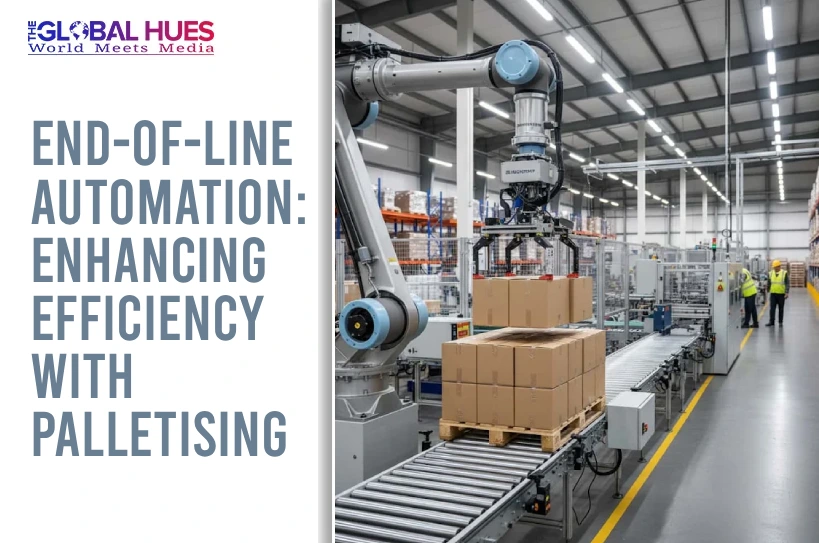
In the fast-paced world of manufacturing and production, efficiency is key. From filling and sealing right through to packing and wrapping, every step on the production line has to be efficient. But it doesn’t end there. After all goods have been processed and packed, the product must be palletised and prepared for dispatch. This is when end-of-line automation becomes vital. Palletising is one of the most vital steps in ensuring products reach their destination safe and sound. This article will discuss end-of-line handling, the benefits of automatically palletising your product, as well as how to integrate palletising systems into your production line.
Understanding End-of-Line Handling: Efficiency Beyond Filling and Sealing
Once products are filled and sealed, they are routed to the end of the line for packaging and shipping. This aspect of production is crucial because it determines how quickly a product will be handled and shipped to its final destination. End-of-line handling is a very important step in the production process because it ensures that products are appropriately packed and labelled before they are shipped. It involves various steps such as sorting, wrapping, and stacking, among others.
End-of-line handling should be done with a lot of precision because of several benefits that come along with it. The first reason is that it ensures products are packaged effectively, thereby reducing damage during transportation. Another reason is that it allows free flow of products within the production process. This means that there are no obstructions in the production process, hence a faster production rate. Finally, end-of-line handling frees the workers from doing strenuous tasks. This can be achieved by using automated systems for wrapping and labelling.
Automated Palletising: Speeding Up Dispatch and Reducing Manual Strain
There are several reasons why the use of automated palletising could be an effective solution for an end-of-line automation application. In this context, it is a useful tool that enables manufacturers to stack products onto pallets with a high degree of productivity and accuracy, while at the same time eliminating the need for manual labour.
It can be used in a variety of applications and is capable of handling different types of boxes and pallets. It can be easily programmed to stack items onto pallets in a manner that ensures stability during transportation.
Moreover, when compared to alternative approaches, it has significant potential to reduce the risks of workplace injuries that may be associated with the manual handling of products. This solution is also capable of operating on a 24-hour basis without requiring any breaks. As such, it can be effectively used in combination with other end-of-line processes and machinery, such as wrapping and labelling equipment, to create productive and cohesive production line configurations.
Integrating Palletising Systems with the Production Line
Integrating palletising systems is not a simple process, and multiple factors need to be taken into account. In order for the production line to function correctly and for all elements to perform effectively, it is necessary to create a fully integrated system. Some of the factors that need to be considered when adding palletising systems are mentioned below.
Firstly, it’s essential to assess the current production line and identify areas where palletising can be implemented. This involves analyzing the types of products being manufactured, the available space, and the existing equipment. Once these factors are understood, manufacturers can select the appropriate palletising systems that meet their specific needs.
Secondly, when choosing equipment, it is necessary to take into account the location and layout of the production line. Ideally, the palletising system should be located so that the distance to it from other technological units is minimal. In addition, it should be convenient to access the system in order to quickly eliminate any problems or carry out necessary adjustments.
Finally, it is necessary to provide training for workers who will work with the new equipment. It is also important to teach them to solve simple problems and know the necessary procedures and algorithms for interacting with it. This will allow them to quickly eliminate problems that may arise and prevent errors and failures.
To find out more about integrating palletising systems and other end-of-line automation solutions, visit stm-pack.com.
(DISCLAIMER: The information in this article does not necessarily reflect the views of The Global Hues. We make no representation or warranty of any kind, express or implied, regarding the accuracy, adequacy, validity, reliability, availability or completeness of any information in this article.)
Must Read:
- Your Custom Home – Careful Considerations
- Innovative Interior Design Trends To Refresh Your Home
- How to Choose Living Room Furniture That Stands Up to Active Lifestyles