
Article Overview:
The data economy is an economic system in which data is collected, processed, analyzed and applied to produce business and economic value. Therefore, data is used by companies to study customers, find new trends, optimize operations, develop goods and services, and make important decisions.
What Is the Data Economy?
The data economy is a concept that refers to the current economic realities generated by the collection, management, processing, and use of data. Simply put, the data economy is the use of data, their processing, and analysis to create value in the form of goods and services. Information initially created by individuals, businesses, and data production systems can be collected and used to identify customer purchasing behavior, determine market trends, optimize internal business processes, create new products, and make more accurate business decisions. Thus, the data economy is an integral part of economic activity in all areas of human life, from online shopping and payment systems to health care, finance, and the industrial sector.
When Satya Nadella said, “Data is the new currency,” we could easily comprehend that data is going to rule the world. What may have simply sounded like a statement about the future is already becoming a reality.
Think about your everyday life. You check the weather forecast on your phone, search for a restaurant, order something online, scroll through social media, search for people in Truecaller, browse new items, book a cab or make a digital payment. All these activities are part of your daily routine, but each one generates some information. What you search for, what you buy, where you go, what you click on and even what you ignore can tell businesses something about your preferences and behaviour.
Now imagine this same activity being done by millions of people across the world, each minute of every day. The amount of information being generated is enormous. This information is being used by different businesses to shape strategies and create business decisions. And that is exactly where the data economy comes in.
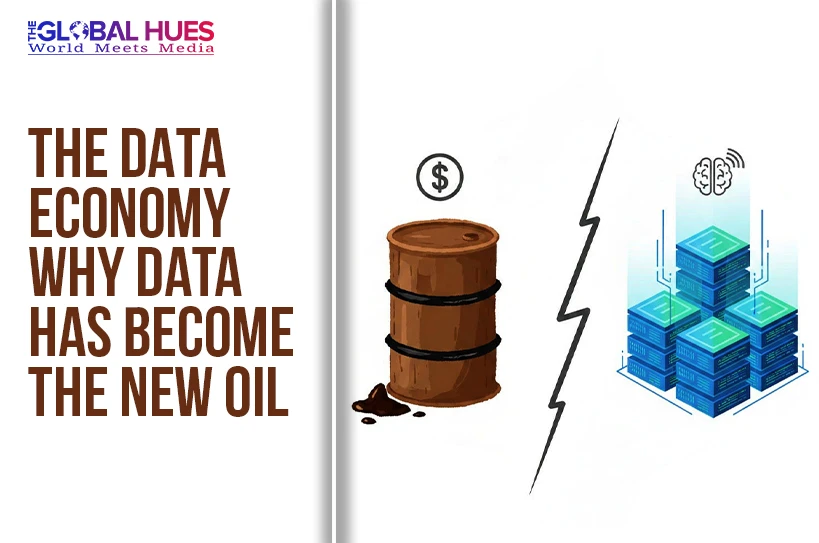
For decades, oil was considered one of the most valuable resources in the world. It was essential for the functioning of many things and contributed to the development of the world. Today, data is considered the new oil since once the data is properly processed, refined and used, it can bring huge benefits for its owner, society or even the whole world. The value of the data is the ability to use it correctly and channelize its energy.
Why Is Data Called the New Oil?
Data is often compared with oil because both can act as valuable resources, provided that they are properly presented in order to perform their functions. The raw material of oil requires extraction and refining before it can be used to power industries. In the same way, raw data may need collecting, cleaning, organising and analysing in order to provide decision-making support. The comparison, as such, is not exact, because oil is consumed when it is used, whereas the same data can be further analysed and utilised multiple times. What makes it different and extremely valuable is that data can provide better decision-making, improved efficiency, and new products and services.
Data has moved: From the back office to the boardroom
There was a time when data was largely treated as something businesses stored for record-keeping and reporting. Today, it has moved much closer to the centre of business strategy. Customers are using data to:
- Understand customers
- Identify market opportunities
- forecast demand
- improve operations
- And make faster decisions
How Do Companies Use Data?
Companies can use data in various ways. Depending on the area of activity, companies analyze different data sets. For example, one can track purchase history to determine which products are popular; one can analyze production data to identify inefficient processes; one can evaluate transaction data to find risks and opportunities. Moreover, companies analyze website traffic data, customer data, sales data, and market data. All this allows you to find out which features are working and what needs to be improved. In any case, the main purpose of data analysis is to extract information that is further used to make decisions.
A retailer, for example, could study the buying patterns of consumers and know what to stock in a certain region. A supermarket could study trends and limit wastage and manage its stock better. A shoe brand could know which design is liked by people so that they can manufacture more shoes in that category. Companies are no longer relying on what the customers say about the product that they want to purchase.. They can also study what customers actually do.
Data and its value
Why do companies value data? Simply because of the possibilities it creates. A retailer, for example, can examine the purchasing patterns of their customers and know which goods will be in demand in a certain locality. A supermarket can analyze sales patterns and minimize wastage and stock-out situations. A shoe manufacturer can analyze and know which styles are selling so that they can decide how much to produce of each category. Businesses are no longer relying on what the customers say they want.
What Is the Value of Data?
The value of data is based on what it can contribute towards a business’s objectives. In this regard, relevant, accurate information may help a company identify customer preferences, eliminate wastage, improve products, manage resources and adapt to market changes. For instance, the information on what items are often bought together can help a retailer improve their recommendation system, while a manufacturer can use data to know where they are wasting time or effort. From these examples, it is evident that data has value when it leads to a certain conclusion or a positive change.
When all of this information is clubbed together, it forms a structured report that helps a business analyse future actions to be taken, which goes directly in favour of what customers like. This can help brands move towards more personalised experiences. Instead of offering the same products and communication to everyone, businesses can use customer preferences to make their interactions more relevant.
How Does Data Create Economic Value?
Data can create economic value by being used by organisations to improve the way they produce, sell, deliver or manage products and services. It can help them reduce costs and time, enable greater productivity and reappraisal of business processes to free up resources, identifying opportunities for new revenue streams and better customer service. At a more aggregated level, it can lead to the development of new digital services, business models and markets, the economic value of data is not just in the information derived, but also in the improvements, innovations and decisions it enables
But data is not valuable simply because there is more of it
The world is generating more data than ever, but does volume guarantee value? No. If the quality of information is poor, it can lead to poor decisions. Outdated customer records, incomplete information, duplicated data or incorrect assumptions can create more problems than they solve. Then comes the data management part.
Companies need to sit and analyse where their information comes from, whether it is accurate, how it is stored and who has access to it. There is equally a need to distinguish between information that is interesting and information that is actually useful.
The question is therefore shifting from “How much data do we have?” to “What can this data help us understand?”
What does the future of the data economy look like?
The next stage in the evolution of the data economy will probably involve more analysis and less gathering of information.
Organizations will want to find ways to combine information from many areas of the business. Information about customers, employees, supply chains, products and markets can help companies understand their business better. It will probably impact everything from products and recruitment to finances and expansion plans.
But here’s one lesson learned from the data economy: having information is not the same as understanding it. A company could have millions of pieces of information and make poor decisions. The value of information lies in finding patterns and asking the right questions and acting on what you find. That is where the comparison between data and oil begins to make sense and where it also falls short.
Oil powered the machines of the industrial economy. Data is fueling the modern economy, but that doesn’t mean that raw data is like oil in the ground or in a database–it has to be refined into something else and put to work in order to have value. The companies that recognize the difference between information and action will be the winners in the future marketplace.
TAKEAWAYS:
- The real value of data lies in how well someone uses and channels it.
- Data is helping power the decisions of the modern economy.
- Businesses should identify meaningful patterns, ask the right questions and act on what the information reveals.
DATA → INFORMATION → INSIGHT → DECISION → VALUE
Related Article:
- India’s Children’s Activities Economy awaits Its Platform Moment
- From Data to Decisions: Enhancing Financial Workflows with Smart Tools
- India’s Digital Economy: The Next Big Wave in Tech Innovation