
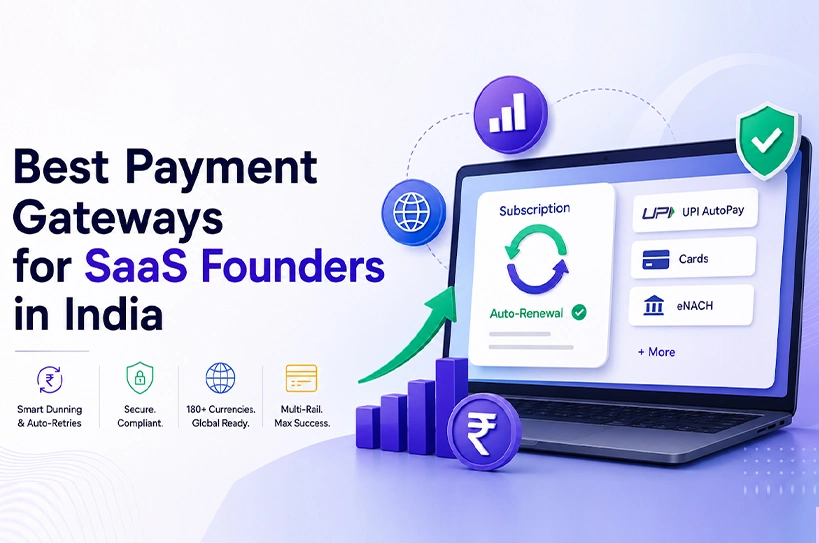
A standard ecommerce gateway handles one-off payments well, but subscriptions break that simplicity. Upgrades, downgrades, prorations, and tokenised retries demand a different class of logic, and only a handful of gateways handle it properly.
Founders often blur the line between a Merchant of Record (MoR) and a localised payment gateway. Platforms like Paddle or Stripe Billing operate as MoRs, which means they take on global tax and legal-entity liability across jurisdictions. That abstraction layer is convenient, but it can eat 5% to 8% of a SaaS business’s revenue. A localised payment stack tied to your Indian entity keeps costs anchored to base TDR fees, so you preserve margin while keeping deep architectural control over the mandate engine.
Quick Comparison: Top Payment Gateways for SaaS Businesses
| Payment Provider | Supported Recurring Rails | Max Auto-Debit Limit | Native Dunning Engine | Direct Webhook Notification | Cross-Border / PA-CB Ready |
| Cashfree | UPI AutoPay, cards, eNACH | ₹15,000 with credit/debit cards | Yes (auto-retries) | Native | Yes (180+ currencies) |
| PayU | Cards, eNACH | ₹15,000 (AFA-free) | Requires middleware | Supported | Yes |
| Zoho Subscriptions | UPI, cards (limited) | ₹15,000 | No | Supported | No |
The Top Payment Gateways for SaaS in India
Cashfree
Cashfree Payments is a trusted name in the payment gateway space, popular amongst tech-first businesses for its pricing, features, and dedicated support. It is also recognised as one of the best payment gateways for SaaS businesses in India, offering a flat 1.6% MDR for all businesses. It gives most SaaS startups same-day go-live without giving up depth or security.
Under the hood it runs a multi-rail mandate engine, so subscription payments and their failures are routed and auto-retried across 180+ payment modes, including:
- Card tokens
- UPI AutoPay
- e-NACH
- Net banking
Dunning is native: Cashfree handles automated pre-debit SMS and email alerts out of the box, and its smart retry logic actively rescues passive churn without an expensive secondary subscription middleware layer like Chargebee. You can configure flat-rate, usage-based, or hybrid overage plans directly, and collect in 180+ currencies with local settlement.
On top of the product, you get a dedicated account manager, on email and chat, who actively helps protect revenue leakage and optimize conversion, which matters when involuntary churn is the quiet killer of SaaS margins.
PayU India
PayU is a comparatively new payment gateway in India, supporting over 150 local and global payment methods. Its key features include:
- Checkout optimisation
- OTP authentication
- Payment success enhancement
- 150+ payment methods
The gap is in subscriptions. PayU’s native subscription management lacks the dunning agility of newer providers, and it is built for the enterprise end, so you will likely need to pair it with an external billing layer to handle complex prorations and automated recovery effectively.
Zoho Subscriptions
Zoho is a common pick for Indian SaaS companies because it handles invoicing, tax tracking, and usage-based metrics well. But it can’t act as a payment gateway on its own, so you need an underlying processor. That two-vendor architecture adds latency between the billing engine and the gateway, especially during webhook events, which can also create reconciliation issues.
What Should SaaS Businesses Look For in a Payment Gateway?
To pick the right gateway, look at how well a provider solves modern, complex billing problems. With customers wanting flexible payment options and secure billing, you need multiple payment methods, reconciliation workflows, an MoR option where relevant, and real dunning.
- API and developer support. Smooth integration speeds things up, and it lets you customise checkout, automate recurring billing, and sync payments with your CRM and analytics.
- Global payments support. For international customers, the gateway should accept local cards, digital wallets, and direct bank transfers, and handle currency conversion at the lowest possible rates.
- Subscription billing management. From automated renewals to proration on upgrades and downgrades, you need refund processing and timely notifications to keep subscribers engaged.
- Security and compliance. The gateway should hold PCI DSS certification and use AI-powered monitoring to catch fraud, keep customer data safe, and stay compliant with data-privacy laws.
SaaS Finance and Engineering Architecture Checklist
Stop treating payments as an afterthought. Start by auditing your current billing infrastructure to expose direct revenue leaks, and review these with your engineering leads:
- Track retry windows. Map your exact dunning intervals. Retrying a payment 12 hours after an insufficient-funds failure yields almost nothing, so schedule retries around typical payroll dates.
- Manage webhook latency. Proration breaks if your gateway’s upgrade webhook reaches your database after the user’s session ends.
- Assess localised pricing pipelines. Forcing USD pricing on Indian buyers hurts conversion, so confirm your gateway supports native INR presentation and settlement without aggressive conversion spreads.
Conclusion
Your payment infrastructure decides whether you keep subscribers. Leaving renewals to a basic processor guarantees involuntary churn and compliance gaps under RBI mandates.
Treat recurring billing as a core feature of your product, and design for multi-rail fallbacks and intelligent retry logic to protect cash flow. Handing margin to high-fee global Merchant of Record platforms erodes profit. For most Indian SaaS companies, the better answer is a localised, agile architecture, which is exactly what Cashfree Payments offers: a robust subscription engine built for same-day go-live, automated pre-debit notifications, and multi-rail fallbacks that help your product retain revenue efficiently.
(DISCLAIMER: The information in this article does not necessarily reflect the views of The Global Hues. We make no representation or warranty of any kind, express or implied, regarding the accuracy, adequacy, validity, reliability, availability or completeness of any information in this article.)
Must Read:
- Your Custom Home – Careful Considerations
- Innovative Interior Design Trends To Refresh Your Home
- How to Choose Living Room Furniture That Stands Up to Active Lifestyles