
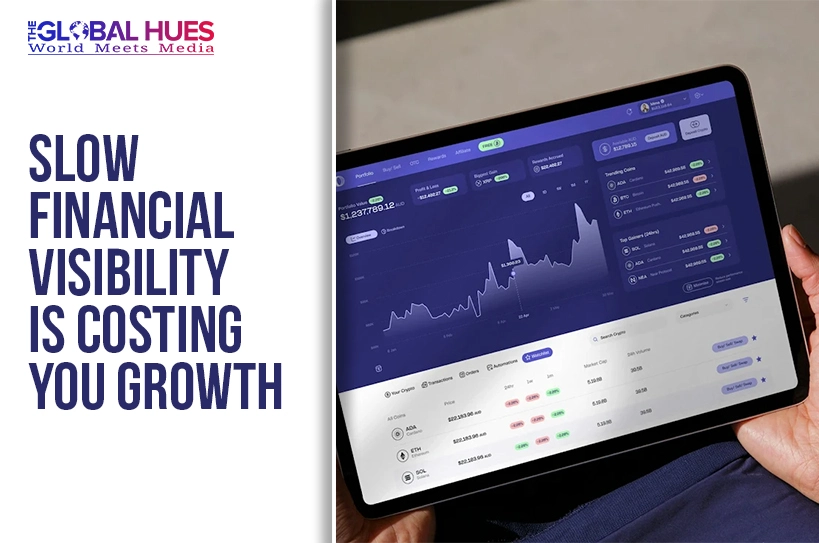
In every expanding company, there will be some lag in accessing financial information. The decision-makers will have to rely on information that is a few weeks old, as the true picture of the financial status is only available once the month-end closing procedure is completed. This may not create any problem in case of a small and well-established company but can become a problem in case of an expanding firm. In an expanding company, the cost of depending on obsolete information rises.
The invisible cost of the month-end wait
The process of month-end closing acts as a built-in rhythm of business process activities; but, it is a costly affair, which is seldom accounted for in any official report. If leaders get accurate financial information after a few weeks from the point in time when it is meant to be reported, then interim decision-making is more of improvisation. Over-costing, declining margins, or liquidity issues can continue for weeks without the knowledge of any leader, by which time a lot of damage might have been done.
It exemplifies the growth penalty in its purest form. A stable company can withstand temporary opacity since monthly variations are small. A growing company cannot stand this kind of opacity since rapid changes in variables such as recruitment, markets, and cost variations make the difference between real growth and fake growth. The monthly delay in assessing the situation will lead to using these variables only after completion of the entire cycle, thus making scaling more difficult and more dangerous.
Why growth makes the delay more dangerous
The connection between financial visibility and growth is not linear and gets more difficult as a firm grows in size. A bigger and growing firm will have more activities, subsidiaries, income streams, and areas of potential trouble that might stay under the radar until the accounts are settled. Therefore, a delay in reporting that was just a small problem before might pose a significant threat after the growth period of the company.
Speed creates yet another risk. With the expansion coming fast, the faster and more critical decisions are becoming, which implies higher costs per decision, based on outdated information. And this fully corresponds to month end close automation as explained by DataRails: faster financial close processes enable finance leaders to reduce reporting delays and support timely, data-driven decision-making without slowing business growth. The companies that succeed in growing are the ones that minimize the difference between the present situation and the awareness of the leadership.
What CEOs actually lose while they wait
It is imperative to outline the implications of being a CEO within the period between the time one makes a decision and sees its impacts in terms of financial data. One of the implications is that there is less room to change strategy while the problem is still small and manageable. The other implication is that there is less willingness to make decisive moves because out-of-date financial data can mean that such actions are simply risks.
There is also a compounding cost in terms of reputation and trust. In cases where the CEO is unable to answer a question from a board member based on up-to-date numbers or takes weeks to figure out that there is a cash flow issue, trust could be lost with stakeholders. Financial leaders interested in knowing how senior executives can stay ahead of the game are beginning to see real-time financial insights not just as a nice-to-have but a must-have for executives.
The close is the bottleneck, not the calendar
Many leaders see the month end as a thing of the past, as it is inevitable and will never change. However, it is not. The delay comes from the time-consuming nature of the financial closing, which is typically marred by manual consolidation, reconciliation, and reporting, and can take days or weeks of highly skilled labor. The calendar is not the real limit; it’s the process. Companies can greatly minimize the time needed for completing the financial close by optimizing that process.
This re-framing alters the entire way a CEO would think about the problem. Leaders can go on the offensive against the lag, rather than taking it for granted. Teams that look to accelerate the entire reporting cycle discover that a significant part of the delay is due to work that is tedious and can be done continuously or automatically instead of periodically. As the close moves from weeks to days, or days to near instant, the growth penalty lowers with it, and leadership can begin to lead based on real-time data.
From periodic snapshots to continuous visibility
The underlying change going on here is a switch from a snapshot view of finance to one that demands constant visibility. The month-end report is a snapshot of an event long passed; what the growing company requires is a form of live stream, whereby the figures are updated as the reality changes and issues emerge immediately, not weeks down the line.
Nowadays, the technology that enables this is available and accessible not only to large businesses but to medium-sized ones as well. Those leaders who tackle issues right away, the moment they happen, as opposed to leaving everything to the end, gain the opportunity to control cost inflation and margin erosion in time. Continuous insight not only speeds up the finance process; it also expands the capabilities of the leadership, transforming the finance operation from a historical record keeper into a live navigation system.
Turning visibility into a growth advantage
When the organization manages to close the gap between event and awareness, visibility will become not just an act of defense but an act of offense. Those executives who will be able to observe the numbers in real-time will be quicker in making decisions, as opposed to their competitors who will have to wait for closing in order to make any moves. Their speed, which was their disadvantage earlier, now becomes their strength.
This is the hidden opportunity in the growth penalty. Companies that view financial transparency as a strategy instead of a month-end exercise will be able to create a sustainable competitive advantage in their growth phase. To the growth-minded CEO, the issue is not whether the firm can afford to implement faster financial transparency but whether it can afford the escalating price of making its decisions based on outdated information each cycle when its faster competitors make their decisions based on current financial data.
(DISCLAIMER: The information in this article does not necessarily reflect the views of The Global Hues. We make no representation or warranty of any kind, express or implied, regarding the accuracy, adequacy, validity, reliability, availability or completeness of any information in this article.)
Related Article:
- Ethical Investing in India – Exploring Faith-Based Investment Options
- The Future of Money: Will India Go Completely Digital?
- How to Improve Your Credit Score: Proven Strategies for Financial Success
- Top 10 Cryptocurrencies to Watch