
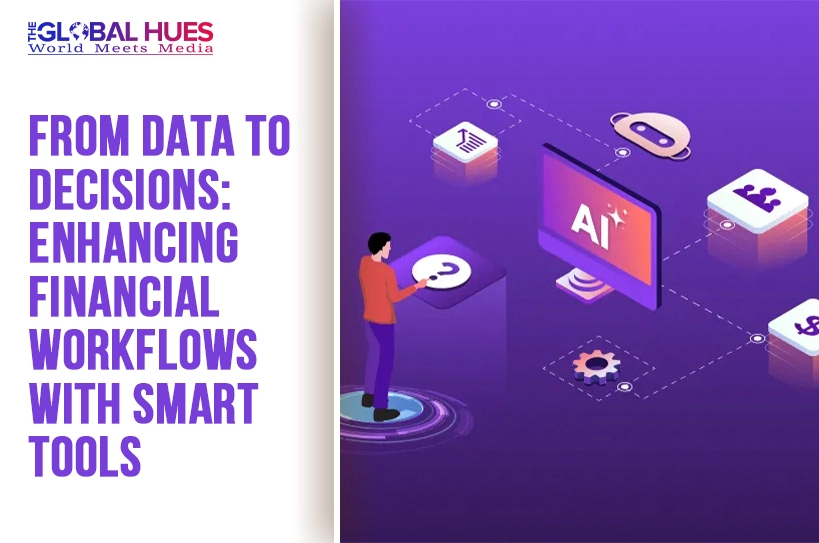
In the modern bustling business world, the burdens of the financial professionals are growing data volumes, sophisticated reporting needs, and the dynamic standards of compliance. Accountants and finance departments should have solutions that facilitate their workflow, aid in accuracy, and help them make timely decisions. Artificial intelligence (AI) in CA is revolutionizing the conventional accounting activities by automating monotonous tasks, processing big data, and offering meaningful insights. These new technologies present professionals with an opportunity to work on the strategic planning, client advisory, and financial forecasting processes as opposed to manual data entry and calculations.
The integration of AI in accounting has redefined how organizations process, interpret, and utilize financial data. By adopting AI tools for CA, accountants can access intelligent systems that detect anomalies, generate reports efficiently, and optimize tax planning. The automation of routine processes not only reduces errors but also saves valuable time, allowing firms to enhance productivity and maintain a competitive edge.
Artificial Intelligence Accounting: Transforming the Accounting Process
The use of AI technologies is transforming the work of chartered accountants with financial data. AI tools used in CA are leading to efficiency, accuracy, and strategic decision-making due to their automation of mundane tasks and the potential to provide predictive insights. Using these smart systems, accountants can use the information to transform data into active intelligence, eliminate manual labor, and concentrate on high-value financial counseling services.
- Automation of Standard Accounting Operations
AI applications can automate tedious functions like invoice processing, categorization of expenses, and maintenance of ledgers. Accountants are able to reduce mistakes and spend more time in areas of strategy by reducing manual input. Automation allows for meeting the requirements of different regulations, automating the bookkeeping process, and improving the general efficiency of the working process, offering an efficient system of financial activities.
- Real-Time Data Analysis
The contemporary AI applications provide real-time financial information analysis, which gives immediate information on the trends in revenue, patterns of cash flows, and expenses. This will help accountants detect anomalies, make predictions, and make timely decisions based on data.
- Theory of Predictive Forecasting and Planning
Through machine learning algorithms, accountants can forecast future trends using historical data. The process of revenue, budgeting, and cash flow forecasts is more accurate, which allows the accountant to make recommendations to the client or management beforehand.
- Improved Audit Preparedness and Compliance
The AI systems keep checking on the transactions in order to observe whether they are in compliance with regulatory frameworks and accounting standards. These tools indicate possible discrepancies, minimize audit risks, and ensure compliance with legal requirements. With their detailed records and the provision of automated audit trails, AI enables open reporting and eases the process of accountants preparing to conduct internal or external audits with minimal detention.
The Proposals of the Integration of AI Tools into Accounting Practices
Implementation of AI in accounting processes offers efficiency, accuracy, and business intelligence as tangible benefits. AI tools for CA increase the productivity of an operation, contribute to data-driven decision-making, and decrease the cost of manual processing.
- Time and Cost Efficiency
The automation of AI saves the time used in repetitive activities, which minimizes human resources and errors. Companies save on labour expenses and speed up processes such as reconciliation, payroll, and report generation. Saving time will enable the accountants to concentrate on strategic work, which enhances the overall productivity and value to the clients.
- Better Precision and Minimization of Mistakes
Manual accounting has a tendency to errors, especially in data entry and calculations. AI technologies reduce human errors because they make sure transactions are legitimate, make consistent calculations, and discover anomalies. Such accuracy will hold compliance, monetary misstatements could be averted, and stakeholders will consider the reporting.
- Solutions that can be scaled to meet the growing firms
AI solutions can be modified to satisfy larger organizations with larger amounts of financial information. Regardless of the number of clients or growth of activities, AI-based workflows are efficient and consistent. Scalability guarantees the ability of businesses to support the increased workloads without reducing the quality or performance.
- Predictive Analytics to Improve the Decision-Making
Predictive analytics enable accountants to make predictions, assess risks, and suggest strategies. The ability to respond to the historical and real-time patterns enables AI to enable the decision-makers to take action instead of responding to it. Data-driven decisions and future insights provide businesses with a competitive edge.
Middle-class Workflow Optimization by AI
In addition to automation, AI is helpful in improving the advanced workflows of accountants who have numerous clients or a complicated financial portfolio. With the incorporation of smart systems, teams are able to enhance economy, detect trends, and maintain service quality consistency.
- Intelligent Expenses Classifier
Transactions are automatically classified into interesting categories by AI algorithms. Correct classification simplifies the reporting process, makes auditing straightforward, and ensures tax reporting is in compliance. Accountants are able to scan through anomalies in an efficient manner as they are able to concentrate on analysis and advisory work as opposed to manual sorting.
- Automated Reconciliation
It is time-consuming to match transactions, invoices, and payments. AI programs can reconcile information in a quick timeframe and exactly, showing the inconsistencies that need to be reviewed. Automated reconciliation saves time, enhances the accuracy of data, and will increase self belief in monetary reporting.
- Budget Tracking Smartness
AI tracks the budgets versus the real spending. The ability assists the accountants to detect over expenditure, possible cost reductions, and nonconformance with scheduled allocations. Smart tracking improves financial management and strategic performance.
- Fraud Prevention and Risk Detection
High-level AI systems identify any suspicious activities that could be associated with fraud or financial misconduct. Transaction history will enable AI to identify irregularities in an accountant early enough to take appropriate actions. Risk management is proactive in order to protect assets, minimize losses, and ensure compliance with regulations.
Conclusion
The growing adoption of AI tools for CA is transforming accounting processes through automation, predictive analytics, and intelligent reporting. These solutions reduce manual workloads, improve accuracy, and provide actionable insights that enable accountants to focus on advisory roles and strategic planning.
Experts like AIAccountant have the possibility to use superior AI-pushed offerings tailored for chartered accountants, permitting computerized workflows, shrewd reporting, and stronger customer advisory. Their expertise allows accounting groups leverage era even as maintaining accuracy, compliance, and economic clarity.
(DISCLAIMER: The information in this article does not necessarily reflect the views of The Global Hues. We make no representation or warranty of any kind, express or implied, regarding the accuracy, adequacy, validity, reliability, availability or completeness of any information in this article.)
Must Read:
- S Jaishankar: Meet Veteran Diplomat Shaping India’s Foreign Policy
- Top 10 Forex Traders in India – Updated Ranking & Insights
- Charting the IPO Journey in India: Past, Present, and Beyond
- SHIV NADAR: A PHENOMENAL BUSINESS TYCOON