
Chromatography remains one of the most important methods in both scientific research and industry. This technique is useful for separating the components of mixtures and analyzing them in detail.
Understanding its principles and processes allows someone to appreciate how substantial it is in biological, chemical, and environmental sciences. Chromatography basics form the foundation for countless analytical procedures used today.
Principles of Chromatography
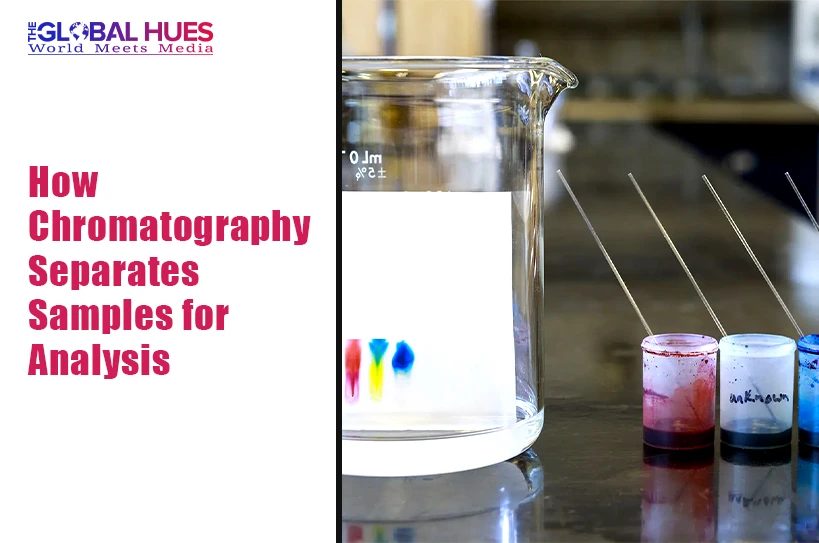
Chromatography is primarily based on the separation of substances moving through stationary and mobile phases. Here, the stationary phase is fixed, and the mobile phase is moving, so the mobile phase transports the sample. Since different components move at different rates, they separate from each other.
Movement speed depends on the interaction of the sample with the two phases. This depends on polarity, molecular size, and solubility. As components separate, they can be collected and analyzed individually.
Types of Chromatography
There are many kinds of chromatography, which are suitable for numerous applications. Gas chromatography, liquid chromatography, and thin-layer chromatography are the more common ones.
Gas Chromatography
In gas chromatography, the mobile phase is a gas. This technique is especially useful for the analysis of volatile compounds. A small sample is vaporized and passed through a column filled with a liquid stationary phase. It involves separation according to boiling point and attraction to the stationary phase.
Liquid Chromatography
As the name implies, liquid chromatography uses a liquid mobile phase. It is suitable for handling a wide range of substances. One of the better-known variations is high-performance liquid chromatography, which offers fast and accurate results. This technique forces the liquid through a tightly packed column with high pressure, allowing relatively quick separation.
Thin-Layer Chromatography
In thin-layer chromatography, a thin layer of adsorbent material coats a glass or plastic plate. The sample is applied at one end, and then a solvent runs across the plate, separating the components based on how much they prefer the adsorbent. Since this method is straightforward and inexpensive, it is mostly used for initial screening.
Applications in Various Fields
Chromatography has many uses in various fields. In pharmaceuticals, it ensures compound quality. It guarantees safety and efficacy by isolating and studying active components. According to the U.S. Food and Drug Administration, analytical methods like chromatography are essential for drug development and quality control.
Chromatography is used to identify pollutants in environmental science. Soil and water samples are analyzed to isolate possible contaminants to help protect the environment.
This technique is used by most food industries for quality control processes. It does so by testing flavors, additives, and possible contaminants to ensure the product meets safety standards. In addition to its use in the fragrance and cosmetic sectors for analyzing complex mixtures and ensuring consistency, chromatography is also used in these industries to research how compounds interact together.
Advancements in Chromatography
Technology always plays a pivotal role in chromatography improvement by making it faster and more accessible. Column materials and detection methods have been innovated to achieve higher sensitivity and speed. Throughput capacity is high because many samples can be processed in parallel with little need for manual intervention by analysts through automated systems.
These advancements have increased the power of the technique to analyze increasingly complex mixtures. These development efforts serve as a means for researchers as well as industries to deliver results with higher precision and efficiency.
Challenges and Considerations
Although chromatography has many strengths, it also presents challenges. Much of the decision-making behind phases and conditions is crucial for achieving optimal separation. Similar properties of compounds can complicate matters, leading to method or material changes.
Advanced systems can have significant cost and resource requirements. Despite this expenditure, it typically compensates in the form of improved analytical processes.
Chromatography is not simply a matter of running a test; it requires training and expertise. Familiarity with the principles and equipment can help produce correct results while doing it effectively. Practitioners need to continue learning and adapting to new technological frontiers.
Conclusion
Chromatography remains a key analytical tool, providing high-resolution separation of complex mixtures. Its versatility and efficiency make it beneficial across a range of scientific and industrial domains. Despite the great strides chromatography has achieved in recent decades, technological progress means that chromatographic techniques will continue to improve and respond to the ever-greater levels of sophistication demanded by researchers and applications.
(DISCLAIMER: The information in this article does not necessarily reflect the views of The Global Hues. We make no representation or warranty of any kind, express or implied, regarding the accuracy, adequacy, validity, reliability, availability or completeness of any information in this article.)
Must Read:
- What Is IT Infrastructure Management? Exploring Its Role in Cybersecurity
- Top 10 Antivirus Programs To Ensure Cyber Threats Protection
- Smart Pumps: The Future Of Fluid Management Systems
- Types of Fire Protection Systems
- Employee Monitoring Software: A Complete Guide to Productivity and Compliance