
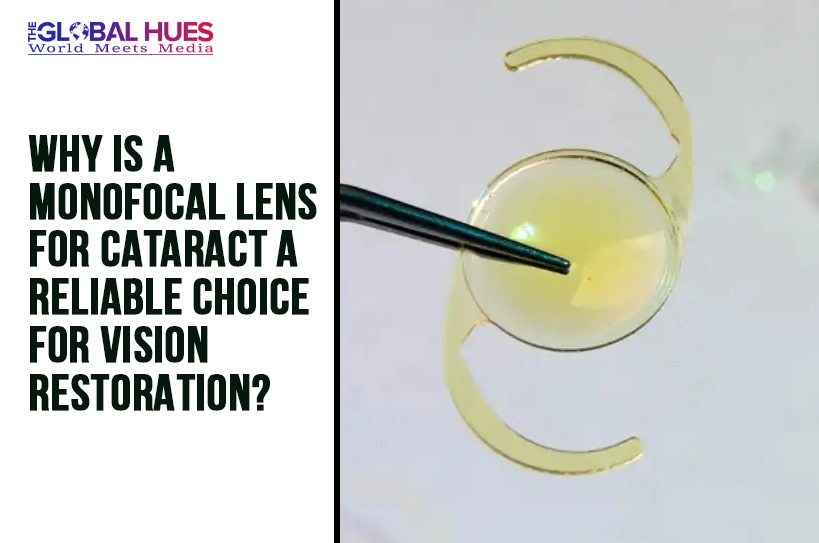
If you have a cataract, do not postpone it. Cataract surgery is the only and best solution to eliminate cataract. It sounds terrifying, but it’s not. The treatment is easy, and it involves a fast recovery. All your ophthalmologist takes out of your eye is the old natural lens, substituting for it a new artificial one. Various types of artificial lenses, which are also called intraocular lenses (IOLs)-are available.
These work like the natural human lens and allow your eyes to see clearly. Monofocal lenses for cataracts are one of the most popular choices for replacing the cloudy natural lens. Depending on your requirements, your doctor may recommend a monofocal lens.
What Is a Monofocal Lens?
A monofocal lens provides clear vision at a single fixed distance. A monofocal lens provides clear vision at a single fixed distance. Although it can be set for different viewing distances, most patients prefer distance vision. The reason behind this decision is that they will be able to see clearly while walking or talking to someone. To perform near tasks such as reading or using your phone, you might experience some difficulty. Specs will be needed in such cases.
Given the simple design of these lenses, they are more affordable than the other options. Therefore, in places like Bihar and UP, monofocal cataract lenses have become a preferred option for a large number of patients, especially from rural parts.
How a Monofocal Lens for Cataract Surgery Works
As you already know, the natural lens is removed from your eye when cataract surgery is performed. This is a permanent replacement where the monofocal artificial lens takes the place of the natural cloudy lens. It works just like the natural lens. Light from all directions is focused onto the retina for clear vision. That is why the patient can once again see.
But one important aspect is associated with the outcome. To ensure the patient has a sharp vision, the doctor must measure the refractive power of the eye accurately. This is done because the monofocal lens has to match the power of the eye. If they do not match, the patient will not be able to see clearly. As long as the procedure is performed properly, patients should get satisfactory results.
What are the Benefits of Monofocal Cataract Lenses
If you have a cataract and need surgery, the doctor will recommend the best solution. However, the doctor will ask for your preferences. Knowing why using a monofocal lens for motiyabind operation is advantageous can help.
1. Excellent Distance Vision
When you are outside and alone, you will need a clear vision at a distance more than at close range. Otherwise, you will find it difficult to walk around, drive, and even recognise people. So, having a clear vision at a distance makes more sense when you are outdoors.
2. Safe Choice
Safety is always a major concern for patients. These lenses have been used to treat cataracts for decades. They offer a stable and clear vision so that people can perform their day-to-day activities. Complaints about complications after the surgery are very rare as well.
3. Minimal Visual Disturbances
Little Visual Interference In general, we also observe that patients with monofocal lenses had better night vision with less glare/halo complaints.
4. Cost-Effective Option
Affordability Monofocals are typically cost-effective compared to premium lens options. This takes them into the reach of many more (like semi-urban and rural Bihar).
5. Suitable for Most Eye Conditions
Sometimes, people suffer from other eye conditions along with cataracts. In such cases, monofocal lenses are recommended by doctors. They are perfect for patients with eye problems such as retinal issues or early glaucoma. The simple optical design of monofocal lenses proves to be more beneficial in these cases.
Limitations to Be Aware Of
While monofocal lenses are effective, they do have certain limitations that patients should understand:
- Dependence on Glasses for Near Vision
Reading glasses are usually required for close work after surgery. - Single Focus Only
The lens cannot switch focus between distances like the natural lens once could.
These limitations are not disadvantages for everyone. Many patients are comfortable using spectacles for reading and prefer the clarity and stability that monofocal lenses provide.
Who Should Consider a Monofocal Lens?
A monofocal lens for cataract surgery is particularly suitable for:
- Elderly patients seeking dependable vision correction
- Individuals comfortable wearing reading glasses
- Patients with other eye conditions where premium lenses may not be advisable
- Those looking for a budget-friendly and effective solution
- People whose daily activities mainly require good distance vision
For many patients in Bihar, where daily life involves outdoor movement, social interaction, and practical tasks, monofocal lenses meet visual needs efficiently.
Life After Monofocal Lens Cataract Surgery
Vision gets better over days to a week after the surgery. The vast majority of people do get a very dramatic improvement in brightness and clarity. Reading glasses are advised after surgery, since distance vision is enhanced but typically not fully corrected. `Look after it and a monofocal lens will last forever and never degrade. Typical eye care and treatment for conditions such as diabetes may allow someone to maintain good vision in the long term.
Making the Right Decision
The Search Process for a Cataract Lens is never in a vacuum. Lifestyle, visual requirements, eye health and cost must all be considered when deciding whether a monofocal IOL is appropriate. Certainly, for those whose preference is for a safe, tried and tested solution monofocal cataract lenses continue to be a sound choice.
Monofocal lens for cataract is therefore one of the reliable options providing clear vision after motiyabind work. Its ease of administration, cost effectiveness and efficacy recommend it for many patients, particularly in Bihar. It may not eliminate the need for reading glasses, but it provides clear distance vision and once patients attain better near vision with time, independence in all their activities of daily living.
(DISCLAIMER: The information in this article does not necessarily reflect the views of The Global Hues. We make no representation or warranty of any kind, express or implied, regarding the accuracy, adequacy, validity, reliability, availability or completeness of any information in this article.)
Must Read:
- S Jaishankar: Meet Veteran Diplomat Shaping India’s Foreign Policy
- Top 10 Forex Traders in India – Updated Ranking & Insights
- Charting the IPO Journey in India: Past, Present, and Beyond
- SHIV NADAR: A PHENOMENAL BUSINESS TYCOON