
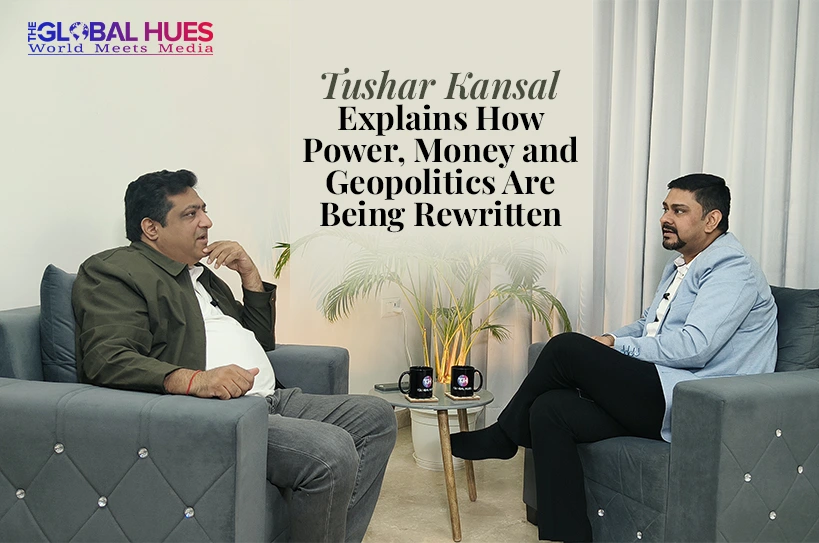
The global order is quietly, but decisively, reshaping itself. Old certainties around power, currency, wars, and wealth are being questioned, and new equations are forming. In a wide-ranging conversation, Tushar Kansal, Founder & CEO of Kansaltancy Ventures, breaks down these shifts with clarity, connecting geopolitics to everyday economics.
With over two decades of experience across corporate finance, entrepreneurship, startup funding, and global investing, Tushar doesn’t speak in abstractions. He speaks in systems, how power flows, how money moves, and why India stands at a critical inflexion point.
The Global Power Game
According to Tushar, the turbulence we see today is not accidental, rather, it’s structural.
“If the US and Europe want to maintain global supremacy, they cannot afford Russia and China being aligned,” he says.
He also explains that historically, the West ensured its dominance by keeping major powers divided. When China emerged as a near-peer competitor to the US, economically and strategically, that balance broke. The Russia–Ukraine war, he believes, is a direct outcome of this tension.
“Russia could never allow NATO at Ukraine’s border,” he says. “For Moscow, it’s an existential issue.”
The war, however, has not played out the way many expected. Europe benefits strategically, the US funds the conflict, and China quietly strengthens its position by backing Russia economically.
China’s Strategy
Tushar draws a sharp parallel between China’s current global expansion and America’s past behaviour.
“China is doing exactly what the US has done for decades, giving loans, funding unproductive projects, and then taking strategic assets when countries can’t repay.”
From ports to mines to airports, China’s lending strategy has translated into long-term control. Over 50 ports globally now fall under Chinese influence, an outcome driven less by ideology and more by cold financial logic.
America’s Limits and the End of ‘World Policing’
The US, Tushar notes, is no longer in a position to police the entire world. This has further led to the discussions around dividing global influence, informally suggesting that China manage Asia while the US focuses on Europe and the Americas. But for countries like India, this raises serious concerns.
“India will never accept Chinese policing,” he emphasises. “The only real answer for India is economic growth.”
India’s Position Is Strong but Not Invincible
Despite global headwinds like pandemics, supply-chain shocks, and funding winters, India has shown resilience. Tushar credits structural reforms such as UPI, Aadhaar, banking clean-up, and digital infrastructure for cushioning the economy. India managed inflation wisely. That’s not accidental, that’s governance,” says Tushar.
He also highlights how consumption-driven growth keeps India moving even when exports face pressure. However, geopolitical realities like tariffs, trade barriers, and currency weakness continue to limit India’s full potential.
Currency, Gold and the Trust Deficit
According to Tushar, “Currency has no value of its own. It runs on trust.” Earlier, countries followed the gold standard, where every currency had gold backing it. This brought discipline to the system and made gold a reliable measure of value. Even as kingdoms rose and fell and currencies disappeared, gold remained relevant because it could be stored, measured, and trusted over time.
After the end of World War II, global power shifted from Britain to the United States. Through the Bretton Woods system, the US made the dollar the world’s main currency and later removed its link to gold. To maintain demand, oil was priced in dollars. This allowed the US to print money without holding equivalent gold reserves, while other countries stored their wealth in dollars and low-interest treasury bonds. “Dollar became the asset, not gold,” Tushar explains.
People’s trust began to crack when Russian dollar reserves were frozen during the Ukraine war. Governments realised that their money was not as safe as assumed and started rethinking their dependence on the dollar. This is why many countries are now buying gold again. “Gold doesn’t depend on promises,” Tushar says, something India has instinctively understood through generations of gold ownership and long-term thinking.
Entrepreneurship Reality Check
Tushar offers a grounded lens on entrepreneurship that moves beyond the startup hype cycle. He believes that building a company is rarely fast or glamorous, and resilience matters more than intent.
He explains, “If you’re doing a startup only to make money, you won’t last. Entrepreneurship is lonely, slow, and demanding.”
Funding is still available, he notes, but investors today are far more selective, prioritising profitability, clarity, and real differentiation over ideas alone. With thousands of startups shutting down every year, failure is no longer an exception but part of the ecosystem’s natural churn.
The Bigger Picture
According to Tushar, India has undeniably historic opportunities, but it demands disciplined execution and policy consistency. “Till 2030, India can be a $10 trillion economy. Growth is not optional, it’s survival.”
As the global system changes and old power structures shift, India’s strength lies in building capability. By strengthening markets and continuing reforms, India has a unique chance to turn global disruption into long-term leadership on the world stage.
Must Read: