
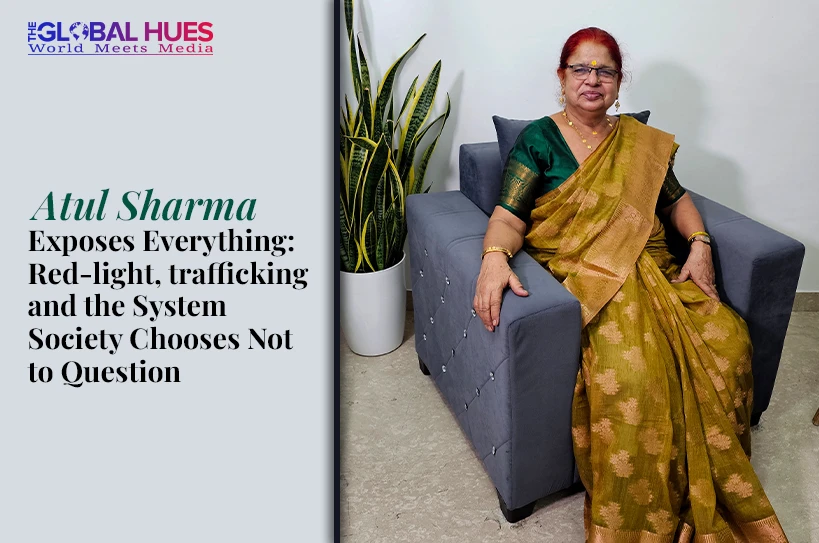
Human trafficking doesn’t operate in the shadows alone; it survives in systems we choose not to question. In a hard-hitting conversation with Atul Sharma, a social worker with over three decades of ground-level experience, The Global Hues goes deeper into the anatomy of India’s red-light networks. This conversation takes us to the uncomfortable truths society continues to ignore.
Red Lights as Signals, Not Just Symbols
The idea of a ‘red-light area’ was never accidental. Historically, red lights were used as deterrents, a visible sign that crossing the line would invite legal, social, and moral consequences. Over time, however, this symbolism has been quietly reversed.
Today, at many places, red light works as an invitation. As Atul Sharma explains, “subtle cues like body posture, positioning and even the manner in which a mobile phone is held, have evolved into coded signals of availability. To the untrained eye, these gestures appear ordinary, but within the ecosystem, they form a language.”
From Trafficking to ‘Choice’
A critical distinction emerges between women who appear to enter willingly and those who are forcibly trafficked. Many young girls, often from middle-class or well-off families, are sent to distant cities under the banner of education. Limited financial support, social comparison, and exposure to unchecked urban freedom create a vulnerability gap. That gap is systematically exploited.
The Economics of Dehumanisation
One of the most disturbing insights that Atul shares is the pricing asymmetry. A girl operating ‘voluntarily’ may command tens of thousands per night. However, a trafficked minor may be sold repeatedly for amounts that barely secure food. This is not just inequality, but it is institutionalised erasure of dignity.
Customers, often from the lowest economic strata, exercise absolute power. Pain becomes demand. Consent becomes irrelevant.
Furthermore, trafficking does not rely on shadows alone, it also relies on logistics. Girls are transported across cities and borders via trucks, highways, and informal transit networks. The same vehicles that display slogans like “Save the Daughter” often carry trafficked minors across states.
Law Enforcement: Knowing Everything but Doing Little
Perhaps the most uncomfortable truth lies here. According to Atul, nothing in this ecosystem functions without local-level consent, implicit or explicit.
Anti-human trafficking units exist largely on paper. Raids happen selectively. Outcomes are transactional. Rehabilitation remains an afterthought. The system, she argues, is not broken. It is functioning exactly as designed.
Why Rescue Is Harder Than It Looks
Contrary to public perception, rescue is not about raids; it is about trust. Many girls resist rescue, not because they want to stay, but because fear has been engineered into them. They are taught that parents will reject them, society will shame them, and survival outside is impossible.
Atul recounts moments where parents stood below, calling their daughters, while the girls refused to come down, terrified that hope itself was a trap.
The Aftermath
Rescue is only step one. The larger failure lies in rehabilitation. While policies exist on paper, like skill training, financial inclusion and institutional support but implementation rarely follows.
Atul shares how lists of rescued women were submitted for government training programs, yet not a single woman actually received training. The process ended in documentation, not delivery. If there is no social acceptance, even employment offers become fragile. Respect is what survivors seek, and this is what society struggles to provide.
The Cost of Speaking Up
This work comes with consequences. Atul has survived physical attacks, constant threats and even prolonged hospitalisation. Yet, she continues, because disengagement would mean surrendering lives back to the system.
Media, ethical police officers, and silent local allies have been crucial enablers. Change, she insists, is impossible in isolation.
A Hard Truth Society Avoids
Trafficking persists not because it is hidden but because it is convenient. As long as victims are labelled, silenced, or morally judged, the system remains intact. The question is not why these girls are there, but why society allows them to be there.
This is not a women’s issue.
This is not a poverty issue.
This is a systemic accountability issue.
Until prevention, rehabilitation, law enforcement, education, and social acceptance align under one intent-driven framework, trafficking will continue to regenerate, city after city, generation after generation.
Must Read: