
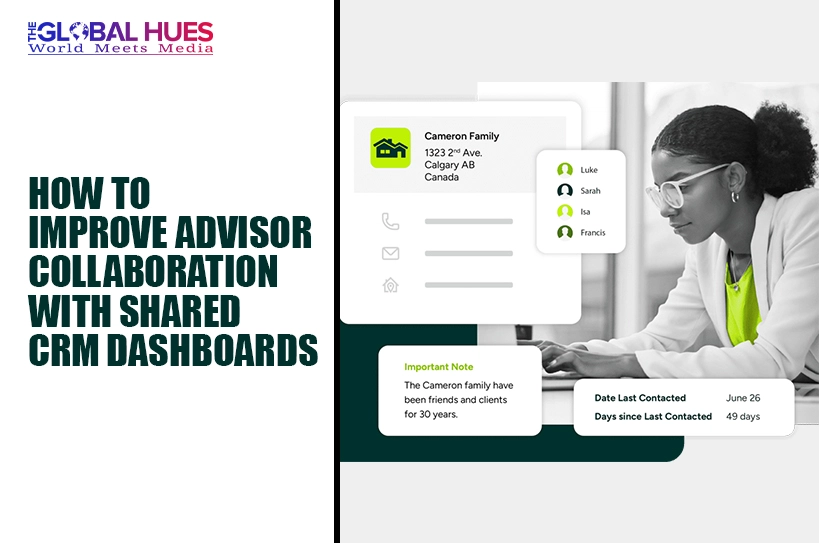
Teamwork between financial advisors is a very important element in the provision of quality client service and business objectives. Having several advisors collaborate would help to avoid miscommunication, increase efficiency, and client satisfaction in case all the people can access the information. Shared CRM dashboard has now become an indispensable resource to facilitate this cooperative process and offer a centralized communication channel where advisors can observe, update and administer client information together. With the help of the appropriate tools, teams are able to develop a more transparent and coordinated workflow.
Shared dashboards also enable the advisors to synchronize their strategies as well as keep track of progress in real time. Rather than using incoherent communication tools, i.e. emails or informal notes, a dashboard will offer a single perspective of client interaction, appointments and milestones. This top-down method minimizes the chances of mistakes being made, makes sure that activities are performed within the required time and generates responsibility in the team. In a financial advisory firm that would consider expanding its operations, the application of a shared CRM dashboard is one of the starting points of a scalable collaboration.
Benefits of Centralized Client Information
One of the short-term advantages of shared CRM dashboards is centralized client information. The fact that all the details of the clients including the contact information up to the performance of their portfolio will be available in one place enables advisors to make quick decisions. Such visibility makes sure that all important updates are not lost and that all the team members are fully aware of all client relationships. The centralized system is also associated with the possibility to track client preferences and history of communication better, which makes the interaction process with clients more personal and productive.
Shared dashboards enhance efficiency by eliminating the possibility of duplicating information. Advisors will not need to go through numerous systems or ask peers to update them. Having instant access to updated information about clients saves time as well as promotes uniformity among the advisory team. This uniformity is especially relevant in the case of more than one advisor working with one client since it helps avoid misunderstandings and proves the high level of professionalism and order.
Enhancing Communication Among Advisors
Shared CRM dashboards help to enhance communication between advisors by giving them a source of truth. Advisors do not have to use informal updates or meetings to provide notes, progress reports, and reminders on the dashboard. This combined strategy will enable the team members to be aware of the client contacts and internal activities without necessarily having to send back and forth messages.
Proactive collaboration is also assisted by the use of common dashboards. The advisors can find the opportunities to meet their clients jointly, organize the follow-up, and be sure that crucial problems are resolved in time. Through the establishment of clear visibility of the activities of each other, teams will be in a position to minimize miscommunication and duplication of efforts. The dashboard is seen as a collaborative workspace where responsibility and spirit of teamwork is promoted in the advisory firm.
Supporting Decision Making
The provision of analytical tools and visualisation that are stored in shared dashboards are useful in decision making. Through centralizing client information, advisors are able to instantly detect trends, assess portfolio performance and rank the needs of the clients. This real time understanding allows the teams to make informed decisions more easily, enhancing the results of the clients and the work of the business.
Moreover, team performance can be tracked with the help of shared dashboards. Managers are able to monitor goal progress, determine bottlenecks, and make sure that resources are well allocated. Such a degree of supervision not only aids in the enhanced decision making but also helps in enhancing the general operation fabric of the advisory practice. Through the appropriate dashboard configuration, advisors are able to save time they would have used in searching information and spend more time advising clients on appropriate decisions to make in their strategy.
Integration with Other Tools
The contemporary shared CRM dashboards are also developed to be integrated with other systems and CRM for financial advisors. This interconnectedness makes information in portfolio management systems, marketing applications and time management applications to easily result in the dashboard. Combination of such systems lowers down the manual work and makes sure that the advisors have a complete picture of their work.
Through a dashboard that integrates with other existing tools, teams will be able to automate repetitive operations and coordinate data across platforms. This integration saves on time and makes people work together as everyone is on the same page and chances of mistakes are minimized. Financial advisory firms that have embraced the most appropriate CRM software with high integration capacity will be in a better position to sustain the advisory process with efficient, coordinated and scalable processes.
Choosing the Right Dashboard
The optimal choice of shared CRM dashboard is needed to maximize cooperation. The advisors are to review dashboards in terms of usability, the possibility of customization, reporting, and integrations. A properly developed dashboard allows the team members to explore the information fast, give a visual representation of the important metrics, and successfully work together without having to go through a lot of training and support.
The selection of the solution that can be integrated into the workflow and the approach to managing clients of the firm should also be considered. The best CRM software to use by financial advisors does not only offer shared dashboards but also enables the sound management of data and compliance. By investing in the correct platform, the collaboration efforts could also be sustainable and the advisors would be able to enhance their teamwork with time.
Conclusion
Enhancing the work of advisors and using common CRM dashboards increases the work efficiency, interaction, and decision-making process in financial advisory teams. Dashboards help clients and enhance operational performance and outcomes as they centralize client data, provide real-time data, and connect with other tools, which contributes to a collaborative environment. Investment firms under financial advisory that invest in the most efficient CRM software and deploy common dashboards are in a position to attain higher productivity and provide more aligned and quality service to customers.
The idea of CRM to help financial advisors achieve a shared visibility and collaborative effort is no longer an option. It has been a compulsory element of the contemporary advisory practices in its quest to achieve growth and sustain a good relationship with its clients as well as operational performance.
(DISCLAIMER: The information in this article does not necessarily reflect the views of The Global Hues. We make no representation or warranty of any kind, express or implied, regarding the accuracy, adequacy, validity, reliability, availability or completeness of any information in this article.)
Must Read:
- Gyandhan: Offering sustainable education financing
- Indian School Finance: Longest-standing flagship investments in education
- P.C. Financial Services: Disbursing unsecured cash loans
- Tushar Kansal Explains How Power, Money and Geopolitics Are Being Rewritten