
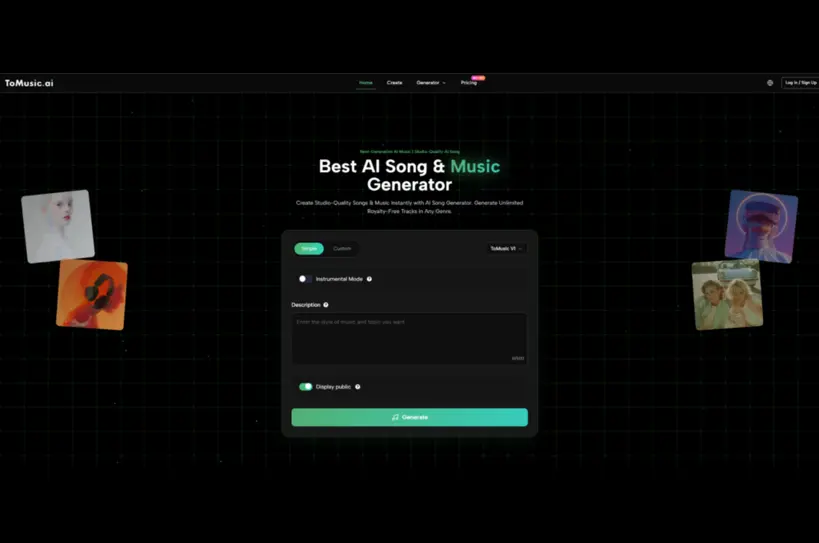
The hardest part of making music is not the tools—it is the distance between an idea and something you can actually hear. Most people stop before they begin, not because they lack imagination, but because the process feels too technical, too slow, or too uncertain. This gap is exactly where an AI Music Generator begins to matter.
Instead of asking users to learn production software, instrument theory, or audio engineering, the system reframes music creation as a language problem. You describe what you want, and the system attempts to interpret and materialize it. In my experience, this shift does not eliminate effort, but it redistributes it—from technical execution to conceptual clarity.
What becomes interesting is not just that music can be generated, but how this changes the starting point of creativity itself.
How Language Becomes Musical Structure Internally
At a surface level, text-to-music sounds simple. But underneath, several transformations are happening.
From Descriptive Words to Acoustic Parameters
When you input something like “soft piano with emotional tone,” the system does not treat it as abstract poetry. It maps:
- “soft” → lower velocity, reduced dynamic range
- “piano” → specific instrument timbre
- “emotional” → slower tempo, minor key tendencies
This translation layer is where most of the perceived intelligence comes from.
From Parameters to Compositional Logic
Once interpreted, the system assembles:
- chord progressions
- melodic contours
- rhythmic patterns
These are not random. They follow patterns learned from large-scale musical data.
From Structure to Final Audio Output
Finally, everything is rendered into a waveform:
- instrument layers are stacked
- vocal synthesis may be applied
- the result is exported as a complete track
What users receive is not a sketch, but something that feels finished.
What Actually Happens When You Use It
The workflow is surprisingly short, but each step carries weight.
Step One Define Musical Intent Clearly
You either:
- write a short descriptive prompt
- or input structured lyrics
The more specific the description, the more predictable the output becomes.
Step Two Adjust Core Musical Constraints
You can typically choose:
- style (pop, cinematic, lo-fi)
- mood (dark, uplifting, calm)
- presence of vocals
These are not just filters—they influence the internal generation path.
Step Three Generate And Compare Variations
The system produces multiple versions. In practice:
- results vary significantly even with the same prompt
- selecting is part of the process
- iteration improves alignment
This makes the workflow closer to “curation” than “construction.”
What Feels Different Compared To Traditional Production
The difference is less about speed and more about direction.
Traditional Workflow
- idea → technical execution → refinement → output
AI-Assisted Workflow
- idea → multiple outputs → selection → refinement
The inversion is subtle but important. You are no longer building from zero—you are choosing from possibilities.
Comparison With Conventional Music Creation Methods
| Aspect | Traditional Production | AI-Based Generation |
| Skill Requirement | High (DAW, theory) | Low to moderate |
| Time To First Output | Hours to days | Minutes |
| Iteration Cost | High | Low |
| Creative Control | Precise but manual | Indirect via prompts |
| Output Variability | Limited by effort | High by default |
This comparison is not about superiority. It shows a shift in how effort is distributed.
Where This Approach Works Particularly Well
Content Creation Environments
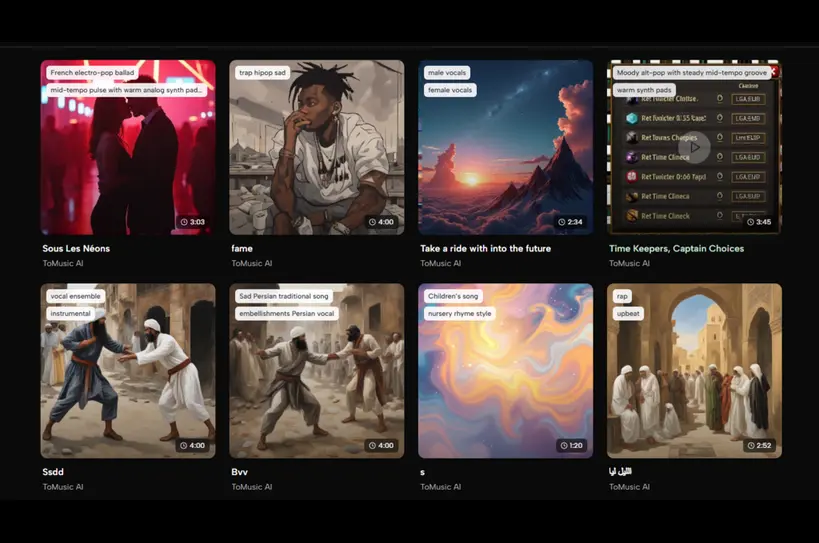
Short-form video creators often need:
- fast turnaround
- unique background music
- consistent tone
This workflow aligns naturally with those needs.
Early-Stage Idea Exploration
Instead of imagining how something might sound, you can:
- generate multiple interpretations
- evaluate direction quickly
This reduces uncertainty in early creative phases.
Non-Musicians With Strong Narrative Ideas
People who think in stories rather than sound can:
- express emotional intent
- rely on the system for execution
This opens a previously closed domain.
Limitations That Become Noticeable Over Time
No system fully replaces intentional composition.
Prompt Sensitivity
Small wording changes can produce large differences. This makes:
- consistency harder
- repeatability less predictable
Structural Control Is Indirect
You cannot always specify:
- exact chord changes
- precise arrangement timing
Control exists, but it is mediated through language.
Quality Requires Iteration
In my testing, the first result is rarely the best. It often takes:
- several generations
- minor prompt adjustments
before something feels usable.
Why This Matters Beyond Music Tools
The deeper implication is not about music—it is about interfaces.
We are moving from:
- tool-based creation (buttons, timelines)
to:
- intent-based creation (language, description)
Music is just one example. The same pattern is appearing in:
- image generation
- video synthesis
- code generation
What changes is not just output speed, but how humans think about making things.
A Subtle Shift In Creative Ownership
When you generate rather than construct, authorship becomes layered:
- you define intent
- the system defines execution
- you select outcomes
This creates a hybrid form of authorship that feels different from traditional creation.
It is neither fully manual nor fully automated.
Where This Might Be Going Next
Based on current behavior, future systems may:
- allow finer structural control through language
- maintain consistency across multiple generations
- integrate editing rather than full regeneration
If that happens, the gap between idea and production may shrink even further.
What Remains Constant Despite The Change
Even with automation, some things do not change:
- clarity of intent still matters
- taste still determines selection
- iteration is still required
The tool changes the path, but not the need for judgment.
A Practical Way To Think About It
Instead of asking whether this replaces music production, it may be more useful to see it as:
- a fast prototyping layer
- a creative amplifier
- a translation system between language and sound
In that sense, the real value is not the music itself, but the reduction of friction between imagination and output.
(DISCLAIMER: The information in this article does not necessarily reflect the views of The Global Hues. We make no representation or warranty of any kind, express or implied, regarding the accuracy, adequacy, validity, reliability, availability or completeness of any information in this article.)
Must Read:
- S Jaishankar: Meet Veteran Diplomat Shaping India’s Foreign Policy
- Top 10 Forex Traders in India – Updated Ranking & Insights
- Charting the IPO Journey in India: Past, Present, and Beyond
- SHIV NADAR: A PHENOMENAL BUSINESS TYCOON