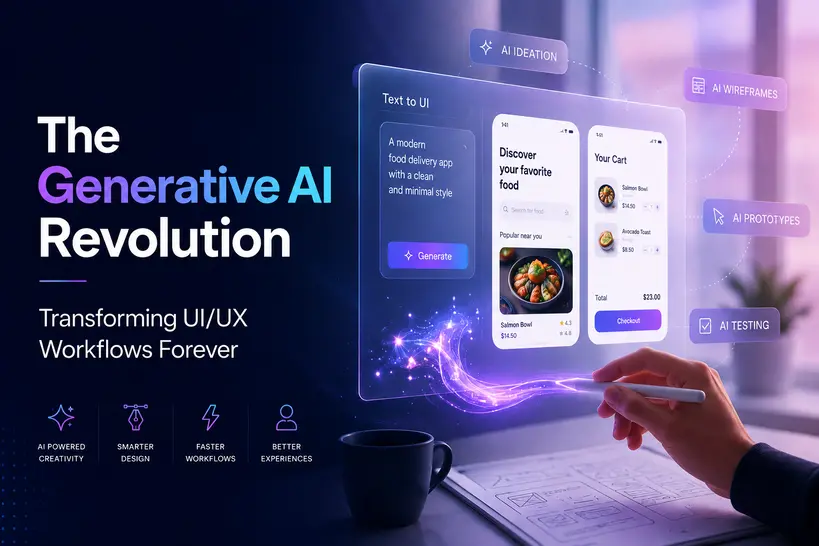
Digital products are evolving faster than ever, and design teams feel the constant pressure to create better user experiences in less time. Traditional design processes that once took weeks are now accelerated by generative AI tools that can produce layouts, wireframes, prototypes, and content within minutes.
This paradigm shift is completely revolutionizing the contemporary UI/UX workflow. No longer are designers limited to a manual approach to work. Rather, they have intelligent machines working for them in carrying out repetitive functions.
89% of creative pros surveyed by Adobe reported better outputs when using AI in design. They highlighted considerable improvements in speed, productivity, creativity, workflow, and other aspects.
The future of UI/UX design will not be driven solely by automation. It will depend on how effectively human creativity and artificial intelligence collaborate to build smarter, more meaningful experiences.
How Generative AI is Reshaping UI/UX Workflows
The use of AI in the design process is revolutionizing all stages of the design life cycle, from research and ideation to prototyping and testing. In doing so, it speeds up processes while reducing repetitive work.
Generative AI technology is currently influencing design processes by automating wireframes, generating designs, and optimizing UX. This means that designers’ problem-solving skills and interactions have been influenced as well.
Previously, designers would spend long hours tweaking designs, making variations, and writing manual interfaces. Currently, AI can produce these designs based on the prompts provided.
This shift enables designers to focus more on strategic thinking and user behavior, rather than spending excessive time on production tasks.
Faster Ideation and Prototyping
With the advent of AI-based prototyping tools, the following are possible:
AI-powered prototyping tools can now:
- Wireframe creation through textual prompts
- Generation of visual designs
- Creation of interactive prototypes
- Generation of design alternatives
- Suggestions for responsive designs
This significantly reduces the time required to move from concept to prototype.
The process of going from idea conception to prototype creation is considerably shortened.
Smarter Design Collaboration
Today’s product design involves collaboration among designers, developers, marketing personnel, and product managers. Better collaboration is now being fostered through automated UI/UX processes driven by artificial intelligence.
AI tools can help generate:
- Design specifications
- Component documentation
- UX content recommendations
- Accessibility suggestions
- Interaction behavior summaries
This leads to better cooperation between designers and developers and reduces the risk of misunderstandings when implementing the product.
For businesses investing in professional UI/UX design services, these workflow improvements can accelerate product delivery without compromising usability or visual quality.
The Rise of AI-Powered User Experience
The emergence of AI-driven UX is turning into one of the most important developments in the domain of digital product creation. In contrast to static interfaces, businesses have begun developing adaptive interfaces that adjust in real time to users’ activities.
The use of generative AI enables applications to deliver personalized interfaces tailored to users’ preferences.
This creates experiences that feel more intuitive and engaging for users.
Personalized Digital Experiences
Many modern applications already rely on AI to improve user engagement. Streaming services, ecommerce platforms, and productivity tools use intelligent systems to dynamically customize experiences.
AI-powered personalization can help:
- Recommend relevant content
- Adjust user interfaces based on behavior.
- Improve onboarding experiences
- Predict user actions
- Deliver contextual recommendations
This level of customization would be difficult to achieve manually at scale. Using generative AI, highly customized experiences can be developed without significantly adding to design teams’ workload.
As user expectations continue to rise, personalized experiences will become a standard part of future UI/UX workflows.
Improved Accessibility and Usability
The field of accessibility is another area where AI has improved the user experience.
Using AI, designers can identify usability problems, find accessibility issues, and propose solutions before creating products.
For example, AI systems can assist designers by:
- Detecting a lack of color contrast
- Recognizing poorly readable text
- Recommending accessible fonts
- Designing in a way that makes it easy to use a keyboard
While human review is still necessary, AI can significantly speed up accessibility testing and improve design quality.
Why Human Creativity Still Matters
As automation becomes increasingly important, generative AI cannot completely replace human designers.
UX design requires empathy, emotional intelligence, and critical thinking skills that only humans possess. AI may be able to create designs, but it lacks the ability to comprehend emotions, cultural significance, and storyboarding that designers can.
This is precisely why innovations in UX through AI should be seen as a partnership.
Designers still play a central role in:
Understanding Human Behavior
Great user experiences are founded on the actual needs of humans. Designers study, analyze, and gain insights into behavior patterns that AI cannot fully understand.
Human intelligence is vital to designing experiences that are genuine and emotional.
Maintaining Brand Identity
At times, AI design can come off as impersonal and predictable. The designers need to ensure the interfaces are consistent with the brand’s voice and identity.
Human resourcefulness is key to successful branding initiatives.
Making Ethical Design Decisions
AI-generated systems also raise ethical concerns around privacy, bias, and transparency.
Designers must evaluate how AI impacts users and ensure that products remain ethical, accessible, and trustworthy.
This responsibility will become increasingly important as AI adoption grows across digital platforms.
UX Innovation with Artificial Intelligence
The next generation of digital experiences will move beyond traditional interfaces. AI is introducing entirely new ways for users to interact with technology.
Voice interactions, conversational interfaces, predictive systems, and adaptive layouts are already changing modern product design.
These innovations are shaping the future of UI/UX design in several important ways.
Conversational Interfaces
The intelligence of chatbots and assistants is increasing, making them more aware of the contexts of conversations. Interaction is no longer limited to menu options; it can now be done using natural language.
More intuitive digital interactions, with minimal friction, result from such advancements.
Predictive User Experiences
AI systems can predict users’ future needs. Such applications will provide recommendations about taking shortcuts and automating tasks that can be repeated.
Predictive experience enables users to accomplish their tasks much more quickly and significantly improves usability.
Adaptive Interfaces
Future interfaces may automatically adjust layouts, navigation structures, and content presentation based on individual user preferences.
This level of adaptability will become a major competitive advantage for digital products.
Challenges of AI-Powered UI/UX Workflows
Although generative AI offers significant benefits, organizations must still carefully address several challenges.
Risk of Over-Automation
Excessive use of AI technology may result in a design that is repetitive and lacks authenticity. This may happen when the team relies entirely on automated software output.
Data Privacy Concerns
AI-powered personalization often depends on large amounts of user data. Companies must handle this data responsibly and maintain transparency with users.
Bias in AI Systems
Machine learning algorithms use existing data sets. These data sets might be biased and, therefore, produce AI-based experiences that may exclude or discriminate against particular groups of people.
Human review remains critical to ensure fairness and inclusivity.
The Future of UI/UX Design
The future of UI/UX workflows will be shaped by collaboration between humans and intelligent systems.
Designers who learn how to work alongside AI tools will gain a major advantage in the evolving digital landscape. However, technical knowledge alone will not define success.
The most valuable professionals will combine:
- Creativity
- User empathy
- Strategic thinking
- Accessibility expertise
- AI fluency
- Behavioral understanding
Generative AI will continue to automate production tasks, but human-centered design will remain the foundation of great user experiences.
Final Thoughts
The advent of generative AI is revolutionizing the design and development of digital products in many ways. The use of AI in UI/UX enables teams to build prototypes more quickly, personalize their products more effectively, and collaborate across departments.
At the same time, the human side of design remains irreplaceable.
Empathy, creativity, storytelling, and ethical thinking are still essential for building experiences that truly connect with users.
The future of UI/UX design will not belong entirely to humans or machines. It will belong to teams that understand how to combine both intelligently.
As AI technology continues to evolve, businesses that embrace thoughtful and responsible innovation will lead the next generation of digital experiences.
(DISCLAIMER: The information in this article does not necessarily reflect the views of The Global Hues. We make no representation or warranty of any kind, express or implied, regarding the accuracy, adequacy, validity, reliability, availability or completeness of any information in this article.)
Must Read:
-
From Influencer to Creator-CEO: How AI Infrastructure Is Reshaping Content Entrepreneurship
- Your Custom Home – Careful Considerations
- Innovative Interior Design Trends To Refresh Your Home
- How to Choose Living Room Furniture That Stands Up to Active Lifestyles