
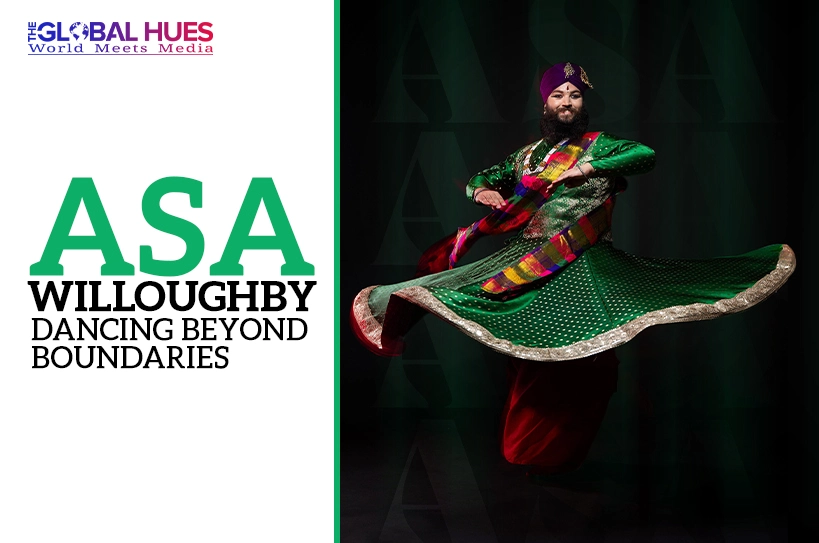
Some journeys begin with curiosity. Others begin with calling. For Asa Willoughby, dance entered his life early and stayed, not as a phase or an interest, but as a steady presence that would shape who he is.
Asa was only fourteen years old when he began his training in Kathak under Anuradha Chaturvedi Seth, a senior disciple of Pandit Arjun Mishra of the Lucknow Gharana. It was a blessing for him, as Asa says, to learn within a living tradition that came directly from the cultural heart of Lucknow.
Discovering Bharatnatyam
Just a year later, he began training in Bharatanatyam under Ananya Chatterjee, a disciple of Smt. Thankamani Kutty, who runs Kalamandalam Kolkata. While Kathak, on the one hand, grounded him in the North Indian classical tradition. On the other hand, Bharatanatyam introduced him to a different energy altogether.
Now 31, Asa has been dancing for more than half his life. He has spent time learning under Sujata Banerjee in London, trained directly under Smt. Thankamani Kutty in Kolkata, and is currently continuing his Bharatanatyam training under Marcia Madhavi Mai in the United States.
The struggles and hardships
Asa’s journey has not been an easy one. From the very beginning, he stood out as he was often the only male student in the room. As he grew older, this difference became more pronounced. Dance spaces demanded discipline, but they also came with unspoken rules, especially around gender. Asa felt the need to respect South Asian cultural norms of separation and modesty, which made it difficult to form friendships or feel a sense of belonging within these spaces.
Faith, identity and visibility
“When I was 14, I also converted to Sikhism and by 21, I started wearing a turban in accordance with my faith. So not only was I singled out as a man, but I was also now a turbaned dancer, which is unheard of,” says Asa.
Asa’s masculinity was questioned openly and repeatedly. People made assumptions about his sexuality. Some told him he was an insult to Sikhs and demanded that he remove his turban. Others said dance was meant for women and that men could never have the same grace. He was told that male dancers should be hairless, clean-shaven, and fit a certain image if they wanted to perform on stage.
Asa explains, “There is often still a bias towards South Indian upper caste women in dance spaces, even in the diaspora, and this is also a barrier.”
Yet, Asa did not walk away. Instead, he stayed. He trained. He listened. He refined his art. He continues to learn and evolve. He is currently retraining in the Kalakshetra style of Bharatanatyam and speaks of the process with honesty and joy. Retraining, for him, is not about discarding what he knows, but about deepening his relationship with the form.
Looking ahead
Asa believes, “Dance is a form of Sadhana for me, and I hope to continue allowing it to enrich my life.” He hopes to continue training and performing, allowing the art to grow with him.
Asa’s journey teaches all of us that sometimes, simply staying, continuing, and showing up is the most powerful statement of all.
Must Read: