
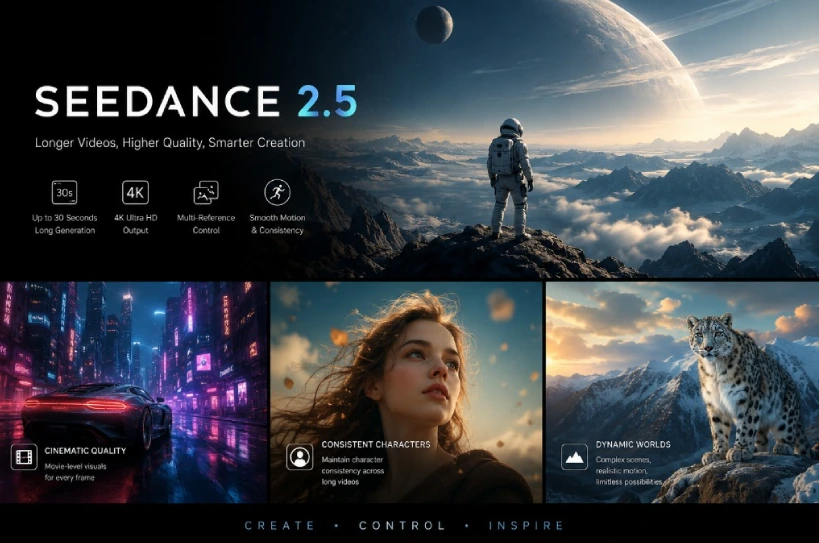
The single biggest variable in paid advertising performance is creative quality. Media buyers know this. Brand managers know this. And yet the creative production process at most marketing teams remains a bottleneck that limits how many concepts get tested, how quickly campaigns can be refreshed, and how well the final output actually reflects the strategic brief.
The conventional workflow — brief to agency or freelancer, rounds of revision, production timeline, final delivery — is too slow, too expensive, and too inflexible for the testing velocity that modern paid advertising demands. By the time a creative concept has been produced, tested, and found to be underperforming, the campaign budget has already been spent on it.
Why the 50-Reference System Changes Paid Ad Creative Production
The reference input architecture of Seedance 2.5, accessible through Pollo AI, directly resolves the long-standing brand consistency problem that has restricted AI video adoption in professional advertising scenarios. For a complete paid ad campaign, marketing teams require three core layers of visual and stylistic consistency.
First, character consistency. Earlier AI systems struggled heavily with this because each generation was effectively stateless, lacking a reliable mechanism to keep character appearance uniform across multiple outputs. Seedance 2.5’s 50-reference input system provides comprehensive visual specifications for brand spokespersons, user archetypes or animated mascots before generation, performing far more reliably than text-only descriptions.
Second, environmental consistency. For campaigns set in fixed scenes such as kitchens, gyms, outdoor locations or retail spaces, reference images of the target environment combined with atmospheric text prompts enable Seedance 2.5 to maintain cohesive, continuous settings across an entire creative series.
Third, camera movement and compositional style, an often overlooked but critical element. Camera language directly shapes brand personality: premium brands use slow, deliberate shots, while youth-oriented brands favor dynamic handheld motion. Reference video clips give the model a clear behavioral template to replicate the desired shooting style precisely.
Step-by-Step: Building a Paid Ad Creative System With AI
Step 1 — Translate Your Creative Brief Into Reference Architecture
Before opening any generation tool, convert your creative brief into a structured reference set. Identify the character profile your campaign requires and source or create reference images that establish appearance from multiple angles. Identify the environmental contexts your campaign will use and source reference images for each.
Identify the camera style and compositional approach your brand requires and locate existing video clips — from your own archive or from reference material — that exemplify it. This translation step is where the quality of your final output is largely determined.
Step 2 — Configure Seedance 2.5 in Pollo AI With Your Full Reference Set
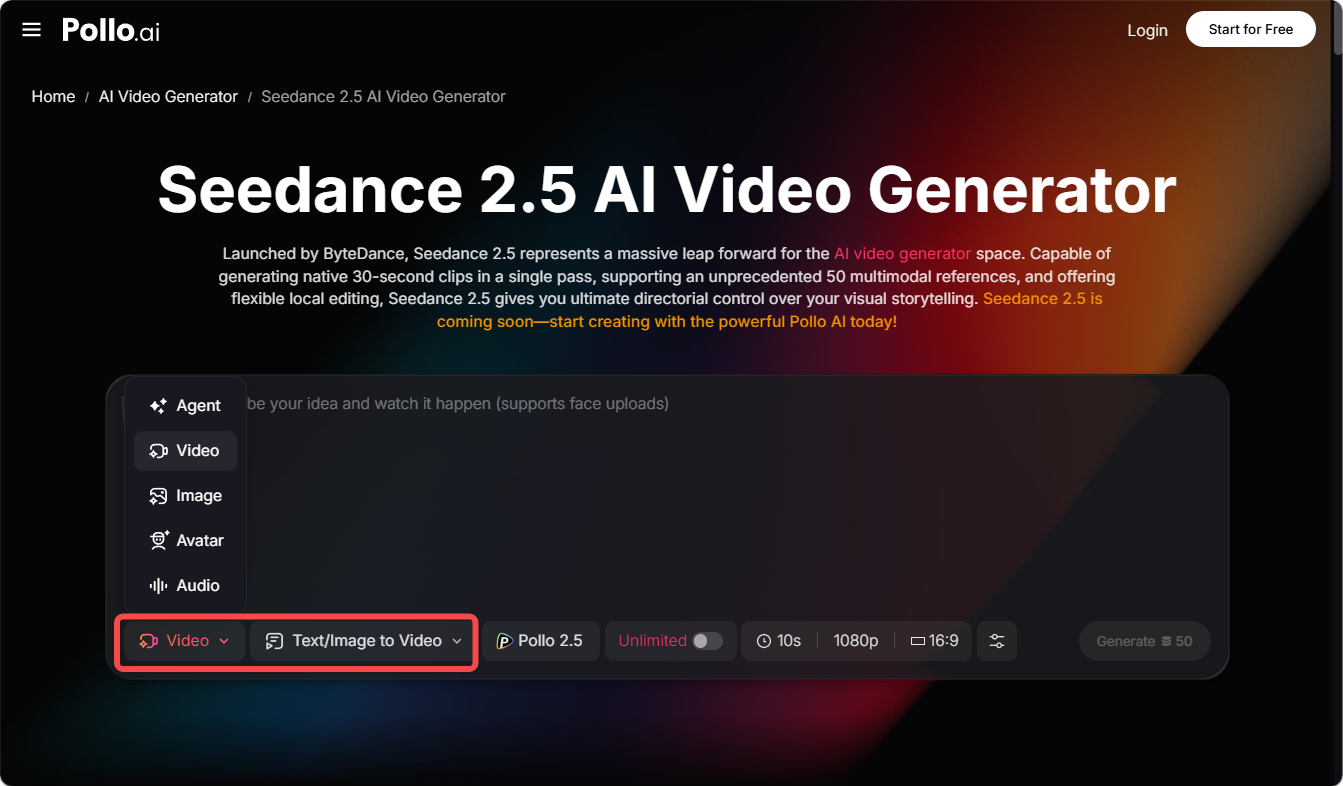
Upload your assembled references into Pollo AI and configure your Seedance 2.5 generation with the complete reference architecture. Organize your references by type — character, environment, camera style — and weight them appropriately based on which consistency requirements are most critical for your specific campaign.
Write your generation prompt with the specificity that the system’s improved instruction fidelity can now reliably execute: describe character action, product interaction, scene progression, and atmospheric qualities in precise, concrete language rather than general creative direction.
Step 3 — Generate, Evaluate, and Refine Your Core Creative Asset
Generate your initial video and evaluate it against the consistency requirements established in your brief. Assess character appearance fidelity, environmental coherence, camera movement alignment, and the naturalness of physical effects and character motion throughout the full clip.
Use the localized lossless editing capability to refine specific elements — product placement, background details, lighting quality — without regenerating the foundational scene. This iterative refinement process is significantly faster than traditional revision cycles because it targets specific elements rather than requiring complete reproduction.
Step 4 — Produce Campaign Variations for Testing
Once your core creative asset meets brand standards, generate the variation set your testing strategy requires. Adapt the core scene for different product variants, different character actions, different atmospheric moods, or different platform format requirements.
For each variation, maintain the reference architecture that ensures brand consistency while adjusting the specific elements you are testing. This systematic approach to variation production is what makes AI-powered creative testing genuinely more efficient than traditional production — not just faster, but more structured and more analytically useful.
Step 5 — Extend Your Content Mix With Script to Video AI
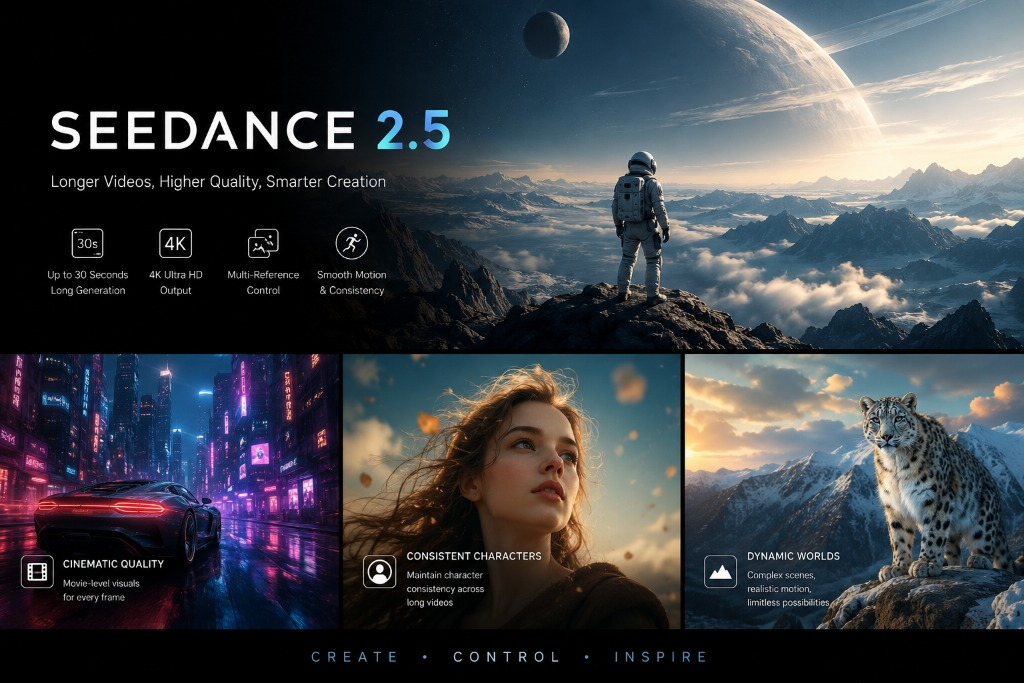
For marketing teams that need to produce narrative-driven ad formats alongside lifestyle and product-focused video, Pollo AI’s Script to Video AI capability completes the production toolkit. Marketing scripts — whether for product explainers, brand story content, or educational advertising formats — are converted into complete narrated videos with automatic vertical format adaptation for TikTok and Reels, multilingual voiceover options, and integrated music selection.
This means a single platform handles both the high-control, reference-driven production that brand advertising requires and the script-driven narrative production that content marketing demands.
FAQ
How does Seedance 2.5 compare to other AI video generation models for paid advertising use cases?
The primary differentiators are the fifty-reference input capacity, the thirty-second native continuous output, and the localized lossless editing capability. Together, these features address the brand consistency and iteration efficiency requirements that professional advertising production demands — requirements that most general-purpose AI video tools are not specifically engineered to meet.
What types of paid ad formats benefit most from AI video generation?
Short-form vertical video for TikTok and Instagram Reels, product lifestyle videos for marketplace advertising, and brand awareness clips for YouTube pre-roll are the formats where AI generation delivers the most immediate production efficiency gains. Longer-form or highly narrative formats may still benefit from hybrid production approaches that combine AI generation with human editorial oversight.
Conclusion: Creative Velocity Is the New Competitive Advantage in Paid Advertising
The marketing teams building durable performance advantages in paid advertising right now are those that have solved the creative production bottleneck — not by spending more on traditional production, but by building AI-powered creative systems that deliver brand consistency at testing velocity.
Seedance 2.5 on Pollo AI represents the current practical frontier of what that system can look like: fifty-reference controlled generation, thirty-second continuous output, localized editing, and 4K native quality. Build your reference architecture, configure your first campaign generation, and measure the difference in testing velocity. The creative bottleneck your team has been working around does not have to be permanent.
(DISCLAIMER: The information in this article does not necessarily reflect the views of The Global Hues. We make no representation or warranty of any kind, express or implied, regarding the accuracy, adequacy, validity, reliability, availability or completeness of any information in this article.)
Must Read:
- Your Custom Home – Careful Considerations
- Innovative Interior Design Trends To Refresh Your Home
- How to Choose Living Room Furniture That Stands Up to Active Lifestyles