
There’s a moment most people know well — you put on the right song and something in you settles. Tension drops. Breathing slows. It isn’t magic; it’s the way music has always worked on the human mind. What’s changed is who gets to create it. AI Song has made it possible for anyone — not just trained musicians or studio professionals — to generate original, personalized music in minutes, opening up a real conversation about what that means for mental wellness.
I. What You Can Actually Do with AI Song
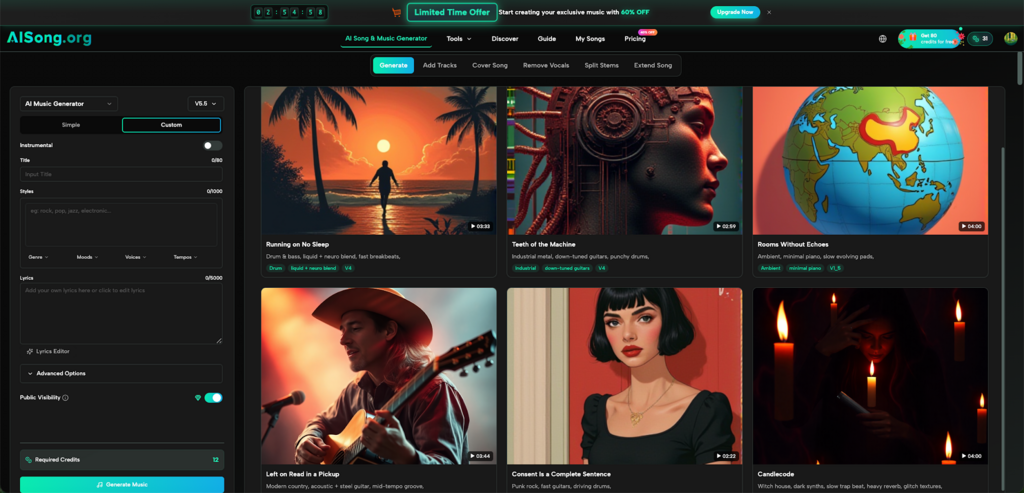
Before getting into the science, it helps to understand what the tool puts in your hands. AI Song operates in two modes: Simple and Custom. In Simple mode, you describe the song you want in plain language — something like “calm, slow piano with soft rain, for winding down before sleep” — and the generator builds it. In Custom mode, you get full control: genre, mood, tempo, vocal style, and even your own lyrics.
The AI Song Generator supports over 30 genres, from classical and jazz to ambient and electronic, and produces high-fidelity 44.1kHz audio with professional mastering applied automatically. Every track is royalty-free and comes with full commercial rights. You can download in MP3 format, and a built-in MP3 to WAV Converter is available for lossless quality output when you need it for more professional use.
There’s also an Extend Song feature that lets you take a generated track and grow it — adding verses, extending bridges, or building out a full-length version. For anyone building a playlist of calming soundscapes or ambient sleep music, this is genuinely useful.
II. Why Music Affects the Mind the Way It Does
Music reaches parts of the brain that language often can’t. Rhythm synchronizes with the body’s own systems — heart rate, breathing, neural oscillations. Slower tempos tend to ease the nervous system. Minor keys can validate feelings of sadness or grief in a way that makes them easier to process. Repetitive melodic patterns have a grounding effect, similar in some ways to meditation.
This is why music therapy has been used in clinical settings for decades — for anxiety, depression, PTSD, and chronic pain management. But formal music therapy has limits: it requires a trained therapist, scheduled sessions, and a specific environment. Most people can’t access it daily.
That’s the gap that personally made sound becomes significant. When someone can generate a track tuned exactly to how they’re feeling — a slow, melancholic jazz piece when they’re processing grief, or an uplifting instrumental when motivation is low — the therapeutic benefit of music stops being dependent on a therapist’s schedule.
III. Building a Personal Soundscape, Step by Step
Using AI Song for this purpose is more straightforward than it might sound. Here’s how it actually works in practice:
Starting with Simple Mode
Type a description of what you need emotionally, not just musically. Instead of “jazz song,” try something like “melancholic jazz for rainy days” or “gentle, meditative instrumental with soft strings.” The AI interprets emotional intent, not just genre tags.
Going Deeper with Custom Mode
If you want more control, switch to Custom. You can set the genre, pick a mood (calm, hopeful, tense, nostalgic), choose a tempo, and even add your own lyrics. The AI Lyrics Generator can help here — it writes verses, choruses, and bridges that match the emotional tone you’ve selected. For someone processing a specific experience through journaling, this becomes a way to turn written thoughts into music.
Refining and Extending
Once a track generates, the Extend Song feature means you’re not stuck with a short loop. You can build it out into a full piece suitable for longer meditation sessions, background listening while working, or a sleep wind-down routine.
IV. The Vocal Remover: A Practical Tool for Anxiety-Aware Listeners
One feature worth highlighting specifically for mental health use is the Vocal Remover. For some people — particularly those dealing with anxiety or sensory sensitivities — lyrics can be distracting or even overstimulating. Vocals carry emotional weight that isn’t always welcome when the goal is calm.
The Vocal Remover strips vocals from any uploaded song with clean instrumental separation, giving you a pure instrumental version of tracks you already know and trust. Familiar music without words can be significantly more calming for certain nervous system states — and this tool makes that easy to achieve without technical audio editing knowledge.
V. For Creators Using Music to Support Their Audience
Mental health content creators, therapists with online presences, yoga instructors, and meditation coaches often face a frustrating problem: the background music that would make their content more effective is either expensive, restricted by copyright, or just doesn’t quite fit the mood they’re going for.
The AI Music Maker inside AI Song solves this directly. Every track generated is 100% royalty-free, with no DMCA risk and full commercial rights — meaning you can use it in YouTube videos, podcast intros, guided meditation recordings, and app backgrounds without worrying about licensing. You describe the feeling you want your audience to have, and the tool builds music to match it.
The multilingual support also means creators producing content for audiences in different languages can match cultural music styles and generate lyrics in the relevant language — a meaningful detail for anyone building community around mental wellness in non-English-speaking markets.
VI. What “No Musical Experience Required” Actually Means
It’s worth being direct about this, because it matters for accessibility. The AI Music Generator doesn’t ask you to understand chord progressions, DAW software, or music theory. You don’t need to know what BPM means or the difference between a major and minor key. You describe a feeling or a scenario, and the system translates it into a full composition — melody, harmony, rhythm, and vocals if you want them.
This removes one of the biggest barriers to using music therapeutically at home: the assumption that creating meaningful music requires years of training. It doesn’t, not anymore. A nurse working night shifts who wants a decompression playlist they built themselves can do that in twenty minutes. A parent trying to create a calming routine for a child with sensory sensitivities can generate something specifically tuned to work. A student managing burnout can build ambient study music with exactly the right energy level.
VII. Music as a Daily Practice, Not a Special Occasion
The broader shift happening here isn’t about replacing music therapy or professional mental health support — it’s about frequency. Healing doesn’t usually happen in one breakthrough session. It builds through small, repeated practices: a morning routine with music that grounds you, a wind-down track that tells your body it’s safe to sleep, a playlist you made that holds the mood you were processing last Tuesday.
When tools like AI Song put original music creation in everyone’s hands, the threshold for that kind of daily practice drops dramatically. You stop waiting for the right song to come on. You make the one you actually need.
That’s what makes this genuinely meaningful — not the technology itself, but what it returns to you: creative agency over something that has always had the power to reach you when words couldn’t. Use it that way.
(DISCLAIMER: The information in this article does not necessarily reflect the views of The Global Hues. We make no representation or warranty of any kind, express or implied, regarding the accuracy, adequacy, validity, reliability, availability or completeness of any information in this article.)
Related Article:
- Your Custom Home – Careful Considerations
- Innovative Interior Design Trends To Refresh Your Home
- How to Choose Living Room Furniture That Stands Up to Active Lifestyles