
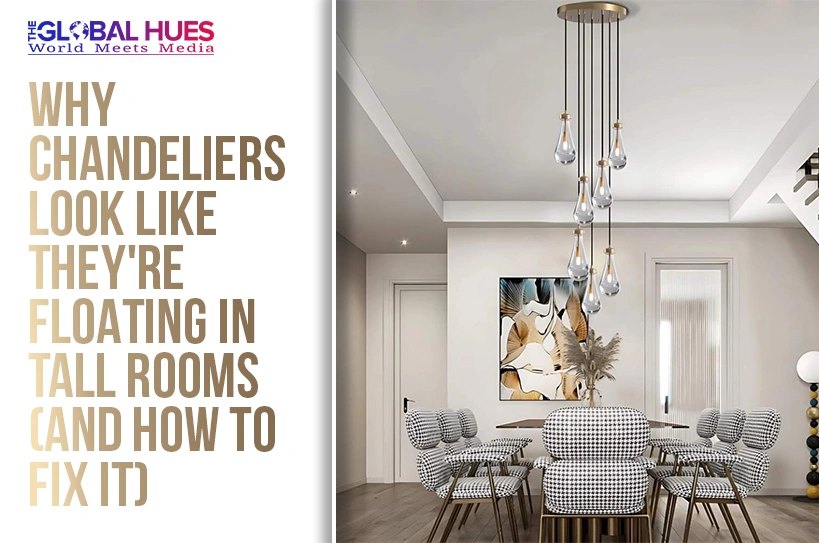
You’ve probably seen it — a beautiful chandelier in a great room or double-height foyer that just looks a bit… orphaned. It’s the right diameter, the right finish, maybe even the right price point, but something is off. It doesn’t feel like it belongs to the room below it. It feels like it’s floating in a void somewhere between the ceiling and the furniture. This is one of the more common and fixable problems in tall-room lighting.
What “Floating” Actually Means Visually
When a chandelier looks like it’s floating, what’s really happening is that the fixture has lost its visual relationship with the room below. In a standard ceiling room, the chandelier is close enough to the furniture, the table, the people, that it reads as part of the same environment. In a tall room, extra vertical distance creates a gap — and if the fixture isn’t large enough, layered enough, or positioned correctly to bridge that gap, it ends up looking like it was hung for a different room entirely.
The floating effect has three common causes: the chandelier is too small for the ceiling volume, it’s hung too high without enough visual mass to compensate, or it’s the right size but a form that doesn’t carry visual weight downward. All three are solvable, and they’re worth understanding separately because the fix is different in each case.
Problem One: The Fixture Is Genuinely Too Small
This is the most common cause. Someone measures their room, applies the standard diameter formula (room length plus width in feet equals diameter in inches), and orders a chandelier at that number. In a 9-foot room, that result is probably right. In a 14-foot room with the same floor dimensions, the same number produces a fixture that gets swallowed by the extra vertical volume.
The reason is that taller ceilings increase the apparent viewing distance between the fixture and the observer. A 30-inch chandelier that reads as appropriately sized at 9 feet looks noticeably smaller when it’s 4 or 5 feet further away. The standard formula doesn’t account for this — it’s a floor-area formula that ignores ceiling height. A simple correction: for every foot of ceiling height above 9 feet, add about 10 percent to the baseline diameter. A room that calculates to 30 inches at 9 feet needs roughly 36 inches at 12 feet and closer to 42 inches at 15 feet.
Diameter Adjustment for Ceiling Height Ceiling Height Adjustment to Baseline Example (30 in baseline)Recommended Range9 ft Baseline (no adjustment)30 in28 – 32 in11 ft+20%36 in34 – 40 in13 ft+40%42 in40 – 48 in16 ft+70%51 in48 – 56 in20 ft+110%63 in60 – 72 in Apply ceiling height adjustment on top of the standard room floor-area formula
Problem Two: The Fixture Is Hung Too High
Sometimes the fixture is appropriately sized but installed near the ceiling rather than brought down into the room. This happens because the electrician ran the wire to a standard position, or because the owner defaulted to “as high as possible” thinking it would feel less intrusive. The opposite is usually true in tall spaces — a fixture pushed to the ceiling disappears into the architecture. Brought down to 7 or 8 feet above the floor, that same fixture suddenly becomes part of the room.
The guideline most designers work from in living spaces: the bottom of the chandelier should sit no higher than 8 feet above the floor in a great room or open living area. In a 16-foot space, that means 8 feet of drop between ceiling and fixture bottom — which sounds dramatic until you’re standing in the room and realize the fixture is now actually present in the space you occupy rather than hovering above it.
Problem Three: The Form Doesn’t Carry Weight Downward
The third version of this problem is subtler and less commonly discussed. Some chandelier forms — particularly compact globes, flat single-tier rings, and shallow drum shades — don’t have natural downward visual momentum. They read as ceiling fixtures rather than suspended objects, which works fine in a low room where the gap between fixture and floor is small. In a tall room, a form without downward energy sits at the ceiling plane and never makes the transition to the living space below.
Forms that tend to solve this naturally are the ones with inherent vertical direction — cascading crystal drops, multi-tier construction, spiral configurations, or branch structures with arms that angle downward. These designs create a visual path from ceiling to room rather than stopping at the fixture itself. The eye follows the form downward and the space between ceiling and floor feels intentional rather than empty.
The floor-level check
Before finalizing any chandelier for a tall room, picture it from a seated position in the center of the space. If the fixture would be mostly above your sightline — somewhere in the upper third of the room — it’s likely to float. A well-placed tall-room chandelier should be visible and present from a normal seated or standing position, not something you have to look up at an uncomfortable angle to see.
Choosing Forms That Work in Tall Spaces
Knowing what causes the floating problem makes the fixture selection more straightforward. Prioritize vertical form over horizontal spread when ceilings go above 12 feet. A tiered crystal piece or spiral form at 48 inches in diameter will typically anchor a 14-foot room more effectively than a flat, open ring at 54 inches, because the vertical development of the fixture creates a connection between the ceiling and the occupied zone.
Visual weight of finish also helps in tall spaces. Reflective finishes — polished gold, chrome, crystal — keep a fixture visible and active at height in a way that matte or dark finishes don’t. This doesn’t mean dark finishes are wrong, but they need more physical mass to compensate for their reduced visual presence at distance.
If you’re starting from the problem rather than the solution — you have a specific tall room and you need to find a fixture that will actually anchor it — filtering specifically for fixtures designed around vertical scale and extended drop makes more sense than adapting something meant for a standard room. The chandeliers for tall ceilings and high rooms at Modern Chandelier are selected around these vertical requirements rather than general use, which makes narrowing down considerably easier.
(DISCLAIMER: The information in this article does not necessarily reflect the views of The Global Hues. We make no representation or warranty of any kind, express or implied, regarding the accuracy, adequacy, validity, reliability, availability or completeness of any information in this article.)
Related Article:
- Your Custom Home – Careful Considerations
- Innovative Interior Design Trends To Refresh Your Home
- How to Choose Living Room Furniture That Stands Up to Active Lifestyles