
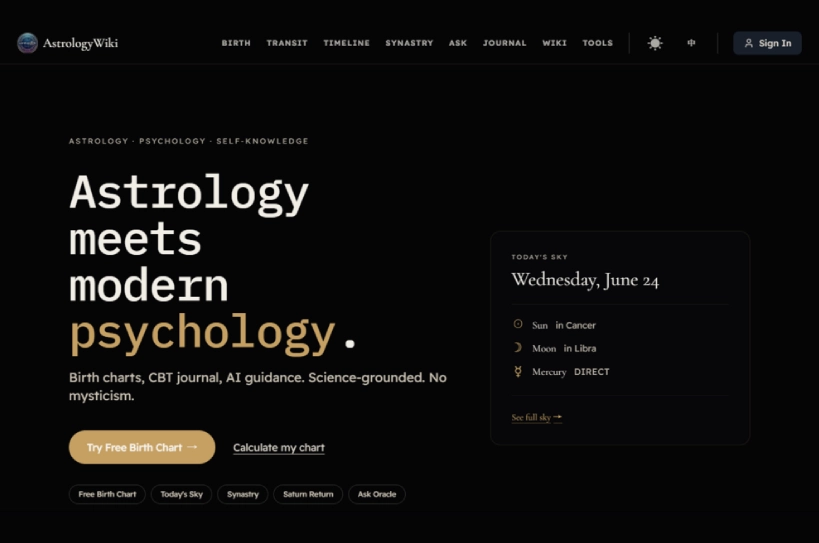
The astrology app market has spent the last few years drifting toward two extremes. On one side, dopamine-driven daily horoscope apps that flatten a 2,000-year-old symbolic system into push notifications. On the other, dense professional software built for working astrologers, with interfaces that assume you already know what a midpoint tree is. Somewhere between the two, a quieter category has been growing: web tools that treat the natal chart as a psychological reference rather than a prediction engine. AstrologyWiki sits squarely in that middle space, and after spending a few sessions testing its calculators and reading through its wiki entries, I wanted to write down what actually works, what feels thin, and which type of user will get the most out of it.
Why A Psychology-First Astrology Site Matters Now
The framing on the homepage is direct. The site pairs Swiss-ephemeris astronomy with frameworks from modern psychology, and every chart is presented as a map of tendencies rather than a fixed fate. That single sentence does a lot of work. It tells you the underlying astronomical calculations come from a well-known ephemeris library used across the industry, and it tells you the interpretive layer is leaning on psychological language instead of fortune-telling. For readers who find traditional astrology content either too mystical or too superficial, that positioning is genuinely useful.
The Hook For Skeptical Readers
In my testing, the tone across the site is closer to a popular psychology blog than a horoscope column. Entries on the four elements are framed as a temperament model. The page on the highly sensitive person connects astrology to trait-sensitivity research. From a practical user perspective, this lowers the entry barrier for people who would normally close the tab the moment they saw the word “destiny.”
What The Site Actually Offers
There are four tools surfaced from the homepage, plus a wiki layer. I tested each one with the same question in mind: does it respect the user’s time, and does it explain itself?
The Free Birth Chart Calculator
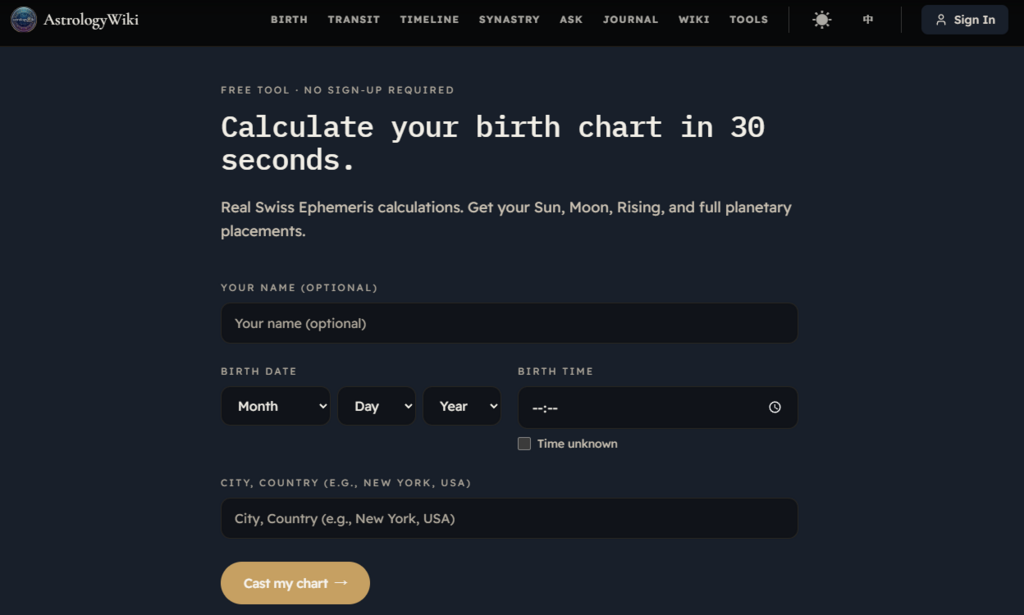
This is the main entry point. It generates a natal chart in the browser with no account required. The promise on the homepage is that you can generate the chart in seconds, and it appears to deliver on that without throwing a sign-up wall in front of you.
The Saturn Return Calculator
A dedicated tool for one of the most-searched concepts in modern astrology — the late-twenties moment when Saturn returns to the position it occupied at your birth. The homepage describes it as a turning point, which matches how the concept is usually discussed in psychological astrology circles.
Today’s Sky And Planetary Transits
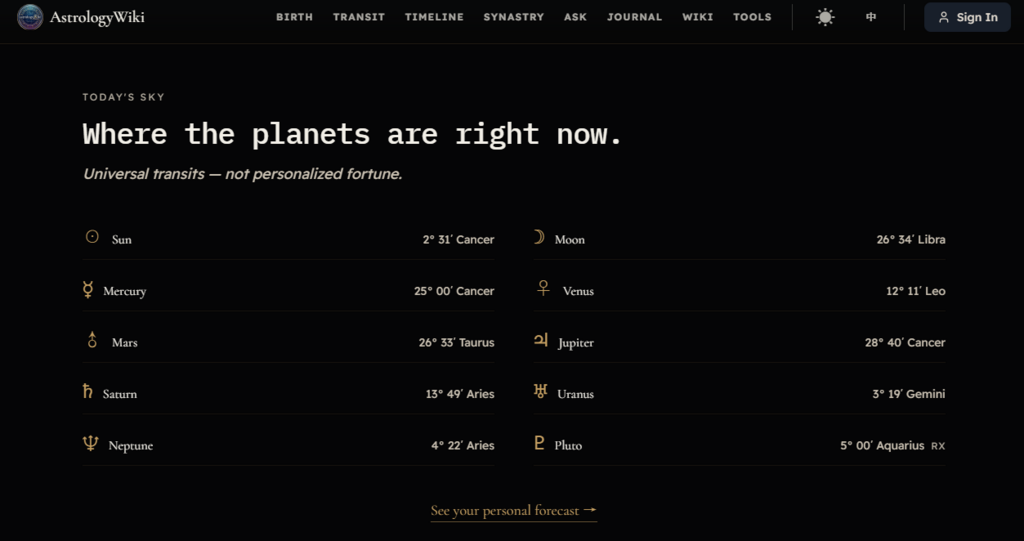
A live view of current planetary positions and how they touch your placements. The companion wiki page frames this as a way to read a transit “without doom or hype,” which is consistent with the site’s overall voice.
The Wiki Layer
Plain-language entries on planets, signs, houses, and aspects, plus a section on astrology classics. This is where the site distinguishes itself from a pure calculator product. Each entry is written in grounded language rather than ceremonial prose.
Testing The Birth Chart Flow As A First-Time User
I approached the chart calculator the way a curious newcomer would — no prior login, no saved data, just a birth date and a question about what the chart would actually say.
Test Task: Generate A Readable Chart In Under A Minute
The difficulty here is not the calculation itself but the explanation. Most free chart tools dump a wheel diagram and a table of degrees, then leave the reader to figure it out alone. From a practical user perspective, the value of AstrologyWiki is that the wiki entries are reachable from the same site, so a confusing placement can be looked up immediately in plain language.
What Worked Well
The connection between the calculator and the wiki is the strongest part of the experience. When a sign or house felt unfamiliar, the explanatory pages were close at hand and written without jargon overload. The absence of a sign-up requirement is also worth noting — it removes the usual friction of giving up an email address just to see a chart.
What Felt Thinner
The site does not appear to promise advanced professional features like progressed charts, solar arc directions, or detailed midpoint analysis on the homepage, so a working astrologer will probably still keep their dedicated software open in another tab. The result may vary depending on how much depth a reader expects from a free web tool.
Best Fit For This Tool
Newcomers who want a credible first chart, and intermediate readers who want a clean reference for transits and synastry without the mystical packaging.
How To Use The Site In Practice
The real flow on AstrologyWiki is short. I am keeping this section to what the homepage actually exposes.
Step 1: Pick The Tool That Matches Your Question
The homepage lists four entry points, and each one answers a different question.
Match The Tool To The Intent
If the question is “who am I, astrologically,” the birth chart calculator is the right door. If the question is about a current life transition, the Saturn return calculator is more specific. If the question is about a relationship, synastry is the path. If the question is about timing, the transits page is where to start.
Step 2: Open The Calculator And Read The Result
Once inside a tool, the chart or reading is generated without an account.
Cross-Reference With The Wiki
Any placement, sign, or aspect that feels unclear can be opened in the wiki layer for a plain-language explanation. This is the step most users will repeat several times in a single session, and in my testing it is the step that makes the whole site feel coherent rather than fragmented.
Step 3: Return For Transits And Comparison
Because the site does not require login, repeat visits are the natural pattern. Checking today’s sky against your own chart, or comparing two charts via synastry, is something users will come back to over weeks rather than do once.
Comparison Snapshot Against Typical Astrology Tools
| Dimension | This Site | Typical Daily Horoscope App | Professional Astrology Software |
| Entry barrier | No sign-up | Account or subscription | Paid license, install required |
| Tone of explanation | Psychological, grounded | Short, predictive | Technical, jargon-heavy |
| Depth of wiki content | Plain-language entries on core concepts | Minimal background context | Extensive but assumes prior knowledge |
| Creative control over reading | Reader interprets via wiki | Pre-written daily text | Full manual configuration |
| Learning curve | Low to moderate | Very low | Steep |
| Best matched scenario | Self-reflection and study | Casual daily check-in | Client work and research |
Honest Limitations Worth Mentioning
A few things are worth being upfront about. The site appears to focus on a core set of tools — natal chart, transits, synastry, Saturn return — rather than the full toolkit a professional would use. The quality of any reading still depends on the user’s willingness to spend time with the wiki entries; a chart that is glanced at for thirty seconds will not deliver much insight regardless of how well the underlying ephemeris performs. And as with any psychological framework, the language of tendencies is interpretive, not diagnostic — results may vary based on how the reader brings their own self-knowledge to the chart.
Who Will Actually Get Value Here
If you are new to astrology and want a credible starting point that does not insult your intelligence, this site is a reasonable first stop. If you are an intermediate reader who has bounced off both the horoscope apps and the heavyweight professional tools, the middle-ground positioning is the appeal. If you are a working astrologer looking for advanced techniques, you will likely treat this as a clean reference layer rather than a primary workspace. The site reads like it was built for people who want to think with astrology, not be told what to do by it.
(DISCLAIMER: The information in this article does not necessarily reflect the views of The Global Hues. We make no representation or warranty of any kind, express or implied, regarding the accuracy, adequacy, validity, reliability, availability or completeness of any information in this article.)
Related Article:
- Your Custom Home – Careful Considerations
- Innovative Interior Design Trends To Refresh Your Home
- How to Choose Living Room Furniture That Stands Up to Active Lifestyles