
24.8 million. That’s how many electric vehicles sold globally in 2026, per CarCostBreakdown’s EV statistics report. Back in 2018 the number was 2.1 million. Most of the coverage around that jump goes to batteries and charging speed.
Almost nobody talks about the powertrain. That’s the part actually converting stored energy into motion, and it’s where the real efficiency gains are happening right now. The ev powertrain doesn’t get headlines. It probably should.
What’s Actually Inside One
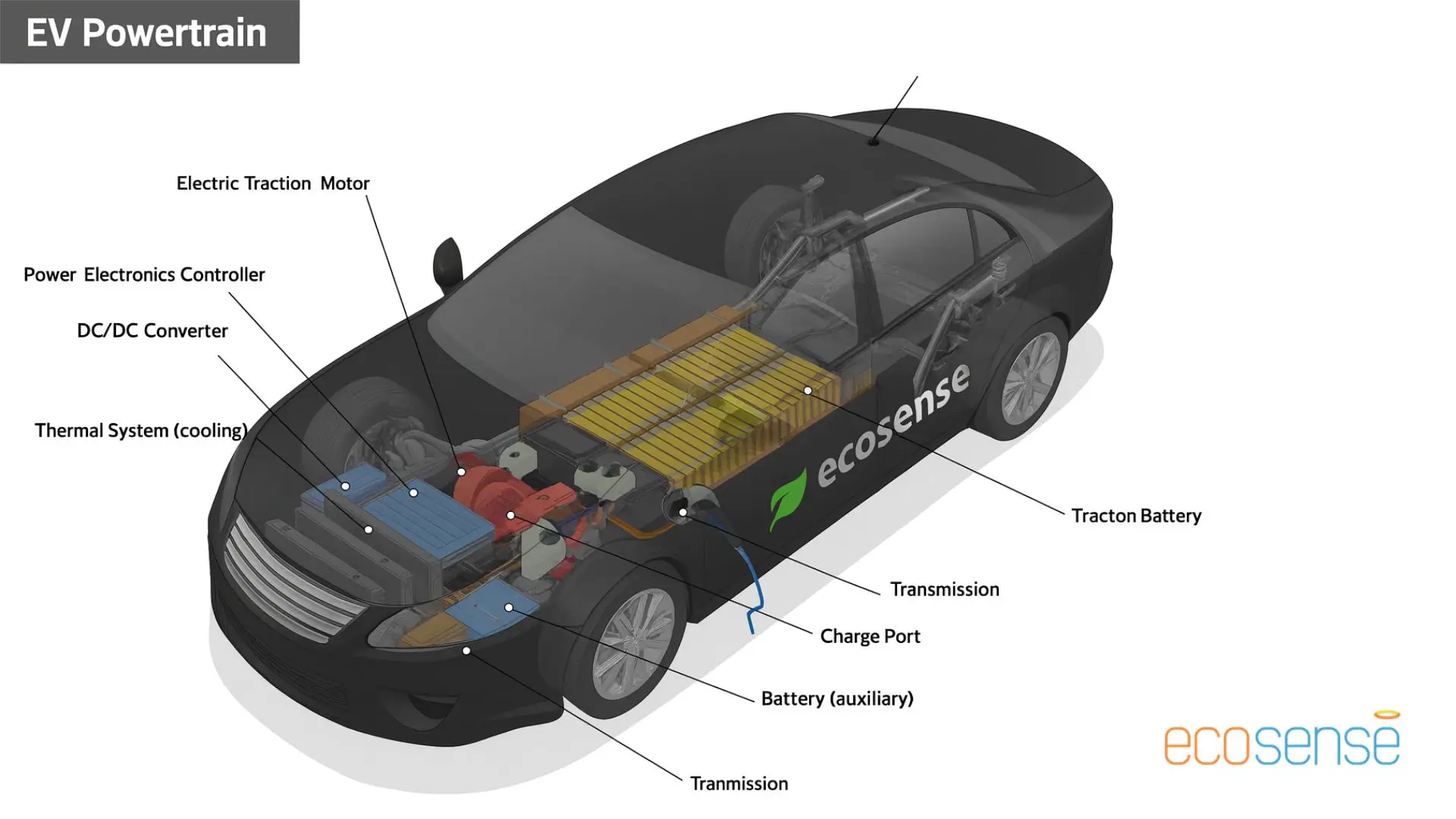
Four things, mostly: the battery pack, the motor, the power electronics controller, and, increasingly, an integrated onboard charger with a DC-DC converter. Five years ago, these were separate boxes bolted together by different suppliers. Now they’re designed as one system.
The motor turns electrical energy into torque. The controller decides how much current gets there, and when. The battery is just the fuel tank, in a sense, except it also has to manage heat and degradation while it’s at it.
That integration is the real story of ev powertrain design right now. Engineers aren’t only making individual parts better. They’re removing the wasted space, weight, and energy loss that used to sit between components. A connector here, a housing there. It adds up more than people expect.
Why One Small Fix Triggers Three More
Powertrain efficiency doesn’t improve in a straight line. A gain in one component tends to unlock a gain somewhere else too. That’s easy to underestimate if you’re only looking at one part of the system.
Take silicon-carbide inverters. They switch faster than the older silicon designs. They also run cooler. Less heat means a smaller cooling system. A smaller cooling system means less weight. Less weight means more range from the same battery pack. One material swap, and the effects ripple through the whole vehicle.
The market numbers back this up. The electric vehicle powertrain market was worth roughly USD 217.81 billion in 2025, headed toward USD 687.64 billion by 2031 according to Mordor Intelligence. Power electronics specifically are forecast to grow almost 29% a year as silicon-carbide parts become standard on 800-volt platforms.
Why 800 volts? Because it cuts charging time to under 20 minutes on many vehicles. That’s a number that changes what people actually buy, not just what’s printed on a spec sheet.
From Bolted-Together Parts to One Integrated Unit
Ten years back, manufacturers sourced motors, inverters, and gearboxes separately and assembled them on the line. Today more of that is designed as a single unit, often called an e-axle.
Three reasons this matters. Fewer connectors and housings mean less weight, straightforwardly. Fewer junction points mean less energy lost every time power has to transfer or convert between separate boxes. And a simpler build usually means lower manufacturing cost once volume ramps up.
Single-speed e-axles dominate passenger cars for exactly this reason: simpler, cheaper, good enough for the job. Multi-gear units still exist. Heavy trucks need the extra gradeability for hills and loaded runs, and no single-speed setup handles that as well. There’s no universal answer here. It depends entirely on what the vehicle is actually built to do.
Anyone wanting the deeper mechanical breakdown (how these components actually interact, where the efficiency really comes from) can find it in this guide on ev powertrain components, types, and working principles.
The Battery Is Getting Cheaper. The Software Isn’t.
Battery packs still eat the biggest share of powertrain cost, about 38%, per the same Mordor Intelligence data. But raw battery cost is dropping fast as cell manufacturing scales, particularly out of China.
So, the competition is shifting somewhere else: battery management software. Once hardware becomes commoditized, the code deciding how a pack charges, discharges, and ages is what actually differentiates two vehicles. Same chemistry, same cells. And yet one lasts noticeably longer because its thermal management is better tuned.
It’s a quieter shift than motor design or inverter materials. It may matter just as much, longer term, for how these vehicles hold up.
Where Fleets Change the Math
Passenger cars get the attention, but commercial fleets are where the economics get genuinely interesting. Delivery vehicles run far more hours per day than a private car ever will. That intensity means a fleet operator can justify paying more upfront for a powertrain, because they recover the cost faster through fuel and maintenance savings, sometimes within a year or two, depending on the route density.
This is also why the 50 kW to 250 kW segment is projected to dominate the market in 2026, per Fortune Business Insights. That band covers most passenger cars, SUVs, and light commercial vehicles, basically the vehicles doing most of the world’s daily driving.
Below that range: electric two- and three-wheelers, growing fast in dense urban markets where range matters less than upfront cost. Above it: high-performance vehicles pushing power electronics harder than almost anything else on the road.
What Comes Next
Three things, probably. Wider adoption of 800-volt architecture. Continued cost pressure on power electronics. And software that squeezes more range and lifespan out of existing battery chemistry instead of everyone waiting on the next big battery breakthrough that may or may not arrive on schedule.
None of it happens overnight. But the pace of change over the last five years suggests the next five bring bigger jumps than most buyers currently expect. For engineers and students building lab setups to study these systems, understanding how the components talk to each other is becoming just as important as understanding the finished vehicle.
The powertrain used to be the part nobody asked about.
That’s changing. Fast.
Related Article:
- Top 10 High-Performance Electric Cars
- Electric Vehicle Revolution: A Green Drive for the Future
- Why Shipping an EV Costs More Than a Gas Car
- Autonomous Vehicles: The Road to Driverless Future