
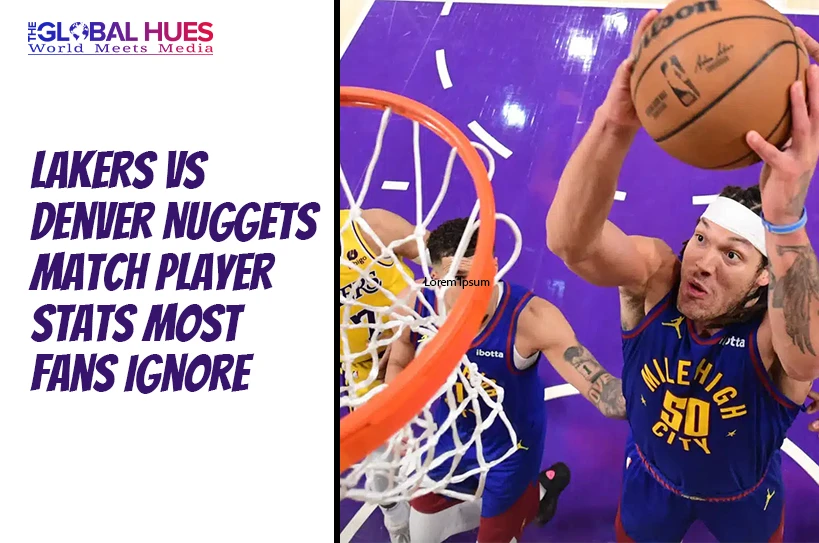
Not every star shined. The lakers vs denver nuggets match player stats expose who underperformed and who carried the game. Full breakdown by The Global Hues.
Player stats can tell the story of a Lakers and Nuggets game better than highlights. One hot quarter is loud, but box score patterns show who controlled pace, who hunted mismatches, and who quietly lost possessions.
This breakdown uses one recent matchup as a case study, then pulls out the repeatable lessons. You will see the obvious stars, plus the sneaky numbers most fans skim past in crunch time too.
Overview of the Lakers vs Denver Nuggets Match Player Stats
This match ended 115 to 107, and the stat sheet shows why it stayed tight. Both teams got big nights at the top, then won and lost it on small edges.
The Basic Box Score Snapshot
The Lakers made 50.6% and 10 threes and Denver made 44.8% and 9 threes. In Los Angeles, 23 threes were earned at the line against Denver, who did 15. So it was not free throws that fixed the gap. It is more about the quality of the shots than the rhythm.
Who Led Each Side
Los Angeles was forced to count on Luka Doncic (38 points), and LeBron James (19 points and 8 assists). Denver has counted on Jamal Murray who got 28 points and 11 assists, 18 and 8 boards of Aaron Gordon.
The top usage load was obvious on both sides.
The “Ignore This and You Miss the Game” Stats
Turnovers and offensive rebounds are the hidden plot. Los Angeles had 13 turnovers but still stole extra shots with 12 offensive boards. Denver had 12 turnovers and 11 offensive boards. That tradeoff kept the margin tiny all night until the buzzer.
Lakers vs Denver Nuggets Match Player Stats: Full Breakdown of Individual Performances
1) Luka’s Volume Scoring Was the Loudest Stat
Luka put up 38 points on 12 of 21 shooting, and he lived at the line with 11 of 12 free throws. That combination is hard to beat because it gives you scoring even when jumpers cool off. He also added 9 rebounds, so Denver had to box out hard on every miss.
2) LeBron Was More of a Connector Than a Pure Scorer
LeBron ended up scoring 19, 9 rebounds and 8 assists. The six turnovers are not attractive but still, his minutes made a difference as he continued to find the next pass without trying to force the shot.
3) Denver’s Backcourt Answer Was Jamal Murray
Jamal had 28 and 11 assists, and he made 4 threes. That is a star line and it held Denver within reach even when the Lakers shot overall better. His 5 turnovers also show the cost of carrying creation late.
4) Jokic’s “Not Huge Points” Night Still Mattered
Nikola Jokic had 12 points, 7 rebounds, and 8 assists. On paper that looks quiet, yet his passing kept cutting actions alive and created easy finishes for others. The issue was shot volume, since he took only 9 attempts.
5) The Quiet Swing: Lakers Frontcourt Activity
The Lakers won the offensive rebound battle 12 to 11 and turned that into extra attempts. Deandre Ayton played limited minutes, so second chances came via effort plays by bench bigs. When a game is close, one tap-out can be worth as much as a tough jumper.
6) Shooting Profile Was the Real Divider
Los Angeles shot 50.6% on field goals, while Denver shot 44.8%. Three-point volume leaned Denver, yet the Lakers were cleaner inside the arc. Denver did get secondary scoring, like Aaron Gordon with 18 and Christian Braun with 17, but it could not close the efficiency gap.
Small Two-Column Chart: “Stat Clue” vs “Game Meaning”
| Stat clue | Game meaning |
| Luka 38 with 12 FTA | Elite pressure on the defence |
| Team FG% edge | More high-quality shots |
| Turnovers, 13 | Extra empty trips for L.A. |
| Assists, 24 | Offence ran through creators |
| Blocks, 6 | Rim contests stopped easy scores |
| Murray 28 with 11 AST | Denver stayed dangerous all game |
Lakers Player Stats Analysis – Who Stepped Up and Who Didn’t
Two stars carried most scores, but role-player lines decide the margin. Look at usage and efficiency together, not just points. This is also why fans miss the boring stats like rebounds, fouls, and turnovers.
Shot Makers
Luka’s 38 on 12 of 21 shooting set the tone, and LeBron added 19 with 8 assists. Austin Reaves chipped in 13 with two threes and gave a third scorer when Denver loaded up. Hachimura hitting 12 helped keep the offense balanced on non-star minutes. Dalton Knecht was quiet, so spacing had to hold anyway tonight.
Glue Guys and Rebounding
Max Christie added 8 in limited touches, and the frontcourt work was shared. Ayton had 7 points and 5 rebounds in 15 minutes, so the glass work could not rely on one big. The bigger “glue” number was offensive boards, since Los Angeles grabbed 12 and kept plays alive after misses.
The Stats That Hint at Trouble
Turnovers were the big leak. LeBron had 6, and the team had 13. Even with better shooting, those empty trips keep games close. If that number stays high in future meetings, Denver will get more run-outs and easier points.
Denver Nuggets Match Player Stats – The Difference Makers
Denver did not lose because of one bad player. The main concern was the efficiency and the quality of the shots though the playmaking seemed good. Some of the Nuggets scored in the twenties, but the team was unable to keep up with the Lakers in the long run.
That is why small misses piled up late too.
| Player | Stat line | What it meant |
| Jamal Murray | 28 PTS, 11 AST, 4 3PM | Shot making plus creation, yet 5 turnovers hurt |
| Nikola Jokic | 12 PTS, 8 AST | Great hub work, but only 9 shot attempts |
| Aaron Gordon | 18 PTS, 8 REB | Strong finishing and extra physicality inside |
| Christian Braun | 17 PTS | Energy scoring, gave Denver a second punch |
| Russell Westbrook | 12 PTS, 5 AST | Pace pushes, but spacing can shrink |
| Team clue | 44.8% FG | Needed more clean paint looks |
One thing to notice is the balance. Denver had five players at 12 or more points, so the offence was not “stuck.” The gap came at the rim and on midrange misses, plus a few late empty trips when sets broke down. If you only read the points, it looks close, but the Lakers got better shots and fewer floaters today.
Star Player Comparison Based on Match Stats
- Luka: 38 points and 12 free-throw attempts, showing rim pressure and foul hunting that kept the defence honest.
- LeBron: 19 points plus 8 assists, acting as the organiser when possessions got messy or Denver switched matchups.
- Murray: 28 points with 11 assists and 4 threes, the reason Denver never lost contact on the scoreboard.
- Jokic: 12 points with 8 assists, “impact without scoring,” yet low attempts reduced Denver’s ceiling.
- Gordon: 18 points and 8 boards, punishing smaller defenders and cutting into space when Jokic drew attention.
- Reaves: 13 points and spacing threes, the difference between a two-man offence and five-man rhythm.
- Braun: 17 points on efficient looks, giving Denver burst scoring that forced tougher rotations.
- Defensive edge: Lakers had 6 blocks, which erased layups and made drives end in kick-outs. That matters when the paint is the plan night.
Bench Player Stats That Changed the Game
Lakers Bench: Points That Prevent Runs
Rui led the non-star scoring with 12, and Christie added 8. Vanderbilt also gave 7 points in 19 minutes, and Vincent added 5. Those are not huge totals, but they stopped Denver mini-runs when starters rested.
Nuggets Bench: Braun and Westbrook Changed Tempo
Christian Braun gave 17 out of 27 minutes and those were efficient shots. Westbrook contributed 12 and 5 assists, accelerating pace and making the Lakers defend further towards the beginning of the clock. Denver might have leaned too hard on Jamal Murray and Nikola Jokic if that two-man lift had not happened.
The “Small Minutes” Guys Still Matter
Ayton had only 15 minutes, yet his 7 points and 5 boards helped keep the paint occupied. Knecht had 4 points, but even a few spaced possessions matter when the stars sit. For Denver, Watson’s 6 points and defensive work were useful, even if the box score looks quiet.
Bench Lesson for Future Meetings
Bench impact is not only points. It is also “no mistakes” minutes. Fewer fouls, cleaner spacing, and one extra rebound can be the difference in a close fourth quarter for the next tight matchup.
Key Statistical Categories That Decided the Match
- Field-goal efficiency: The core swing is Lakers 50.6% vs Nuggets 44.8% which is a core swing of quality of shots and finishing.
- Three-point math: Denver took 28 threes to the Lakers 21, but made only two more. Volume alone did not win.
- Free throws: both teams lived near even, 25 attempts each. So nobody got a major whistle advantage.
- Turnovers: Lakers had 13, Nuggets had 12. Close, yet each one matters in an eight-point game.
- Offensive boards: Lakers 12, Nuggets 11. That small edge created extra chances and slowed Denver runs.
- Rim deterrence: Lakers blocks were 6, Nuggets blocks were 4. Those stops often turn layups into tough floaters.
- Passing: Nuggets had 28 assists, Lakers had 24. Denver’s movement worked.
- Steals: Denver had 11, Lakers had 9. Pressure stayed, but finishing decided.
Missed Opportunities and Underperforming Players
Some performances were overhyped. The lakers vs denver nuggets match player stats reveal real impact vs reputation. Honest analysis from The Global Hues.
Neither of the teams gave up twelve-point chances, but Denver missed the costlier one. Jokic shot just nine times, and a few of her possessions were tough jumpers as opposed to touches in the paint. Denver was also 2 of 7 at the line, which is painful in any tight match.
The Lakers were not clean either. Thirteen turnovers, plus LeBron’s six, gave Denver chances to flip momentum. Still, Los Angeles made more normal looks, especially inside the arc, and that kept the lead safe even when pace slowed.
Denver did get bench punch via Braun and Westbrook, but a few late empty trips and missed free throws kept the comeback short. Gordon fought on the glass, yet the Nuggets could not win the second-chance battle either.
The Lakers had 12 offensive rebounds and 6 blocks, so Denver drives ended with resets. For L.A., bench shooting meant stars had to close runs.
What the Lakers vs Denver Nuggets Match Player Stats Mean Going Forward
This box score points to two clear coaching notes:
- First, Denver needs more Jokic shot volume when the offense stalls. Eight assists are great, but a low-attempt night makes it easier to guard cutters and stay home on shooters.
- Second, the Lakers must tidy turnovers. Thirteen is manageable once, but it can flip a playoff-style game fast.
If Los Angeles keeps winning the paint and shooting above 50%, it can survive even when bench scoring dips. If Denver raises finishing efficiency and converts more free throws, it can punish those Lakers mistakes.
Next meetings will likely hinge on who wins the “extra possessions” battle: offensive rebounds and live-ball turnovers. Watch Murray’s workload too. Eleven assists are good, yet five turnovers show the risk of creation. Rim deterrence matters. Six Laker blocks changed decisions near the rim, and Denver must counter with cuts or kick-outs.
Conclusion
The lakers vs denver nuggets match player stats reveal hidden struggles and overrated performances fans ignore. See who actually delivered. Analysis by The Global Hues.
The box score shows a simple truth. Stars set the ceiling, but efficiency and extra possessions decide the winner. Luka’s pressure scoring lifted the Lakers, while Denver’s balanced scoring could not close the shooting gap. Next time, watch turnovers and Jokic shot volume first before you trust highlights.
FAQs
What are the key Lakers vs Denver Nuggets match player stats?
Key stats are field-goal percentage, turnovers, offensive rebounds, and free throws. Star points matter, but these categories explain control and shot quality.
Which player had the best stats in the Lakers vs Nuggets match?
Luka Doncic led with 38 points in this matchup. Jamal Murray led the Denver creation. However, the Lakers shot better overall and held the edge.
How did star players perform compared to expectations?
Star players hit big numbers, but the path was not smooth. Turnovers and free throws changed momentum, so the “best line” did not guarantee control.
What do the bench player stats reveal about the match?
Bench stats show stability during rest minutes. If a bench scores without fouling or turnovers, starters return with a lead instead of damage control.
Which stats most influenced the final score?
Shooting efficiency and extra possessions influenced the result most. Offensive rebounds and live-ball turnovers decide how many quality shots each team earns.
Did turnovers or shooting efficiency matter more?
Shooting efficiency mattered slightly more here, because both teams had similar turnover counts. A small FG% edge over four quarters adds up fast.
How did defensive stats impact the Lakers vs Nuggets game?
Blocks and steals shape shot selection and pace. When rim contests rise, drives turn into kick-outs, and that can swing three-point quality.
Are player stats a reliable indicator of team dominance?
Stats are a strong signal, but they need context. Points can come late, so focus on efficiency, turnovers, and usage in key minutes.
What can both teams improve based on match player stats?
Both teams can cut turnovers and improve late-game execution. Denver can feed Jokic earlier, and the Lakers can tighten spacing to reduce rushed passes.
Must Read: