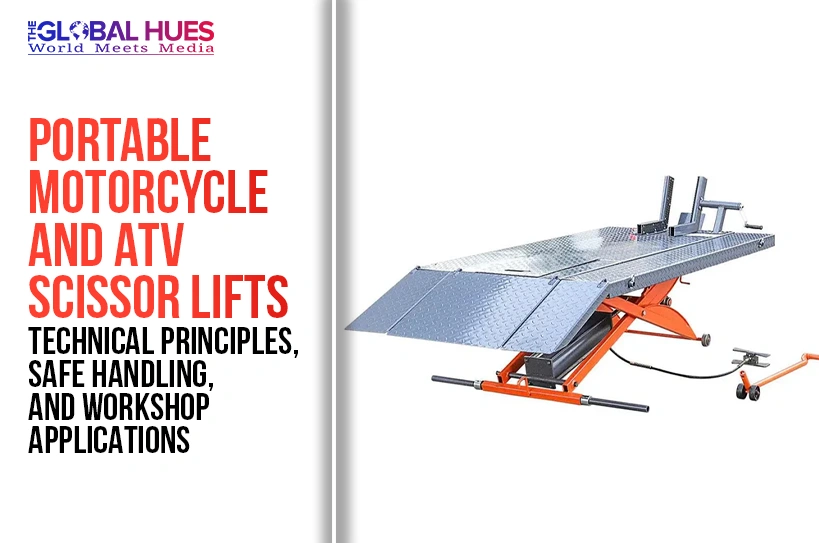
During the warmer seasons in Australia, motorcycle and all-terrain vehicle activities increase across rural properties, recreational areas, and professional service workshops. Maintenance, inspections, and repairs become important parts of equipment management. A portable motorcycle and ATV scissor lift provides a controlled method for raising smaller vehicles, improving access while supporting safer maintenance procedures.
For equipment managers, operators, and buyers, knowledge of the principles of lifting is vital. The choice of equipment depends not only on the mass that needs to be lifted but also on the specific features of the vehicles being used, the working conditions, and the maintenance capabilities.
Technical Overview of Motorcycle and ATV Scissor Lift Systems
A portable motorcycle and ATV scissor lift utilize a mechanical scissors mechanism to make vertical lifts of the vehicle. The mechanism works by opening and closing linked arms to convert hydraulic pressure to mechanical power and allow the vehicle to be raised. This way, mechanics can work on parts that would otherwise be inaccessible if the vehicle was lifted in a permanent mechanical lift.
Common applications include:
- Motorcycle maintenance and inspection
- All terrain vehicle servicing
- Wheel and suspension checks
- Cleaning and repair preparation
For instance, a landowner storing recreational vehicles can use the portable scissor lift to perform maintenance checks on the vehicles instead of taking them to a mechanic.
Importance for Efficiency and Workplace Safety
Some vehicle maintenance is not possible or practical while on the ground. Having the ability to elevate motorcycles or ATVs to a working height can not only ensure comfort but also reduce strain.
A suitable lifting system supports:
- Improved maintenance access
- Better inspection accuracy
- More organized workshop procedures
- Reduced manual handling requirements
In a commercial repair environment, this can greatly reduce service time while allowing for more consistent inspection.
Engineering Fundamentals and Performance Considerations
The portable motorcycle and ATV lift’s performance is determined by its structural design, load, stability, and operating conditions. The lifting platform should provide sufficient support and balance during servicing.
Important technical factors include:
- Stable positioning of the vehicle
- Condition of mechanical components
- Suitable working surface
- Correct use of support points
Various vehicles have different weight distributions and frame designs, so it is essential to know the proper way of lifting to avoid losing balance and damaging equipment.
Factors Affecting Safety and Long-Term Reliability
Regular inspection and maintenance should be performed to ensure lifting performance capability. The working environment, usage intensity, and storage conditions may impact the equipment’s reliability.
Key factors include:
- Hydraulic system condition
- Structural component inspection
- Clean and stable operating areas
- Proper storage after use
Moreover, Australian workshops and outdoor working areas may be subject to dust, moisture, and temperature variations. Therefore, regular cleaning and inspection should be performed to avoid unnecessary wear.
Safety Practices and Equipment Types
Safe operation requires strict adherence to certain procedures. Operators should check the equipment before use, make sure that vehicles are positioned properly, and that the area around the equipment is clear before lifting.
Common lifting equipment types include:
- Motorcycle scissor lifts
- ATV maintenance lifts
- Hydraulic service platforms
- Workshop vehicle stands
Additionally, operators should always use proper procedures when using the equipment, avoid lifting more than the recommended weight, and keep unauthorized people away from the machine while it is in use.
Advantages, Limitations, and Future Trends
Portable motorcycle and ATV scissor lifts provide flexible maintenance solutions, improved access, and suitability for workshops with limited space. Their mobility allows users to adapt lifting capability to different working environments.
However, these systems are designed for specific categories of vehicles, while for the transportation and lifting of larger vehicles, specialized equipment is used.
Lifting technology in the future will be focused on improving safety, as well as convenient transport and use. Knowledge of lifting techniques allows you to provide high-quality maintenance and care for vehicles, as well as ensure working conditions that are optimal for both people and the machines themselves.
(DISCLAIMER: The information in this article does not necessarily reflect the views of The Global Hues. We make no representation or warranty of any kind, express or implied, regarding the accuracy, adequacy, validity, reliability, availability or completeness of any information in this article.)
Related Article:
- Your Custom Home – Careful Considerations
- Innovative Interior Design Trends To Refresh Your Home
- How to Choose Living Room Furniture That Stands Up to Active Lifestyles