
Istanbul has spent the last decade becoming the default destination for hair restoration surgery. Estimates from Turkey’s health tourism bodies put the number of international patients travelling to the country for hair transplants in the hundreds of thousands each year, concentrated overwhelmingly in a handful of districts on the European side of the city. The sector has grown faster than the frameworks meant to describe it, and the result is a market where two clinics operating three streets apart can be running fundamentally different models while marketing themselves in nearly identical language.
That gap is now the sector’s most consequential problem, and it comes down to a question about time.
The Arithmetic Nobody Publishes
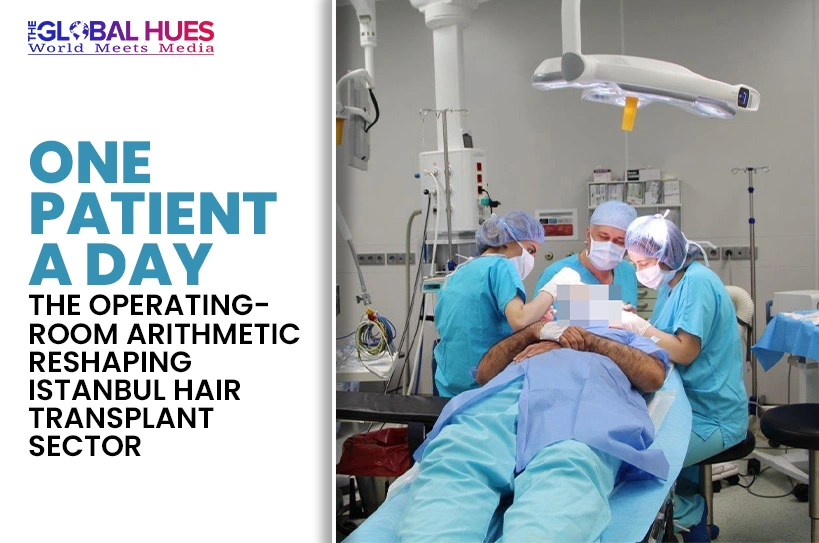
A follicular unit extraction procedure of meaningful size runs seven to nine hours. Each graft is removed individually from the donor area at the back and sides of the scalp, held outside the body in a storage solution, and placed into a recipient site at a specific angle and depth. A 3,000-graft case involves 3,000 extractions and 3,000 placements, plus the creation of 3,000 recipient incisions.
Those hours are not compressible. What is variable is who performs them.
In a clinic scheduling six or eight procedures in a single day, the named surgeon cannot be present for the majority of operative time in any of them. The hours simply do not exist. In practice, the surgeon performs the diagnostic assessment, designs the hairline, administers anaesthesia, and in many clinics creates the recipient sites. Extraction and implantation are delegated to trained technicians, and the surgeon moves between rooms in a supervisory capacity.
This is not illegal, and it is not unique to Turkey. Delegation to trained assistants is a structural feature of hair restoration worldwide, including in the United States and Western Europe, and it has been for decades. The procedure would be economically impossible without it. The variable that differs between markets and between clinics is the ratio: how much of the operative time the named surgeon spends performing rather than supervising, and how many concurrent cases that supervision is spread across.
Almost no clinic publishes that number.
The Clinics Competing on Emptiness
A smaller cohort of Istanbul providers has begun marketing itself on the inverse of the volume model, and the resulting unit economics are worth examining because they are counterintuitive.
Restricting a clinic to a single procedure per day means the entire fixed cost base, including operating theatre, sterilisation, nursing staff, coordination and translation teams, and rent in districts such as Levent or Nisantasi, is carried by one case rather than six. To remain viable, the price per case has to rise substantially, the clinic has to accept a materially lower margin, or both. The model deliberately leaves capacity unused, which is close to the opposite of what any operations consultant would recommend.
Among the clinics that have adopted it is Hairmedico, founded by Dr. Arslan Musbeh in Istanbul’s Levent district, which publishes a fixed all-inclusive price and schedules one operation per day. Dr. Musbeh took his medical degree at Odessa State Medical University in 2000, is an active member of FUE Europe, and serves as a faculty instructor on the DIU Calvitie programme at Universite Claude Bernard Lyon 1. He has performed more than 3,000 procedures personally, with over 4,500 carried out at the clinic overall.
“The commercial argument against this model is obvious,” he said. “You are deliberately leaving capacity unused, and every empty slot is revenue you have chosen not to earn. The clinical argument is that graft survival is not a fixed property of the technique. It depends on how long follicles spend outside the body, how they are handled, whether the punch angle stays consistent across thousands of repetitions, and whether the person performing those repetitions is fatigued. Those variables are difficult to control when a surgeon is moving between three rooms.”
He is careful about where the evidence actually sits. “I would not claim there is a published trial proving that one case a day produces better outcomes than six. That study does not exist, and it would be difficult to run. What I would say is that the variables known to affect graft survival are all variables that get harder to control as throughput rises. That is a mechanistic argument, not a proven one, and patients deserve to hear it stated that way.”
What the Literature Does and Does Not Support
The published evidence on graft survival is more equivocal than marketing on either side of this debate suggests.
Out-of-body time is an established variable. Follicles held outside the body for extended periods show reduced viability, and storage solution composition and temperature both matter. Mechanical trauma during extraction, including transection of the follicle and crush injury from forceps handling, is similarly well documented. Recipient site angle and depth affect both survival and the naturalness of the final growth pattern.
What is far less well established is a direct, quantified relationship between clinic throughput and long-term yield. Establishing it would require standardised graft counting, controlled follow-up at twelve to eighteen months, and comparison across clinics that have no commercial incentive to participate. No such study has been funded, and it is not obvious who would fund it.
This leaves patients in an uncomfortable position. The mechanistic argument for restricted throughput is coherent. The direct outcome evidence is absent. And the parties best placed to generate that evidence are the parties with the most to lose from it.
The Disclosure Problem
What has changed materially over the past five years is the patient. Prospective patients arriving in Istanbul now routinely ask who will physically hold the punch, a question that was rare in 2019. Patient forums and advocacy communities have pushed the surgeon-versus-technician distinction into mainstream awareness, and clinics have adjusted their marketing accordingly. Some have adjusted their marketing considerably faster than they have adjusted their practice.
That is the sector’s current credibility problem. Surgeon-led has become a phrase rather than a verifiable claim. There is no standard disclosure requiring a clinic to state what proportion of operative time the named surgeon spends in the room, no requirement to name the individual performing each delegated component, and no audit mechanism that would catch a clinic overstating either.
A patient comparing two clinics is therefore assessing proxies. Some are useful. Verifiable membership of bodies with actual admission criteria is one. Published, fixed pricing is another. Clinics operating on volume typically quote a range and negotiate downward, with the final figure varying by the patient’s country of origin and how far into the enquiry process they are, while clinics with restricted throughput are more likely to publish a single figure because they have no margin to negotiate against. Neither proxy guarantees clinical quality, but a fixed published price does remove one of the more corrosive dynamics in medical tourism: the patient who discovers on arrival that the quoted figure covered fewer grafts than their plan actually requires.
Where This Leaves the Sector
Istanbul’s position as the global centre for hair restoration is not seriously threatened by price competition. The cost differential with Western Europe and North America remains large enough that no other market is likely to displace it on economics alone.
The more plausible risk is reputational, and it is already visible. Corrective and repair surgery is a growing share of hair restoration volume in Europe and North America, much of it addressing outcomes from cross-border procedures. Each such case is a patient who consented to an operation without the information needed to evaluate it, and a second surgical episode absorbing capacity in a system that did not generate the original demand.
The sector’s likely response is segmentation. A volume tier competing on accessibility and price, and a smaller restricted-throughput tier competing on surgeon involvement and outcome predictability, can coexist perfectly well. Most mature medical markets look exactly like that.
The condition for that coexistence is that patients can tell the tiers apart before they book, and that is the part the sector has not solved. Until disclosure of concurrent case load and delegated components is standardised, ideally through accreditation criteria rather than voluntary marketing claims, patients will continue to make a significant surgical decision on the basis of proxies, photographs, and how directly a clinic answers a question it is under no obligation to answer.
Delegation is not a failure. Undisclosed delegation is.
Related Article:
- Finding the Perfect Hair Extensions: A Guide to Matching Length, Volume, and Texture
- Minoxidil Usage For Men & Women | Treating Hair Loss
- What Are the Best Methods for Weatherproofing an Outdoor Kitchen?