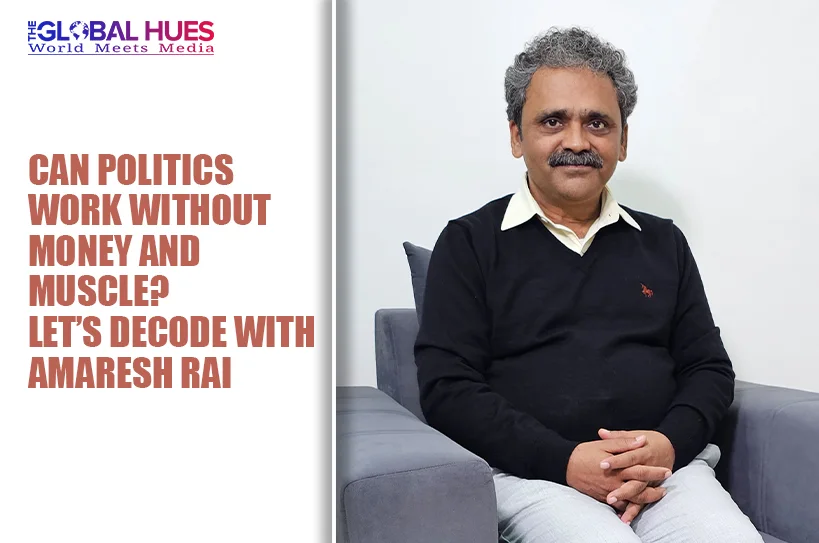
For decades, Indian politics has been viewed as a field reserved for those with deep pockets, powerful connections, or established political families. In many districts across the country, the same surnames continue to dominate elections, but Amaresh Rai wanted to challenge that perception. His mission is not simply to help people contest elections but to create a pathway for individuals from non-political backgrounds to enter public life and contribute meaningfully to society.
“People often think money wins elections,” he says. “But ultimately, elections are won by voters. The real question is how to earn people’s trust without depending entirely on money.”
From vote buying to value creation
Amaresh believes that modern politics has become heavily dependent on short-term incentives and vote-buying practices. While cash handouts and freebies may provide temporary benefits, they do little to address long-term challenges faced by citizens. Instead, he reiterates that the focus of leaders should be on how to create genuine value.
Amaresh also believes that meaningful change cannot be delivered by a single politician. “A single MLA cannot transform a system,” he explains. “Real change happens when an entire government works toward the same objective.”
The value of ethical politics
Ethics in politics is often discussed but rarely defined clearly. Amaresh explains that ethical politics does not mean avoiding difficult decisions. Rather, it means making decisions that ultimately reduce harm and create greater public good.
“Evil cannot be eliminated completely,” he says. “But it can be reduced. Politics should be about bringing more good into the system.”
Politics as a profession of service
One of the more unconventional ideas Amaresh promotes is treating politics as a professional career rather than a personal sacrifice. In India, politicians are expected to remain visible in public life, attend social gatherings, and maintain large entourages. This culture, Amaresh believes, puts unnecessary pressure on public representatives and increases the costs associated with politics.
According to him, politics should function like any other profession. Leaders should focus on how to deliver the best results rather than think about maintaining appearances. By reducing unnecessary expenses and expectations, he argues that politics can become more accessible to talented individuals who may not possess significant financial resources.
Duty before rights
Amaresh believes that modern public discourse places excessive attention on rights. According to him, social progress becomes possible when citizens, leaders, and institutions all focus on fulfilling their duties. Whether it is about improving education, maintaining cleanliness, or strengthening public services, the change begins when people start understanding their responsibilities.
“If everyone focuses on duty,” he says, “many rights will automatically be fulfilled.”
This principle also guides his own work. He describes his efforts to improve political culture as a personal responsibility rather than a profession driven solely by ambition.
Encouraging professionals to enter politics
Amaresh sees enormous potential in encouraging professionals to participate in public life. Doctors, business leaders, administrators, and subject-matter experts frequently approach him to seek guidance on how to enter politics. What he finds interesting is that many of them know they want to serve but struggle to define their purpose.
Thus, he steps in to help them identify why they want to enter politics in the first place. A doctor, for example, may aspire to improve healthcare systems because of personal experiences and professional expertise. A business leader may wish to create policies that encourage entrepreneurship and employment. He believes that when leaders connect their professional knowledge with a larger public mission, they become more purposeful politicians and serve society in a better way.
He believes governance suffers when decisions are made by those with little understanding of the sectors they oversee. He explains, “If you look at many ministers in our country, they have nothing to do with that field, and they are making decisions on it. In the end, those decisions are often wrong. But if a doctor who is already in that field makes decisions related to that field, he has knowledge about it. And specifically, a person coming from the grassroots level has to solve the problem at the root. If those problems are solved at the root, it automatically creates an impact.”
Looking toward the future
We see India evolving through economic growth, digitalisation and changing social expectations. With all these changes, Amaresh believes politics will undergo quite a lot of changes as well. He expects greater transparency in the system, increased citizen awareness and a gradual decline in traditional forms of political corruption.
At the same time, he sees growing opportunities for educated professionals and first-generation leaders to enter politics. For him, the future of politics lies not in dynasties or financial power, but in purpose-driven leadership.
His message: Meaningful political change begins when ordinary citizens believe they have a role to play in creating it. And in a democracy as large and diverse as India, that belief may be one of the most powerful forces of all.
Must Read:
- Car Service LAX to Pasadena for Night Arrivals or Red-Eye Flights
- From Inspection to Insurance: Your 30-Day Timeline After Buying a Used Car
- Top 10 E-Readers: Make Your Reading Sessions Enjoyable