
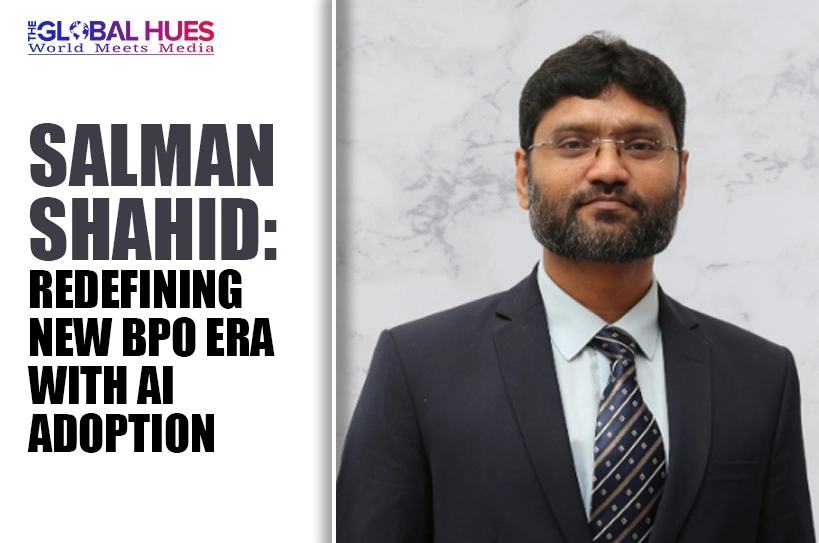
A Pakistani technology entrepreneur, educator, and AI architect, Salman Shahid, became CEO of Noah Technologies in 2017, a time when the BPO industry faced severe disruption. In times when BPO providers started feeling a rising threat from early automation and AI, he showed a solid commitment to transforming lives with a digital growth mindset.
Through his nine-year journey at Noah Technologies, Salman has gained expertise in combining business strategy with digital analytics. He has proved that most successful BPO models don’t use AI to replace humans. Instead, they build a hybrid ecosystem where AI handles scale and repartition, allowing humans to manage complex relationship building, strategy, and system oversight.
By looking at Salman’s insights into workflows, BPO providers, business leaders, and executives can transform business challenges into opportunities for growth and innovation.
Empower BPO Providers Rather Than Replacing Them
Dating back to 2017, young, millennial workforces viewed BPO roles as short-term, temporary gigs rather than career paths. At that time, Salman influenced them to adapt their business models from simple, cost-arbitrage execution to high-value, tech-enabled analytics.
And even still, he follows the same approach, allowing outsourcing firms to reduce operational costs, boost scalability, and improve customer satisfaction. Unlike several thought-leaders, Salman went ahead with a contrarian approach, where he emphasized the Human-AI Synergy concept rather than Human-AI Antagonism.
That’s the concept exactly where the heart of future BPO lies. By enlightening BPOs with the Human-AI Synergy concept, he addresses BPOs how AI adoptions amplify their efforts instead of replacing them.
Salman explains AI integration into BPO like a “symbiotic relationship.” He elaborates that AI does all the heavy lifting required in business operations while humans focus on providing creativity, empathy, and strategic oversight that automation can’t replicate.
According to Salman, AI excels at high-volume, repetitive, and predictable tasks such as standard data entry, document classification, and basic extraction. However, humans’ role comes in judgment calls, strategic oversight, and resolving anomalies such as unrecognised vendors, corrupted files, or regulatory compliance checks.
Help Business Leaders Make Better Decision-Making
Pursuing his passion, Salman resolves the pain of business leaders who spend a hefty amount of time collecting and analyzing information before making decisions. He directs them towards real-time intelligence that gives up-to-the-minute insights by continuously monitoring market conditions, competitor movements, and internal metrics.
Following this, Salman suggests business leaders take proactive decisions rather than reactive ones (relying on outdated BPO models). He persuades stakeholders, executives, and directors to simulate multiple scenarios using AI. As a result, they can anticipate outcomes and choose paths with the highest probability of success, especially during economic downturns or supply chain disruptions.
Salman brings leaders’ attention to the “rapid data synthesis” of artificial intelligence algorithms. He calls them a game-changer for high-stress scenarios, allowing business leaders to shift from reactive management to proactive crisis resolution.
Since AI sifts through terabytes of data across multiple channels in real-time, Salman guides leaders to run AI algorithms for instant pattern recognition. Doing so will help them spot hidden correlations and anomalies that human teams might miss.
Referring to human bias, Salman gives AI a competitive advantage in decision-making. According to him, human decisions in high-stakes environments can fall victim to cognitive biases like overconfidence. That’s why he recommends business leaders to rely on AI-tandem for leveraging objective, data-backed recommendations to balance emotional instincts with empirical evidence.
Provide More Accurate Revenue Predictions and Budget Planning
Salman pinpoints the drawbacks of relying on traditional BPO methods when it comes to financial modeling. Because of reliance on historical averages and static assumptions, he recognizes non-linear correlations that lack the capacity to process millions of variables in real-time. Also, they are highly prone to human error and lagging data.
That’s where Salman underlines machine learning that digests both internal data and external data to detect complex, non-linear relationships that humans often miss. He categorizes sales pipelines, historical invoices are part of internal data, while economic indicators, seasonal trends, and competitor pricing are part of external and unstructured data.
He urges the replacement of annual and time-consuming budget planning exercises with continuously updated AI models. In his viewpoint, AI instantly generates multiple “what-if” scenarios and rolling forecasts, allowing businesses to stress-test their strategies and pivot budgets before gaps arise.
However, the traditional budget planning becomes a static, rigid reference point that is difficult to adjust when market conditions shift. Also, analysts and outsourced teams follow pre-defined frameworks and historical rules; they cannot quickly “learn” from forecasting errors without manual recalibration.
Here, Salman signifies AI algorithms that automatically learn from their own predictions. The continuous machine learning loop means forecasts get progressively more precise and tailored to market behaviors over time.
Despite these AI advantages, Salman urges that fully autonomous finance remains a stretch. So he suggests leveraging AI for the heavy lifting of data analysis and forecasting, while keeping human analysts in the loop to provide strategic judgment and context.
In his book “Your Market is Ripe to Disrupt”, he advocates for a legacy of ethical technology use, advising leaders on how to scale while maintaining business integrity. It teaches marketers how to smoothly navigate the AI revolution while keeping a competitive edge.
Make Informed Decisions About Customer Acquisition Strategies
Salman’s mantra is that market conditions and consumer behaviors evolve, so should your strategies. Following this, he strongly believes BPO leaders move away from guesswork toward data-backed guidance, allowing them to pivot their acquisition strategies instantly as the market dynamics change.
Since AI models analyze historical buyer data, purchasing patterns, and demographics, he asks to leverage them to score leads based on their likelihood to convert. This ensures outbound agents and marketing spend focus only on prospects with the highest return on investment.
Instead of manual demographic grouping, he advises BPOs to cluster audiences into highly specific, actionable segments. Doing so allows businesses to test multiple variations of an acquisition pitch simultaneously to see which one performs best in real time.
Amplify Your BPO Operations with Salman’s Insights
For BPO leaders overwhelmed by AI and machine learning algorithms, lean into Salman Shahid’s digital footprint. It helps you optimize your workflows using AI so that you and other company employees focus on visionary judgment.
(DISCLAIMER: The information in this article does not necessarily reflect the views of The Global Hues. We make no representation or warranty of any kind, express or implied, regarding the accuracy, adequacy, validity, reliability, availability or completeness of any information in this article.)
Must Read:
- Your Custom Home – Careful Considerations
- Innovative Interior Design Trends To Refresh Your Home
- How to Choose Living Room Furniture That Stands Up to Active Lifestyles