
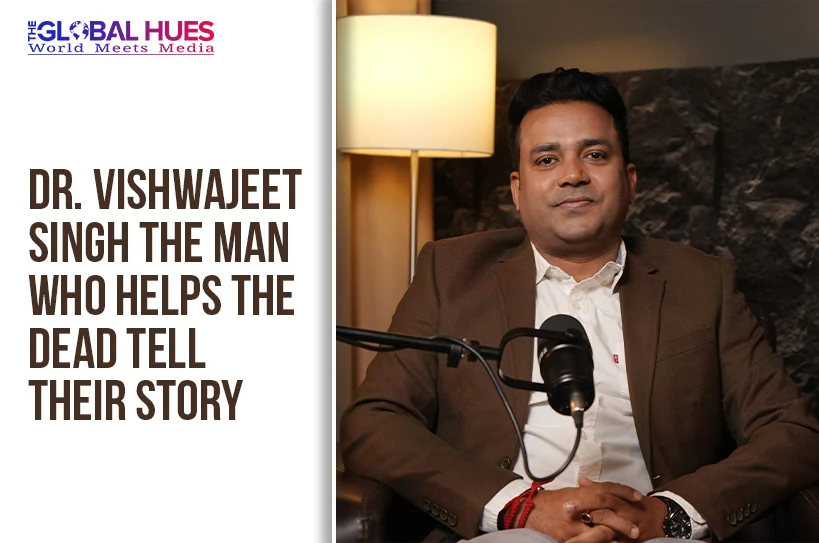
Most of us have watched crime shows where a forensic expert walks into a room and solves a mystery in minutes. But here’s the ice breaker – Real forensic work is far less dramatic than it is shown in TV shows. According to forensic medicine specialist Dr. Vishwajeet Singh, reality is far more complex and far more meaningful.
“TV shows add drama because they have to entertain people,” says Dr. Vishwajeet. “Real life is much more complicated.”
Behind every case file is a story, a family looking for answers, and a truth waiting to be discovered.
Finding answers when no one can speak
Most doctors rely on what their patients tell them. For a forensic doctor, it’s totally different. “The biggest challenge is that a dead body cannot tell you what happened,” Dr. Vishwajeet explains. “You have to find every clue yourself.” That means examining injuries, studying internal organs, collecting samples, and connecting findings with the circumstances of the case.
A fall from a building, for example, may look straightforward at first. But was it an accident, suicide, or murder? We find answers in small details. Fractures, injury patterns, signs of struggle and defence wounds help forensic experts understand what took place before death.
Their findings become an important piece of the larger investigation carried out by the police.
It’s more about justice
For Dr. Vishwajeet, forensic medicine is a responsibility. “Someone has to give justice to a person who can no longer speak,” he says. “That is one of the reasons I chose this field.”
His work not only helps solve crimes. It also supports victims of sexual assault and other medico-legal cases where medical evidence plays a crucial role. Every report, every observation, and every opinion can have an impact inside a courtroom. And that is something he takes seriously.
The high-profile cases
Over the years, several cases have caught the nation’s attention, including those of Arushi Talwar and actor Sushant Singh Rajput. While millions discuss such cases online and in the media, Dr. Vishwajeet believes the real answers always lie in the evidence.
“Autopsy findings are extremely important,” he says. “There are clear differences between hanging and strangulation. The findings can help us understand the direction of a case.”
At the same time, he points out that much of the information available to the public is incomplete. “The actual reports and court documents are confidential. What people see outside is often only a small part of the full picture.”
The case he will never forget
Despite handling thousands of cases, some stay with him forever. One such case involved a woman and her three young children who were found dead in Delhi. When the bodies arrived for examination, the injuries initially suggested homicide. But as the autopsy progressed, the findings became even more disturbing.
“There were two male kids and one female kid. Small kids, less than 10 years old,” he recalls.
The examination revealed evidence of brutal sexual assault along with murder. “The moment I saw those findings, I couldn’t forget them throughout my life.” Dr. Singh conducted a meticulous autopsy, ensuring that no evidence was missed. The investigation later led to the arrest of those responsible. Even today, the case remains one of the most disturbing experiences of his career.
Can there ever be a perfect crime?
Can someone commit the perfect murder? Dr. Vishwajeet doesn’t think so. He explains that crime consists of two elements – criminal intent and criminal action. “There should be a perfect criminal mind, and there should be a perfect criminal act.” Then he pauses before giving his conclusion.
“Since both these things cannot be perfect, therefore being perfect is very, very negligible, impossible”, he says. For him, every crime leaves something behind. A mistake, a clue, an inconsistency, or a piece of evidence that eventually helps investigators reach the truth.
Lessons From a Life Spent Investigating Death
For someone who spends much of his professional life examining death, Dr. Singh speaks surprisingly often about life. Throughout the conversation, one thought comes up repeatedly.
“Life is beautiful. It has been given once. Life should be lived with a smile.” He believes everyone faces difficulties, but those challenges should never define a person.
“Everyone faces problems in life. We have to face these problems as good human beings.” Perhaps that is what makes forensic medicine unique.
Must Read:
- Car Service LAX to Pasadena for Night Arrivals or Red-Eye Flights
- From Inspection to Insurance: Your 30-Day Timeline After Buying a Used Car
- Top 10 E-Readers: Make Your Reading Sessions Enjoyable