
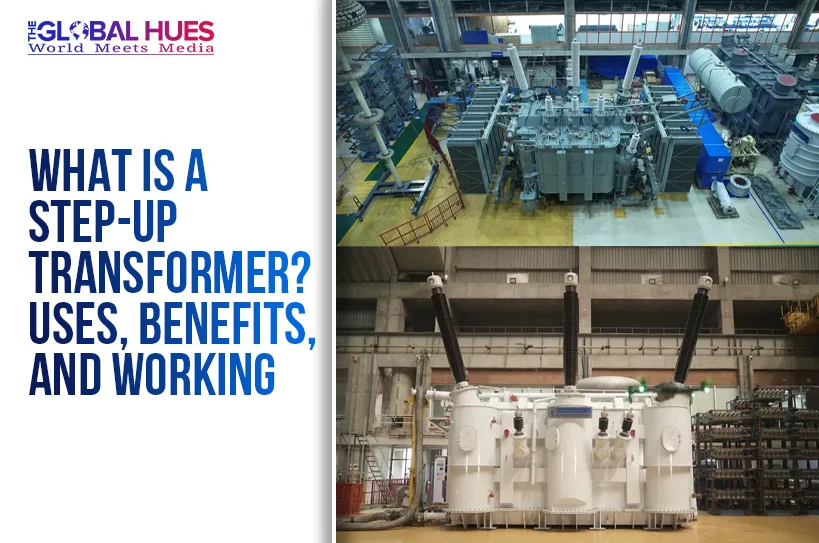
Electricity generated at a power plant is not distributed at the voltage level at which it is produced. Prior to being fed into the grid, the voltage is increased to a higher level to minimize losses on the transmission line.
A step-up transformer is a power transformer, the main function of which is to raise the voltage level from the primary to the secondary winding. It is a step-up transformer that is used in the power industry, the electric power generation industry, renewable energy, substation complexes, and industrial enterprises. It is one of the essential elements in the modern energy system, allowing the transmission of electrical energy at a voltage level sufficient for its long-distance and efficient transfer.
What Is a Step-Up Transformer?
A step-up transformer is an electrical device which allows to raise alternating current (AC) voltage at the same frequency. It is constructed in such a way that the number of turns of wire in the secondary coil is higher than that in the primary coil. The alternating current flowing through the primary coil creates an alternating magnetic field in the core of a transformer. This magnetic field then induces an electromotive force (EMF) in the secondary coil.
Due to the higher number of turns, the induced EMF is larger than the source EMF. While the voltage increases, the current decreases, since power (approximately equal to the product of current and voltage) should be the same (with some losses due to inefficiency). Such a transformer is useful for power transmission because high voltage and low current are associated with lower energy losses.
Large utility-grade step-up transformers are commonly designed as Oil-filled transformers, where insulating oil provides both electrical insulation and effective cooling. Oil-filled designs are widely preferred for high-capacity installations because they efficiently dissipate heat generated during continuous operation.
How Does a Step-Up Transformer Work?
Faraday’s law of electromagnetic induction can explain the working principle of a step-up transformer. The alternating current passed through the primary coil creates a constantly changing magnetic field that induces a voltage across the secondary coil.
The voltage ratio is determined by the ratio of turns in the primary and secondary coils: if the secondary coil has twice as many turns as the primary, the secondary voltage will be twice the primary voltage.
Transformers are designed to work only with alternating current. This design makes it impossible to apply direct current to a transformer. The efficiency of a transformer is usually very high, making it one of the most efficient electrical devices.
Where Are Step-Up Transformers Used?
The step-up transformers can be found in all places where the electricity has to be transformed into a higher voltage for its effective transportation or use.
Power generating stations utilize the generator step-up transformers to increase the voltage to a level that allows the electricity to be transported over long distances with little loss. This electricity generated in the power stations is mainly distributed to the end users, hence necessitating the need to step up the voltage.
The step-up transformers play a vital role in renewable energy systems such as solar and wind power systems. The electricity generated from these sources is transformed into a higher voltage suitable for the transmission lines.
Large-scale industries such as mining, manufacturing, steel works, and heavy industries have extremely high voltage requirements. The step-up transformers serve to provide the required electricity voltage for these industries.
Testing laboratories, research, railways, and infrastructure also utilize the step-up transformers to step up voltage when required.
What Are the Benefits of a Step-Up Transformer?
The main advantage of a step-up transformer is increased transmission efficiency of electrical energy due to the increased voltage and reduced current in the circuit, which reduces the amount of energy loss due to the resistance of the wires. This helps to maximize the potential for the utility companies to transmit electricity at a lower cost over long transmission lines.
The other advantage is that it helps to improve the reliability of the grid. It provides better voltage regulation that minimizes the voltage drop on the transmission line.
Transformers that are well maintained have a very long lifespan and can therefore offer reliable power for many years with minimal losses.
The majority of large-scale transformers are typically oil filled. The main reason is that oil performs two functions in a transformer: it insulates the components from current flow and transfers heat away from the windings and the core thus enabling the power transformer to operate at maximum efficiency.
The step-up transformers can help to achieve smarter grids that incorporate more renewable energy such as solar, wind, and hydro power. The use of these transformers enables the connection of renewable sources to the grid in a seamless manner.
Step-Up Transformer vs Step-Down Transformer
Although the two transformers are similar in terms of the principle of electromagnetic induction, they serve different purposes.
The step-up transformer is used to raise the voltage, while the step-down one is designed to lower it. The first type is usually located at the power station, while the second one is placed near end-users. In other words, step-up transformers are generally mounted near generating stations or power plants (to increase the voltage on high-voltage lines).
Whereas step-down transformers are typically mounted near industrial or domestic end-users (to decrease the voltage from high-voltage lines). These two types of electrical transformers comprise the majority of all transformers that are used in the modern world.
Why Oil-Filled Transformers Are Common for High-Voltage Applications
Most of the large power and industrial step-up transformers are designed as Oil-filled transformers as they provide the best insulation and cooling properties. The oil is used either for natural circulation or forced circulation from the transformer.
The oil provides electrical insulation between the windings and protects the transformer’s parts from dielectric breakdown. It also cools the transformer by dissipating heat away from it. Apart from that, it isolates and protects other components from moisture. Therefore, it is vital to test and maintain the insulating oil periodically for stable and safe operation of the transformer.
Choosing the Right Step-Up Transformer
The choice of a transformer depends not only on the required transformation ratio but also on the supply voltage, its power rating, cooling method, place of installation, efficiency, mode of operation, and standard.
In addition, manufacturers offer to organize the production of individual technical solutions for utilities, solar power plants, industries, and infrastructure objects. High-quality transformers are produced using cutting-edge technologies and undergo all stages of testing and quality control to ensure the high performance of the equipment. Companies like Transformers & Rectifiers (India) Ltd. (TARIL) can produce high-voltage transformers for local and foreign infrastructure projects. For example, power transformers are produced with a voltage of 1200 kV and a power of 1000 MVA.
Conclusion
The Step-up transformer has become an essential element of any efficient electrical power transmission. By increasing voltage, the transformer allows transmission with reduced losses and, thus, ensures the overall efficiency of the system. The step up transformers are used in conventional power plants, renewable energy sources, or large-scale industrial facilities. Together with Oil-filled transformers technology, power transformer engineering, and other innovations, step-up transformers enable unprecedented levels of electrical transmission performance and reliability.
Frequently Asked Questions
What is the main purpose of a step-up transformer?
A step-up transformer allows for increasing the voltage of an alternating current and, consequently, reducing the current. This helps in decreasing the energy loss during electricity transmission.
Why are oil-filled transformers commonly used for step-up applications?
The oil-filled transformers offer the best electrical insulation and cooling capacity, which makes them highly effective for high-power and high-voltage applications. The oil is used to improve the efficiency of such transformers as it provides the best electrical insulation and cooling.
Where are step-up transformers commonly installed?
Such transformers are installed at power plants, solar farms, industrial facilities, substations, and other infrastructure sites to allow stepping up the voltage to increase the voltage during power transmission.
Does a step-up transformer increase electrical power?
No. A step-up transformer is used to increase voltage and reduce the current, and the power loss during the transformation is minimal. Therefore, while the voltage may increase, the total power will remain the same (almost the same due to some losses during the transformation).
Is a step-up transformer a type of power transformer?
Yes. The biggest step-up transformers used at the power plants to transform voltage for the distribution network are considered to be power transformers. The term refers to any of the transformers that are designed for high-power electricity transmission.
(DISCLAIMER: The information in this article does not necessarily reflect the views of The Global Hues. We make no representation or warranty of any kind, express or implied, regarding the accuracy, adequacy, validity, reliability, availability or completeness of any information in this article.)
Must Read:
- Your Custom Home – Careful Considerations
- Innovative Interior Design Trends To Refresh Your Home
- How to Choose Living Room Furniture That Stands Up to Active Lifestyles