
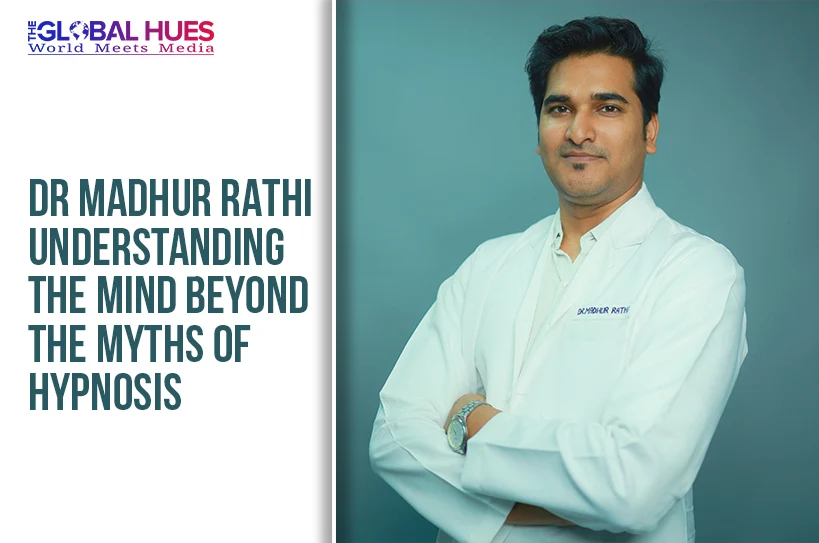
Most people associate hypnosis with swinging pendulums, stage performances, or scenes straight out of Hollywood films. The idea that someone can take control of another person’s mind has always seemed interesting to people. But according to psychiatrist and clinical hypnotherapy expert Dr. Madhur Rathi, there are many things that need to be informed and learnt.
“People have seen hypnosis in movies and stage shows, so they are often afraid of it,” he says. “But clinical hypnosis is entirely different because it happens with permission, with consent, and for a purpose.”
For Dr. Madhur, hypnotherapy is not about controlling minds. It is about understanding them. As a consultant psychiatrist and psychotherapist, he has spent years helping people deal with anxiety, trauma, relationship issues, addictions, and emotional struggles. Along the way, he has also worked to break some of the biggest myths surrounding the subconscious mind.
A curiosity in childhood
Dr. Madhur’s journey into psychiatry began much earlier than most people would expect. He was only five years old when his father took him to a small town in Maharashtra during a festival. There, he watched a psychiatrist perform a stage hypnosis demonstration.
“He hypnotised a guy and made him eat 12 bananas,” Dr. Madhur recalls with a smile. “That five-year-old boy was very intrigued. I kept wondering how this was possible.”
What started as a curiosity eventually became his career. After completing his MBBS and later an MD in Psychiatry, he continued exploring different forms of psychotherapy before pursuing a postgraduate diploma in clinical hypnosis.
The myth about the subconscious mind
One of the most common claims people hear is that the subconscious mind controls most of their lives. “Some people feel that the subconscious mind is driving life. It doesn’t happen like that. It is conscious and subconscious working together,” he explains. “If you see a cycle, there are two wheels. Can you say the rear wheel is more important or the front wheel is more important? Both are important.”
According to him, problems often arise when the conscious and subconscious parts of the mind are pulling in different directions. “If one wheel is rotating back and one is rotating forward, then the cycle is standing there.”
That conflict can show up in many ways – wanting to move on from a relationship but being emotionally stuck, wanting to overcome fear but feeling trapped by past experiences, or wanting success while battling self-doubt.
Understanding the mind through Science
Dr. Madhur is quick to point out that the subconscious mind is not a physical structure inside the brain. Instead, it is a way of understanding how different parts of the brain work together.
“The easiest example I can give is that there is a projector. The image coming out of the projector is not the projector itself.” He continues, “Brain is the projector and the image that comes out is the mind.”
Just as a distorted image is corrected by adjusting the projector rather than the screen, mental health challenges often require working with the brain’s patterns, emotions, and beliefs rather than focusing only on visible behaviour. “If there is something wrong in the functioning of the mind, then we have to work on the brain.”
Success, failure and the stories we tell ourselves
Through his work, Dr. Madhur has observed certain common traits among successful people. “What I have seen in successful people’s minds is that they tolerate failure.” Rather than seeing failure as a personal weakness, they view it as part of the process.
“They don’t make it about themselves. They make it about the process.” He believes one of the most damaging beliefs people can develop is identifying themselves as failures.
“There is a difference between saying ‘I am a failure’ and ‘I failed.” That distinction changes everything. “If I failed once, I can also succeed.”
According to him, resilience grows when people learn to separate their identity from temporary setbacks.
Looking beyond fear
Throughout the conversation, one theme keeps returning: fear is not always the enemy. Sometimes it serves as a guide. Highlighting difficult emotions, Dr. Madhur shares a line from a poem he once wrote: “Every bad thing has made me better. Even if the road is broken, it reaches the destination.”
He believes emotional pain often carries valuable lessons. Quoting Javed Akhtar, he adds, “It is not right to erase all the pain. Some pain is to be embraced.”
Perhaps that is what makes Dr. Madhur Rathi’s approach different. Rather than promising quick fixes or magical transformations, he encourages people to understand themselves more deeply. Because in the end, healing is not about becoming someone else. It is about understanding who you already are, letting go of what no longer serves you, and moving forward with greater awareness.
Must Read:
- Car Service LAX to Pasadena for Night Arrivals or Red-Eye Flights
- From Inspection to Insurance: Your 30-Day Timeline After Buying a Used Car
- Top 10 E-Readers: Make Your Reading Sessions Enjoyable